

Here at Ling, we’re experts when it comes to language learning. And we’re not about to keep all that knowledge to ourselves. That’s why today we’re covering the best practices for learning a language.
Because let’s be real, learning a language is not the easiest task. Occasionally, getting the pronunciation right can be a struggle; other times, you practice and practice and see no progress. And it can also happen that you want to learn, but you just don’t know where to start!
So, with this in mind, let’s take a look at some of the best things you can do when learning a new language.
I want to learn even more languages with Ling!
Download now!
What Are The Best Practices For Learning A New Language?
So, you want to learn a new language and don’t know where to start. Or perhaps you’re already halfway there but want some language learning strategies to speed up your progress. Either way, you’ll surely find something useful on this list.
Let’s see what the best practices for learning a language are:
1. Starting With The Basics
This might be obvious, but it’s really important. You have to start simple.
When we start learning a new language, we’re usually really motivated at the beginning, but it can be hard to keep that motivation going throughout the entire process.
By starting with simple things you can easily remember, you’ll see progress right from the start. But if you start trying to understand complex concepts too early, there’s a high chance you’ll feel like it’s too much and feel tempted to give up.
So, whether it’s some basic Tamil phrases or essential Lithuanian words, make sure to start with something that isn’t much of a struggle.
You’ll have plenty of time for grammar practice and hard-to-pronounce words later!
2. Setting Realistic Goals
This has a lot to do with what we just mentioned. To keep that motivation going, you need to set realistic expectations.
A good way to do this is to sit down and make a plan of how much you want to learn every week, or even every month. But make sure to keep your expectations realistic. If you don’t have much time to study, you can try to learn 10 new words daily; if you’ll be sitting down to study for an hour every day, aim higher.
The trick is to consider what you can actually achieve with the time and resources you have before putting those goals on paper.
3. Being Consistent And Practicing Regularly
Personally, I think this is the most important thing when it comes to the best practices for learning a language.
After all, you won’t learn much if you don’t stick with it!
You have to practice constantly and consistently, because it’s very easy to give up halfway and forget everything you’ve learned.
And that’s where habit-building comes in. If you make it a habit to use your language-learning app for just 10 minutes daily, and keep it, you’ll start seeing progress very soon.
That’s why these apps have streaks, reminders, and other gamified elements. It’s to make sure you practice daily and remain consistent!
4. Building Vocabulary In Context
It’s one thing to manage to learn 500 words in Korean, but it’s quite another to really understand how they work and how to use them in your conversations.
The issue is that several learning methods and apps focus heavily on memorizing vocabulary lists, but they don’t teach you how to use them in context. And this can have an impact on your fluency.
That’s why it’s essential to also learn vocabulary through storytelling, role-playing, or multimedia. The Ling app, for example, ends all lessons with a short real-life conversation. That way, you can see how the words you’ve learned are actually used by native speakers.
5. Having Fun!
I’m not sure the importance of having fun while learning a foreign language is stressed enough. However, the rise of gamified language-learning apps like Ling has certainly helped.
Spending time studying is essential for learning a language, but having fun with the new language every now and then can give you a great boost when it comes to motivation.
A great way to do this is to make new friends who speak your target language and hang out with them every now and then. But if you’re a bit shy or don’t feel confident in your language skills yet, watching movies and series can also help!
The important thing is to find activities that take the pressure off learning but still let you interact with your target language.

6. Speaking The Language As Much As You Can
As I mentioned earlier, getting your pronunciation right can be a struggle sometimes. This is especially true if your target language is very distant from your native language. For instance, learning a tonal language like Thai can be a bit of a struggle for English speakers.
That’s why speaking practice is essential.
However, it can be hard sometimes to apply your new knowledge in real-life scenarios, especially if you don’t have someone to practice with and can’t find practical exercises.
And that’s where the Ling app can also help. It’s voice recognition software and speaking practice lessons can really help you out when it comes to pronunciation. Plus, all audio is spoken by native speakers, so you can hear the words as they’re actually said.
Another great way to get some spoken language practice is to get a language exchange partner. With this system, you find someone who’s learning the language you speak, and speaks the language you learn, and you meet up in person or online to have a chat.
By interacting with a native speaker, you can develop a more natural pronunciation, rhythm, and get some cultural nuances you wouldn’t be able to learn anywhere else.
It’s a great way to learn and make new friends, but be sure to use a safe app or program and put your safety first!
7. Learning By Immersion
There’s a lot of talk about “immersive learning,” but what does it actually mean?
Immersive learning, in this context, is when you surround yourself with the language you’re learning. The idea is that having constant exposure can help you learn faster by forcing you to use the language in more realistic situations.
It’s reasonable to think that you’ll learn Vietnamese faster if you become a digital nomad and move to Vietnam, but not everyone has that opportunity.
Luckily, immersion doesn’t have to be complete. There are many ways in which you can have an immersive experience. Tools like virtual reality and AI can help, or taking a short trip if you have the means, especially if you don’t live far. You can also look up communities that speak the language you want to learn and find ways to interact with them.
On the other hand, a great way to immerse yourself in a language can be through media. Movies, TV shows, music, books, and podcasts can give you a huge level of exposure to a language without having to leave your home.
Learning Korean? Watch K-dramas. Learning Punjabi? Watch some Punjabi movies on Netflix. Learning Albanian? Listen to Albanian music on your way home from work.
By surrounding yourself with your target language this way, you’ll become much more familiar with the way it sounds and find it easier to pronounce new words. Plus, you’ll get the chance to hear it and read it in context, being used by native speakers in their day-to-day lives.
8. Trying Out Memory Tricks
As much as we’d like to avoid it, language learning requires a lot of memorization. It’s not easy to learn thousands of Chinese characters, is it? (But it’s OK, you don’t actually need to learn all of them!)
That’s why trying several memory tricks and finding which ones work for you can be a game-changer. You can try things like word association, acronyms, visualization techniques, memory palaces, and even singing!
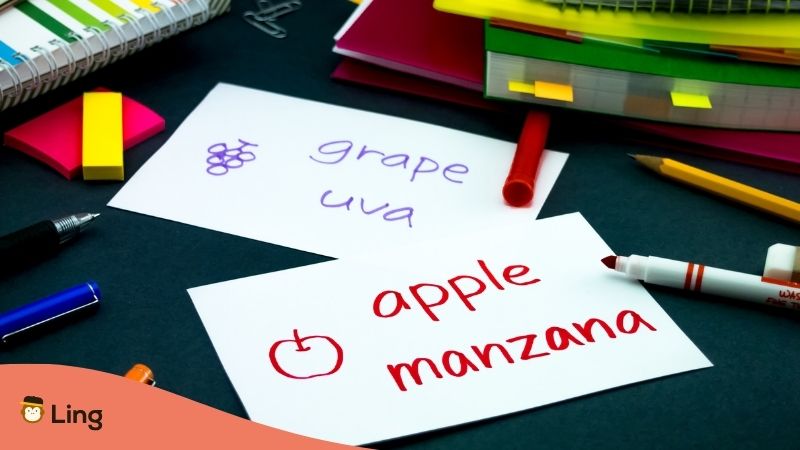
You can also use more traditional memory aids such as flashcards. And they’re actually not that traditional anymore because several language-learning apps now use virtual flashcards to help you learn new words or reinforce what you’ve learned.
9. Seeking Feedback
This is something particularly important for second language acquisition, especially if you’re learning on your own.
Making mistakes is inevitable, and you shouldn’t feel bad because of it. But having someone to correct your mistakes, or any other way of knowing if you’re learning things the right way, is essential.
After all, what’s the use of repeating Mongolian words over and over again if you’re not sure that you’re pronouncing them right? Or practicing German sentences in your notebook every day when you’re not sure you understand German sentence structure correctly?
So, find a way to get feedback. A simple yet costly way to do this is by getting a tutor or signing up for language classes. You can also get a language partner, as I mentioned above.
But another great way to get feedback is to get a language-learning app that has voice recognition.
The Ling app, for example, has speaking lessons in which you repeat words and sentences using your microphone, and after a couple of seconds, the app tells you if you got it right. It can be a great way to improve your pronunciation skills!

10. Finding The Language Style That Fits You Best
This is definitely overlooked when it comes to language learning, but it’s crucial. Knowing what your learning style is can either advance or stop your progress. For example, if you’re a visual learner, then you should use flashcards or play matching games rather than fill-in-the-blank activities.
By learning according to your particular style, you’ll be able to learn faster and better. After all, aren’t you more likely to remember something if you’re actually having fun while learning it?
11. Relying On Good Resources
Last but most certainly not least, one of the best practices for learning a language is using good resources.
There are so many ways to learn a language nowadays, especially online, that it can be hard to know which ones are good. Some apps and courses will give you superficial explanations and very basic content, while others can even have incorrect information.
So you have to make sure you’re learning from a reliable and trustworthy source. This can be a professional teacher, a genuinely good YouTube channel, or a trustworthy app with excellent reviews like Ling.
Want To Increase Your Knowledge Even More? Use Language Learning Applications!
One of the best ways to have a successful language-learning journey is to use language-learning applications. That’s right, with all the technology nowadays, learning a new language doesn’t have to be hard.
You no longer have to attend in-person classes or buy expensive textbooks every time you complete a level; all you have to do is swipe to the next screen!
Of course, not all language-learning apps are created equal, which is why we want to share the best one out there for all language learners.
Why The Ling App Is Built for Serious Learners
The Ling app is much more than just a tool or resource, it’s a language course designed to make learning fun. And it does so while covering the four linguistic skills: speaking, listening, reading, and writing.
It also divides its lessons by topics, making studying more manageable and focusing on real-life situations.
The main features of the Ling app include:
- Gamified lessons that make learning fun.
- Points and leaderboards that make sure you don’t lose motivation.
- Flashcards and short quizzes to review what you’ve learned.
- Native speaker audio to ensure perfect pronunciation.
- Voice recognition for instant feedback.
- A chatbot to practice conversations with.
- And much more.
What Users Are Saying About The Ling App
As I said before, one of the best practices for learning a language is relying on good and trusted resources, and I think the Ling app qualifies as one. For starters, it has 15K reviews and 4.8 stars on Google Play, and almost 8K ratings and 4.6 stars on the App Store.
So let’s see what language learners have to say:
“Really nice app to learn Thai!!! While many apps usually only focus on vocabulary but this also focuses on our speaking and pronunciation… Overall, very nice app!“
★★★★★
Kavya Parab on Google Play
“I’ve tried a lot of language apps, Duolingo, drops, jump speak, and more. Tagalog options are limited in most apps on the market. This is the first app that I’ve found with Tagalog that gives real applicable conversational inputs. I love the real life examples of sentences and conversations. I just tried the conversation simulator and am stoked!”
★★★★★
Patrick Hageman CPT on Google Play
So, if you were looking for a reliable resource to start learning your target language, why not give the Ling app a try? It even has a 7-day free trial so you can see how you like it first!
Frequently Asked Questions When Learning A Language
1. What Are The 5 ‘C’s Of Learning A New Language?
The five ‘C’s of learning a language are: Communication, Cultures, Connections, Comparisons, and Communities.
• “Communication” relates to improving speaking, listening, reading, and writing skills to better communicate in your target language.
• “Cultures” has to do with focusing not only on the language, but on becoming familiar with the traditions and customs of the people who use it daily.
• “Connections” is all about connecting language learning with other subjects and disciplines, such as history and art, to deepen your understanding.
• “Comparisons” involves analyzing the similarities, differences, and contrasts between your native language and the one you’re learning.
• “Communities” refers to using the language outside the classroom (or app!) and finding ways to interact with native speakers and the real world.
2. What Is The 15/30/15 Method?
The 15/30/15 Method is a learning technique that divides your study time into three segments. The first 15 minutes are for reviewing what you’ve already learned, with flashcards or re-reading notes, for example.
The 30 minutes are for learning new material, which can be new phrases, grammatical rules, etc. The final 15 minutes are for applying what you’ve learned. This can be practicing written language, summarizing, chatting with conversation partners, and more.
3. How Can I Learn A Language Fast?
There are several ways to learn a language faster. For starters, you can focus on the words that are actually used often. You can also immerse yourself in the language, whether that means traveling or watching movies and listening to music.
You can also try speaking your target language right from the start by using the shadowing technique. This is when you repeat aloud what native speakers say (and you can also do it by singing!).
4. What’s The Best App To Learn Languages?
The best app to learn a language comes down to personal preference; that is, the best app is the one you’ll actually use every day!
Considering that, the Ling app can be a great choice. It’s designed to keep you motivated with engaging lessons, points, and leaderboards. It also offers a more complete understanding of the language by improving your writing, listening, reading, and speaking skills.
Start Learning A New Language Today!
If you’re looking for a great app to learn that incorporates several of the best practices for learning a language, you’ve found it.
The Ling app applies many of the methods we discussed for effective language learning. It starts slowly by teaching you basic phrases and vocabulary. It helps you stay motivated and build a regular study schedule with reminders and points. It even teaches you vocabulary in context via dialogues and conversations with the chatbot.
Moreover, Ling helps you get some speaking practice with its voice recognition system, and keeps learning fun with its gamified interface. It even uses memory tricks like spaced repetition to make sure you don’t forget what you’ve learned!
And the best thing is that you don’t have to commit to it right away. You can use the 7-day free trial to see if it really fits your needs first.
So, are you ready to start learning a new language with Ling? Download the app and make sure to apply all the best practices for learning a language you’ve just learned!