

If you’re an English speaker looking to learn an Indian language, Hindi is probably the easiest choice. But with hundreds of languages spoken across India, there’s a lot more to explore than Hindi alone.
This guide explores ten options to help you find the easiest Indian language to learn based on your interests and experience. We’ll look at what makes each language easier or harder for English speakers, including differences in grammar, pronunciation, and writing systems.
Key Takeaways
- Hindi is generally considered the easiest Indian language to learn for English speakers.
- Bengali stands out for its beginner-friendly grammar, including no grammatical gender.
- Knowing one Indo-Aryan language can make related languages easier to pick up.
- Dravidian languages like Telugu and Tamil are more different from English but often follow systematic patterns.
- The easiest language depends on your interests, goals, and previous language-learning experience.
10 Easiest Indian Languages To Learn For English Speakers
Most major Indian languages belong to either the Indo-Aryan or Dravidian language family. That can affect how familiar their vocabulary and grammar feel to an English speaker.
I want to learn even more languages with Ling!
Download now!
With that in mind, here are ten of the easiest Indian languages to learn, based on grammar, pronunciation, and writing systems.
1. Hindi
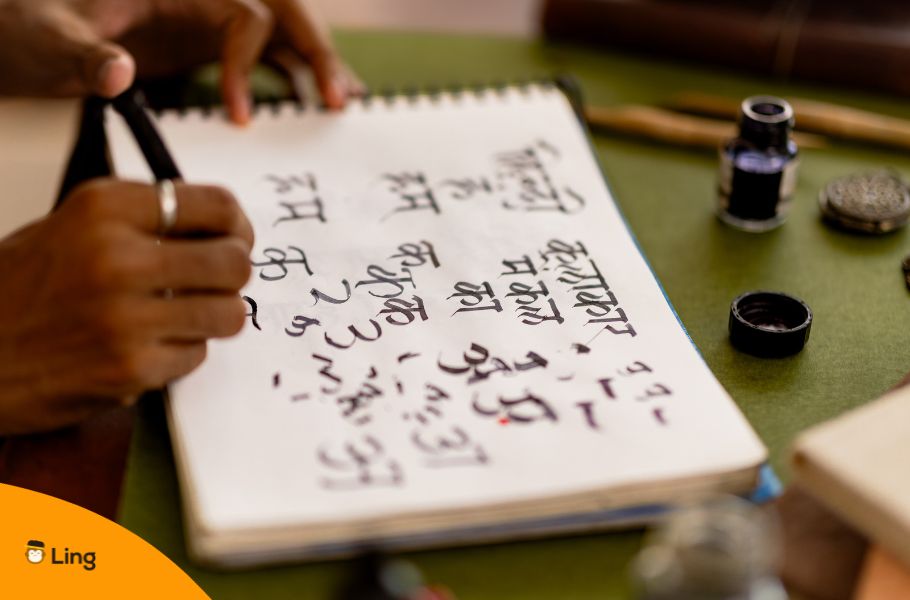
For most English speakers, Hindi is the easiest Indian language to learn. It’s widely spoken in India and around the world, and its pronunciation closely follows its spelling. Modern Hindi also uses many English loanwords in everyday speech.
Hindi verbs follow fairly regular patterns, and the Devanagari script is written from left to right. Hindi and English are also distant relatives within the larger Indo-European language family.
2. Bengali
Bengali can be one of the easier Indian languages to learn because it skips a few complications found in other languages. Unlike Hindi, it has no grammatical gender for inanimate objects, and adjectives don’t change form to agree with nouns.
Bengali also isn’t tonal, so pitch doesn’t change a word’s meaning. The Bengali script is written from left to right and doesn’t distinguish between uppercase and lowercase letters.
3. Punjabi
Punjabi can be easier to learn if you already know some Hindi or Urdu, since they share related vocabulary and grammar. Its Gurmukhi script, used in India, also has a fairly consistent relationship between spelling and pronunciation.
One unusual feature is that Punjabi is tonal, so pitch can change a word’s meaning. You may also encounter the very different Shahmukhi script, which is used to write Punjabi in Pakistan.
4. Gujarati
Learning Gujarati comes with a couple of helpful pronunciation features. It isn’t tonal, so pitch doesn’t change a word’s meaning, and the writing system closely reflects how words are pronounced.
The Gujarati script is also relatively straightforward to write. For example, its letters don’t have the horizontal line you see across the top of Devanagari. Gujarati grammar can take more adjustment, as nouns have three grammatical genders and the language uses postpositions where English typically uses prepositions.
5. Marathi
Marathi spelling generally reflects pronunciation, so once you know the script, it’s easier to work out how unfamiliar words should sound. It also shares many Sanskrit-derived words with other languages in the Indo-Aryan language family.
When learning Marathi, you’ll need to get used to its three grammatical genders: masculine, feminine, and neuter. These categories can influence verbs and adjectives, which adds another layer to forming sentences correctly.
6. Telugu
Telugu, spoken mainly in Andhra Pradesh and Telangana, has a very consistent relationship between spelling and pronunciation, so you can usually tell how a word is pronounced from the way it’s written. It borrows vocabulary from both Sanskrit and English.
Telugu gets a little harder when you move beyond the basics. Everyday spoken Telugu can differ noticeably from more formal or literary varieties, so learning to read the language doesn’t necessarily prepare you for every kind of conversation.
7. Tamil
Learning Tamil can be more challenging for English speakers, but its grammar follows systematic patterns. Sentences generally follow a subject-object-verb structure, with grammatical information added through word endings.
One particular challenge is the difference between spoken and written Tamil. Everyday conversation can differ considerably from the more formal Tamil used in writing, so learners effectively need to become familiar with both forms.
8. Kannada
One helpful feature when learning Kannada is the close relationship between spelling and pronunciation. Once you can read a word, you can generally work out how it should sound.
The bigger challenge is its grammar. Kannada builds grammatical information onto words through a series of endings, so a single word can express what English would need several separate words to say.
9. Malayalam
The Malayalam language can feel more difficult for English speakers because a single word can contain information that English would express with several separate words.
On the easier side, spelling generally gives you a good idea of how a word is pronounced. Reading still takes time to learn, as Malayalam uses a large set of characters and letter combinations.
10. Urdu
Everyday spoken Urdu is highly similar to Hindi, which can make conversation relatively accessible. When learning Urdu, reading is likely to be the bigger adjustment for English speakers.
Urdu is written from right to left in the Nastaliq style of the Perso-Arabic script. Short vowels are often left unwritten, so readers need to understand the context to recognise words rather than simply sounding out every letter.
FAQs: Easiest Indian Language To Learn
What Indian Language Is Most Useful To Learn?
Hindi is generally the most useful Indian language to learn because of its large number of speakers. However, usefulness depends on the region: Tamil, Telugu, Bengali, Kannada, or Malayalam may be more practical if you’re focused on a particular part of India.
Which Indian Language Is Hardest To Learn?
For English speakers, Malayalam can be particularly hard because of its unfamiliar sounds, long words, and differences between spoken and written language. But there’s no single hardest Indian language for everyone, as difficulty depends on your native language and previous experience.
What Is The Easiest Indian Language To Learn For English Speakers?
Hindi is generally the easiest Indian language to learn for English speakers thanks to its consistent spelling and pronunciation, regular verb patterns, and English loanwords. Bengali, Punjabi, and Gujarati are also good options, especially if you know a related language.
Start Learning An Indian Language With Ling!
The easiest Indian language to learn isn’t necessarily the same for everyone. Think about where you’d like to travel, which cultures interest you, and the importance of the language in your everyday life. Most importantly, pick one you’re excited to learn!
Whichever one you choose, Ling offers a course for all ten Indian languages we mentioned in this post, with support for building your vocabulary, practising grammar, and improving your reading, listening, and speaking skills. Find your favorite and start learning today!