


Master pronunciation, vocabulary, and real conversations through engaging lessons built by native speakers and game-based challenges.

Start with pronunciation, essential words, and simple greetings. Build confidence with interactive lessons.
Dive into cultural stories, travel guides, and news articles. Learn through context and real Sorbian.
Engage in real dialogues, role-play scenarios, and speak naturally with confidence and accuracy.
Explore regional dialects, literature, professional vocabulary, and become fluent in all contexts.
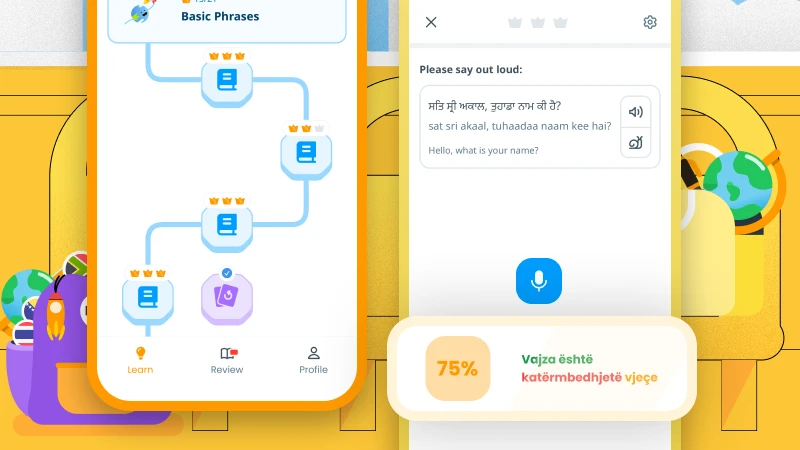

Download the Ling app and unlock interactive lessons, real conversations, and culture-rich content today.
Download Ling for freeThousands of learners are achieving their goals with Ling. See how we’re helping them succeed!


Lower Sorbian is a West Slavic minority language. This simply means that it’s a subgroup of the Slavic language family. Some Slavic languages you may know are Russian, Polish, and Ukrainian (all of which the Ling app offers!)
Here are some quick tidbits about Lower Sorbian:
For more facts about Lower Sorbian, check out the Ling app’s Lower Sorbian language lessons!
Lower Sorbian is used by a population of 7,000 people in Cottbus, a city in northeast Germany, and part of today’s Brandenburg.
If you want to learn Lower Sorbian in person, Cottbus is one of the few places that has a school with the option to learn the language.
As Lower Sorbian is one of the many languages used in Germany, the language has been greatly influenced by German.
Lower Sorbian isn’t a dying language. But, as there are only 7,000 active Lower Sorbian speakers, it is considered an endangered language. Not to mention, people that speak Lower Sorbian are usually of the older generations.
Here’s some Catalan words and phrases from Ling to get you started!
Yes, there’s Sorbian, also known as Upper Sorbian (serbska rěč), and Lower Sorbian (serbska rěc).
Both of these languages are grouped under the West Slavic branch of the Indo-European languages, which means they are very similar to the two West Slavic subgroups: Lechitic and Czech–Slovak.

