


Are you having a hard time learning Thai vocabulary? Maybe you’ve been trying to memorize a bunch of Thai words but you can’t seem to remember them and make them stick.
In that case, have you tried learning Thai vocabulary with flashcards? If you haven’t, you’re in for a treat because this can be a really great method if you’ve been struggling to remember vocabulary terms. So, let’s get right to it!
Learning Thai is more than memorizing words
Explore more →
Thai Vocabulary Flashcards
Did you know that you can learn vocabulary faster with flashcards? Full basic vocabulary builder words are important to have a strong foundation in Thai, which is why we’ve decided to provide you with the basic vocabulary builder words. You can thank us later!
Feel free to download and print them out if you don’t want to spend time making your own Thai vocabulary flashcards.
Emotions
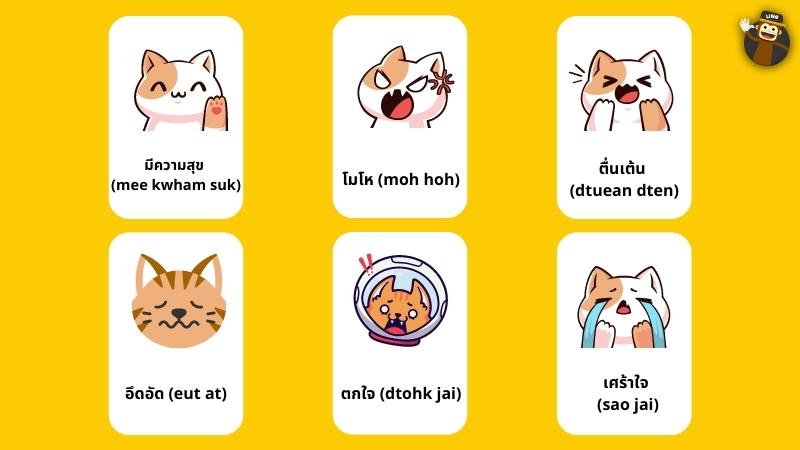
- มีความสุข (mee kwham suk) – happy
- ตื่นเต้น (dtuean dten) – excited
- โมโห (moh hoh) – angry
- เศร้าใจ (sao jai) – sad
- อึดอัด (eut at) – anxious
- ตกใจ (dtohk jai) – shocked
Colors
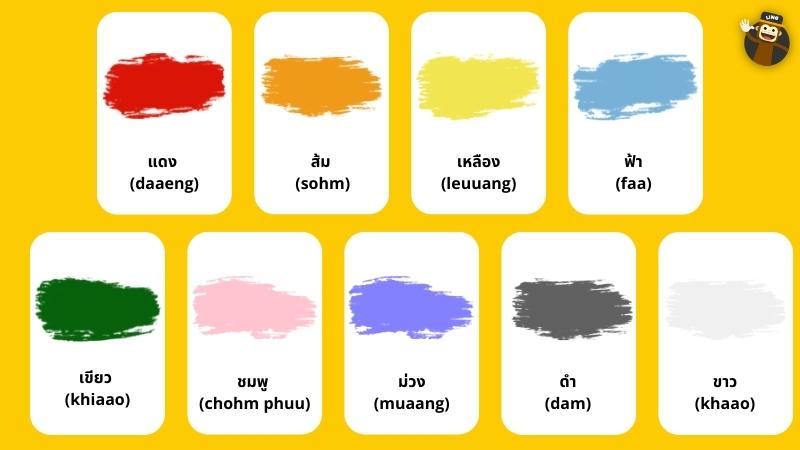
- แดง (daaeng) – red
- เขียว (khiaao) – green
- เหลือง (leuuang) – yellow
- ขาว (khaao) – white
- ชมพู (chohm phuu) – pink
- ดำ (dam) – black
- ส้ม (sohm) – orange
- ฟ้า (faa) – blue
- ม่วง (muaang) – purple
Animals
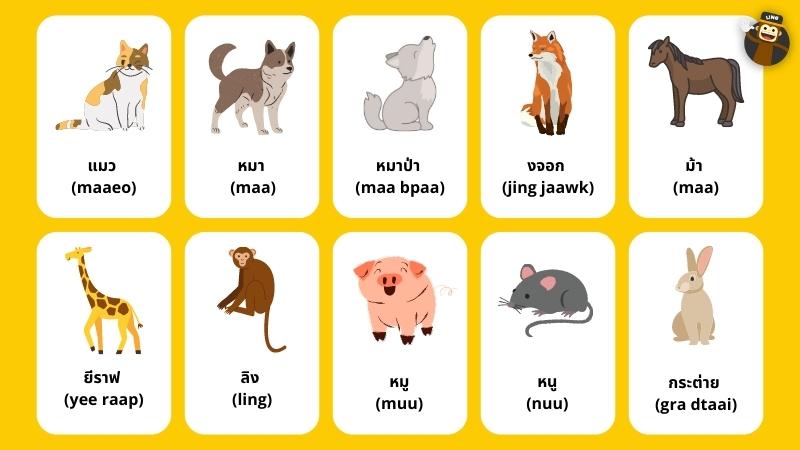
- แมว (maaeo) – cat
- หมา (maa) – dog
- หมาป่า (maa bpaa) – wolf
- จิ้งจอก (jing jaawk) – fox
- ม้า (maa) – horse
- ยีราฟ (yee raap) – giraffe
- ลิง (ling) – monkey
- หมู (muu) – pig
- หนู (nuu) – mouse
- กระต่าย (gra dtaai) – rabbit
Weather & Seasons
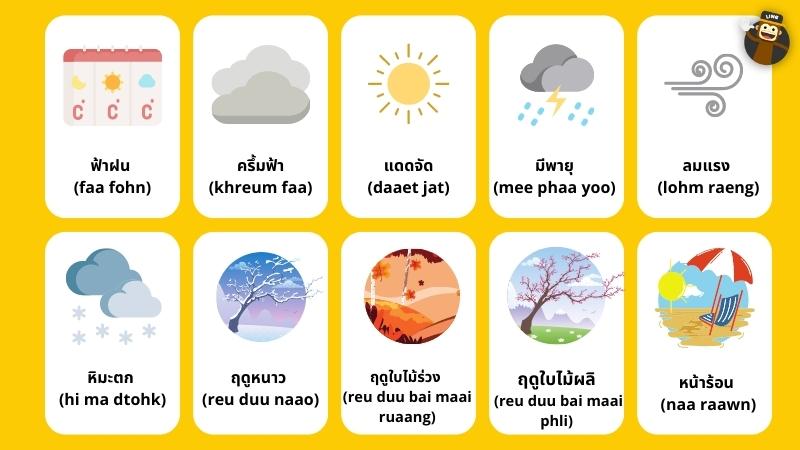
- ฟ้าฝน (faa fohn) – weather
- ครึ้มฟ้า (khreum faa) – cloudy
- แดดจัด (daaet jat) – sunny
- มีพายุ(mee phaa yoo) – stormy
- ลมแรง (lohm raeng) – windy
- หิมะตก (hi ma dtohk) – snowy
- ฤดูหนาว (reu duu naao) – winter
- ฤดูใบไม้ร่วง (reu duu bai maai ruaang) – autumn (fall)
- ฤดูใบไม้ผลิ (reu duu bai maai phli) – spring
- หน้าร้อน (naa raawn) – summer
Days
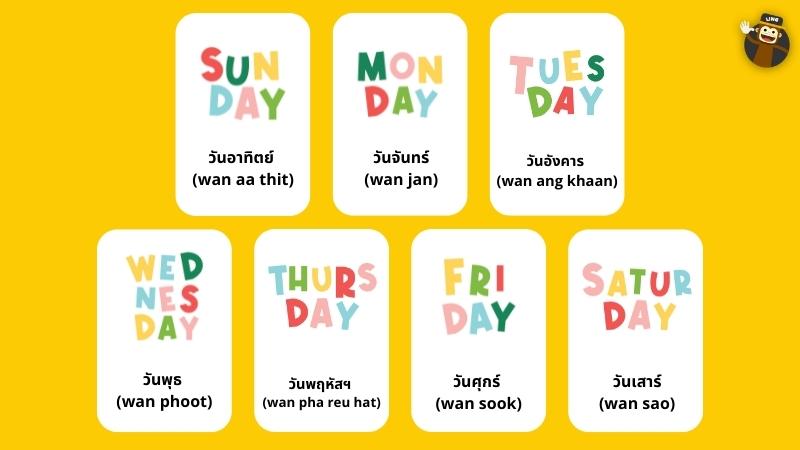
- วันอาทิตย์ (wan aa thit) – Sunday
- วันจันทร์ (wan jan) – Monday
- วันอังคาร (wan ang khaan) – Tuesday
- วันพุธ (wan phoot) – Wednesday
- วันพฤหัสฯ (wan pha reu hat) – Thursday
- วันศุกร์ (wan sook) – Friday
- วันเสาร์ (wan sao) – Saturday
If you love these flashcards, then don’t forget that you can always make them yourself! There’s tons of Thai vocabulary that we didn’t cover here, so there’s still plenty of content waiting to be made into a flashcard.
What Are The Benefits Of Studying With Flashcards?
Flashcards are one of the most common study methods because they help with active recall. Other cognitive benefits linked to flashcards include:
- Enhanced creativity
- Increase in knowledge retention
- Better critical thinking skills
- Better problem-solving skills
Now that you know some of the benefits of using flashcards, let’s take a look at five tips to use flashcards more effectively!
5 Tips To Make The Most Out Of Flashcards
Bear in mind that consistency is key when it comes to language learning! So, it’s not enough to make the flashcards, you also have to make sure that you’re using them consistently to practice.
1. Use Pictures As Much As Possible

Attaching or drawing pictures on flashcards can make a huge impact on your knowledge retention.
According to cognitive psychology, the human brain is less likely to forget visuals than written words. So, if you’re a visual learner, then this is a must for you.
Just keep in mind that it is not recommended to use only images on flashcards because you also need to see the word written out to really remember it.
2. Use Phonetics In The Beginning

Developing clear pronunciation when learning a new language can be easier with the help of phonetics. In case you don’t know, the phonetic alphabet is a set of symbols (see IPA) used for phonetic transcription to show speech sounds.
Feel free to add the phonetic symbols for words directly on flashcards. That way you’ll be able to pronounce each word correctly from the start. Once you learn the phonetic alphabet, you will automatically have better listening skills since you will already be familiar with the authentic sounds of the language.
3. Always Say The Words Out Loud

Studying flashcards silently will only really benefit your writing skills. If you want to improve your speaking and listening skills, then you’ll need to say the words on the flashcard out loud.
Of course, it’s important to make sure that your pronunciation is also correct. So, as we mentioned in the previous tip, you can use phonetics, in the beginning, to help you develop the correct pronunciation.
Moving your lips to produce sounds can also help the memorization process as it has to do with muscle memory. The more you say the words, the more likely your brain is to remember them.
4. Don’t Forget To Switch Directions

Don’t forget to study your flashcards in both ways. In other words, make sure to study from Thai to English and vice versa. If you don’t, you will only be able to recall one side of a flashcard instead of both sides.
5. Categorize Your Flashcards Accordingly
Try classifying your flashcards according to your language level. If you have more challenging flashcards, be sure to make a note of those so that you’re aware of the ones you need to practice more.
If you’re still feeling unsure about flashcards after reading all this and think mobile flashcards would be more helpful for you, then we have the perfect app!
Learn A New Language With The Ling App!
If you are interested in learning Thai or any of the other 60+ languages offered in the app, then you will absolutely love the Ling App!
The Ling App is a language learning app designed to help all learners as they venture out on their language learning journeys. With so many engaging activities to choose from, such as writing and listening exercises, mini-games, quick quizzes, and an AI chatbot to converse with, the Ling App is the perfect all-in-one language learning resource.
You can find everything you could ever need in this app to master all 4 language skills. Even better, you can try the app out for free today by downloading it from the App Store or Play Store.
Start learning Thai, or any other language, now by downloading the Ling App today!