The animals in Thailand run from the macaques and house geckos you meet on your first day to the elephants, gibbons and tigers that keep to the national parks. The Thai word for animal is sàt (สัตว์).
Knowing which creatures you will really run into, and what Thai people call them, makes a first trip much less surprising. The Ling app teaches Thai with native speaker audio, so you can hear every name on this page the way it is actually said.
What Are The Most Common Animals In Thailand?
The animals you see most in Thailand are the ones that live beside people: long-tailed macaques, house geckos, street dogs and cats, chickens, and water buffalo in the rice fields. The big wildlife is there too, but it keeps to the forest and the coast.
Learning Thai is more than memorizing words
Explore more →
- Mammals: Asian elephants, two species of gibbon, long-tailed macaques, dusky langurs, Asian black bears, tigers and clouded leopards.
- Birds: great hornbills, kingfishers, egrets and hundreds of smaller species across the forests and wetlands.
- Reptiles: house geckos on almost every wall, tokay geckos, monitor lizards, pythons and cobras.
- Sea life: reef fish, sea turtles and the stubby-nosed Irrawaddy dolphin along parts of the coast.
- Farm and street animals: water buffalo, chickens, pigs, dogs and cats, all part of daily life.
How Do You Say Animal In Thai?
Animal in Thai is sàt (สัตว์). The word covers everything from a house gecko to an elephant, so it works whenever you want to point at a creature and ask what it is called. Thai also has a separate counting word for animals, and that is where most beginners trip up.
Here is a short exchange from the Nature & Landscape unit of the Thai course in the Ling app, recorded with native speaker audio.
The rest of the conversation, and the rest of the unit, are in the lessons.
Why Is The Elephant Thailand’s National Animal?
The elephant is Thailand’s national animal, and it carries more cultural weight than any other creature in the country. White elephants have long stood for royal power, and the animal still appears in processions, on temple walls and on the Thai navy’s flag.
Wild elephants, though, are a conservation story rather than a common sight. Mapping work by Thailand’s Department of National Parks, Wildlife and Plant Conservation with the IUCN SSC Asian Elephant Specialist Group puts the wild population at 4,013 to 4,422 animals.
Thai is a tonal language, so cháang (ช้าง) only sounds right with its tone in place. The Ling app plays its audio at normal and slow speed, which is the easiest way to copy a word like this.
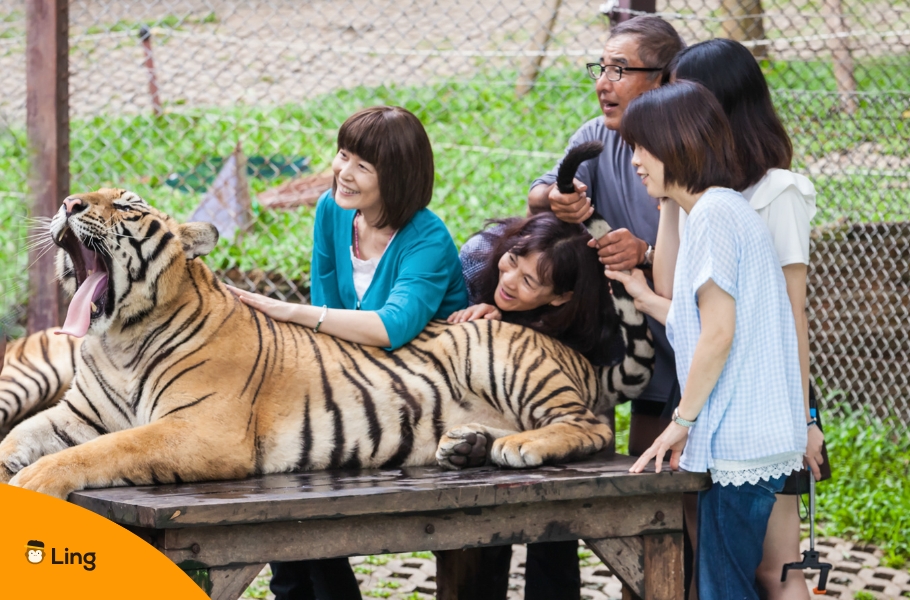
Where Can You See Wild Animals In Thailand?
The national parks are where Thailand’s wildlife actually lives. Khao Yai is the easiest to reach from Bangkok, and the UNESCO World Heritage listing for the Dong Phayayen-Khao Yai Forest Complex records more than 800 species of fauna there, among them 112 mammals, 392 birds and 200 reptiles and amphibians.
Further west, UNESCO’s listing for the Thungyai-Huai Kha Khaeng Wildlife Sanctuaries records 77 percent of the large mammals, 50 percent of the large birds and 33 percent of the land vertebrates found in the wider region. That is tiger and elephant country, largely closed to casual visitors.
- Forest or jungle is bpàa (ป๋า), the word you will see on park signs.
- A mountain is puu-kǒao (ภูเขา).
- An island is gò (เกาะ), as in the dive sites off the southern coast.
- The ocean is má-hǒa-sà-mùt (มหาสมุทร).
Park etiquette matters as much as the vocabulary, and the dos and don’ts in Thailand cover the wider cultural rules.
12 Thai Animal Names To Know
These twelve animal words are worth having on your phone before you fly, each in Thai script with a romanization you can read aloud.
| English | Thai | Transliteration |
|---|---|---|
| animal | สัตว์ | sàt |
| elephant | ช้าง | cháang |
| tiger | เสือ | sěua |
| bird | นก | nók |
| fish | ปลา | bplaa |
| dog | หมา | mǍa |
| cat | ูมว | maew |
| pig | หมู | mǒo |
| mouse | หนู | nǒo |
| chicken | ไก่ | gài |
| crab | ปู | bpoo |
| shrimp | กุ้ง | gûng |
Several of these double as names for people, which is why so many Thai people are called Muu or Nok, and the list of common Thai nicknames explains how those names get chosen.
How Do You Count Animals In Thai?
Thai puts a counting word after the number, and for animals that word is dtua (ตัว). Two dogs comes out as dog, two, dtua. Elephants are the exception language lovers enjoy: they take chêuak (เชือก), a word that first meant rope, while a flock or a herd takes fūng (ฝูง).
The full set is in this guide to classifiers in Thai, which groups them by living beings, clothing and accessories, and household items.
Common Mistakes To Avoid With Animals In Thailand
Most trouble with animals in Thailand comes from treating them as exhibits rather than wild animals.
- Do not feed the macaques. They are bold around people already, and a bag of snacks turns a photo stop into a scramble.
- Skip elephant rides and stage shows, and pick a sanctuary that lets the animals roam. The guide to elephants in Thailand covers the ethical options and the history behind them.
- Give street dogs room, especially after dark and around temples, and do not assume one belongs to somebody.
- Reach for chêuak (เชือก) rather than dtua (ตัว) when you count elephants.
- Do not expect a tiger. Thailand has them, but they live deep in the western forests and sightings are rare.
Tones are what catch out most beginners on these words, and the Ling app keeps track of the words you miss so you can practice them again.
Frequently Asked Questions About Animals In Thailand
What Animals Live In Thailand?
Thailand’s animals include Asian elephants, two species of gibbon, long-tailed macaques, Asian black bears, tigers and clouded leopards in the forests. Along the coast there are reef fish, sea turtles and Irrawaddy dolphins. The animals in Thailand that visitors actually meet, though, are the house geckos, macaques, street dogs and water buffalo that live alongside people.
What Dangerous Animals Live In Thailand?
The animals worth respecting are snakes, including cobras and vipers, monitor lizards, jellyfish in some coastal waters, and macaques that have learned to grab food from tourists. Wild elephants are the biggest risk in the eastern forests. Almost every incident starts with someone feeding or crowding an animal.
Are There Tigers In Thailand?
Yes, Thailand still has wild tigers, but they live in remote western forests and are almost never seen by visitors. UNESCO lists the tiger among the endangered species in both of Thailand’s natural World Heritage sites. Your realistic chance of seeing one is nil, which is a good sign rather than a disappointment.
What Is The National Animal Of Thailand?
The elephant is the national animal of Thailand. White elephants in particular have long stood for royal power, and the elephant still appears in processions, on temple walls and on the Thai navy’s flag.
What Is The Thai Counting Word For Animals?
Thai uses a counting word after the number, and for animals that word is dtua. So two dogs comes out as dog, two, dtua. Elephants are the exception: they take chueak, a word that first meant rope, and a flock or a herd takes fung.
Can You See Wild Elephants In Thailand?
You can, most reliably in Khao Yai National Park, where herds cross the roads in the early morning and late afternoon. Mapping work by Thailand’s park authority with an IUCN specialist group puts the wild population at just over four thousand. Elsewhere, the ethical sanctuaries near Chiang Mai are where most visitors meet rescued elephants.
What Should You Remember About Thailand’s Animals?
Thailand’s wildlife is richer than most visitors expect, and far less visible. The macaques, geckos, dogs and buffalo are everywhere, while the elephants, gibbons and tigers stay in the parks, which is where the UNESCO figures put the real density.
The twelve words above cover nearly everything you will point at, and the counting words add a detail most travelers miss. If you want everyday words beyond animals, the list of Thai vocabulary for everyday life covers the basics, and this guide to why Thai is missing from Duolingo explains why the language is harder to find than it should be.
Meet Thailand’s Animals In Their Own Language
Thailand is one of those places where the animals turn up everywhere, from the gecko on your hotel wall to the hornbill crossing a park trail. Knowing their names turns those moments into something better than sightseeing.
With flashcards, native speaker audio and Dialog for real conversation practice, Ling gives you a way to practice these words before you land. Start learning Thai today and arrive ready to ask what that one is called!