If you’re reading this, you’re likely evaluating which app is the best to learn your target language, and you’ve come down to Ling vs Babbel. Well, we’re here to help.
When it comes to comparing the Ling app and Babbel, similarities include short, interactive lessons, native-speaker audio, and pronunciation practice, and some key differences are the number of languages they offer, how much they rely on audio, and how game-like they feel.
In this post, we’re going to thoroughly compare Ling vs Babbel. We’ll explore their main features, their biggest similarities and differences, how many languages each one offers, their prices, and everything else you need to know.
I want to learn even more languages with Ling!
Download now!
By the end, you’ll be ready to make a decision.
Ling Vs Babbel: A Quick Comparison
Let’s start with a quick summary of the main similarities and differences between the Ling app and Babbel. We’ll explore them in more detail below.
| Feature | Ling | Babbel |
|---|---|---|
| Languages offered | 70+ languages | 14 languages |
| Free version | 7-day free trial | First lesson free |
| Non-Latin script writing practice | ✓ | ✗ |
| Ideal for beginner/intermediate learners | ✓ | ✓ |
| Short, interactive lessons | ✓ | ✓ |
| Native-speaker audio | ✓ | ✓ |
| Speaking & pronunciation practice | ✓ | ✓ |
| Vocabulary in context | ✓ | ✓ |
| Streaks & progress tracking | ✓ | ✓ |
| Flashcards & vocabulary bank | ✓ | ✓ |
| In-app podcasts | ✗ | ✓ |
| Grammar explanations (for some languages) | ✓ | ✓ |
| Pricing | $16.99/month | $9.60/month |
As you can see, Ling and Babbel share many features, such as short, interactive lessons, speaking and pronunciation practice, and native-speaker audio. They also have some key differences, like the number of languages they offer, their free trials, non-Latin-alphabet writing practice, and more.
What Is Ling, And Who Is It Best For?
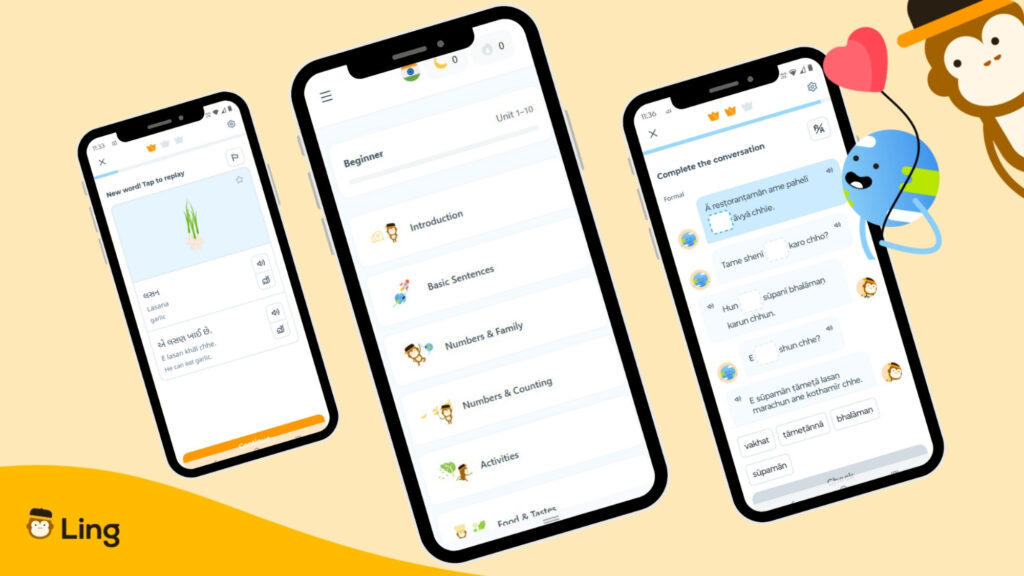
Ling is a language-learning app designed to make learning fun and easy. It has short, interactive lessons, native-speaker audio, conversation practice, vocabulary in context, and more. It offers 70+ languages and specializes in those from Eastern Europe and Southeast Asia.
Here are some of the main features of the Ling app:
- Short, interactive lessons you can complete in 5–10 minutes
- Exercises that take the form of mini-games
- An interactive and gamified approach to learning
- Real, native-speaker audio in every lesson; no AI voices
- Dialogs for conversation practice
- A focus on less commonly taught languages, especially from Southeast Asia and Eastern Europe
- Grammar Notes that explain basic grammar in a simple way (in some languages)
- Culture Notes for extra cultural context (in some languages)
- Vocabulary taught in context, with sentences and examples
- Several review options, such as quick tests, flashcards, and a personal vocabulary bank
- Streaks, points, achievements, and leaderboards to keep you motivated
- Progress tracking and stats
- Speech recognition and instant feedback on pronunciation
- Practical language, with real-life vocabulary you can actually use in conversations
- And much more!
As such, the Ling app is ideal for many learner profiles:
- Travelers who want to explore a new country or region and connect with the locals
- Expats moving to a new country, seeking to make deeper connections
- Learners who want to connect or reconnect with their heritage via language
- People seeking to connect with their partner or spouse and their family
- Curious learners who want to expand their linguistic knowledge
What Is Babbel, And What Type Of Learners Use It?
Babbel is a language-learning app that also relies on short, interactive lessons. It offers 14 languages and includes features such as exercises in the form of mini-games, review options like tests, flashcards, and a vocabulary bank, in-app podcasts for certain languages, conversational practice, and more.
Here are some of Babbel’s main features:
- Quick lessons you can complete in 10–15 minutes
- Language courses in 14 languages
- Focus mostly on popular languages like Spanish and French
- A few less popular languages, like Norwegian, Indonesian, and Danish
- In-app podcasts for some languages
- Speaking and conversation practice with guided scripts
- Short grammar explanations for some languages
- Speech recognition and instant feedback on pronunciation
- Audio recaps for completed lessons
- Progress tracking and stats
Considering that, Babbel is an ideal app for beginners, but also for people who have basic knowledge of a language and want to improve their skills a bit further.
What Are The Main Similarities And Differences Between Ling And Babbel?
The Ling app and Babbel have many similarities, such as short lessons, conversational practice, native-speaker audio, review options, and more. But they also have key differences like the number of languages they offer, writing practice, in-app podcasts, how game-like they feel, and more.
Let’s quickly explore the main similarities and differences between Ling and Babbel:
What Do Ling And Babbel Have In Common?
The main things the Ling app and Babbel have in common are:
- Short, interactive lessons
- Native-speaker audio
- Speaking and conversation practice
- Streaks and progress tracking
- Several review features
Native-speaker audio is key, as studies show that listening is essential to foreign language acquisition, and real, native-speaker recordings beat machine or AI audio any time. There’s also the importance of conversational practice, since studies have also shown that interaction is essential for language learning.
Other features, such as teaching vocabulary in context, having lessons organized by levels and topics, grammar explanations, and review options, make both apps great options for learners who want to study a language on the go.
What Are The Main Differences Between Ling And Babbel?
The most notable differences between Ling and Babbel are:
- Ling offers 70+ languages, and Babbel offers 14
- Ling has writing practice for non-Latin scripts
- Babbel relies more heavily on audio
- The Ling app feels more like a game
Babbel offers 14 languages to its learners. Ling, on the other hand, offers more than 70. Plus, the Ling app specializes in rare and less popular languages, with an emphasis on Eastern Europe and Southeast Asia. That’s why it also offers writing practice for several languages that don’t use the Latin alphabet, such as Hindi, Japanese, Lao, Thai, and more.
Another important difference is that Babbel relies heavily on audio. On the Ling app, all words and phrases are pronounced by native speakers, and you have dialogs for conversation practice. But Babbel includes podcasts within the app, has longer conversational practice, and even offers guided audio lessons in some languages.
As for the learning experience, the Ling app feels much more like a game than Babbel. Babbel’s look is more serious and clean, while Ling’s is more colorful and fun. They both incorporate gamification features, which research has shown can be a great aid for language learning, but Ling takes it further with points and achievements that help keep you motivated, which Babbel doesn’t have.
Ling Vs Babbel: Course Structure And Lesson Depth
Both Ling and Babbel cater mostly to beginner and intermediate learners, so the depth of their courses follows that line. That’s not to say learners who already know a bit of the language won’t get benefits from using the apps, but their main focus is getting you to a conversational level quickly.
Ling’s Course Structure
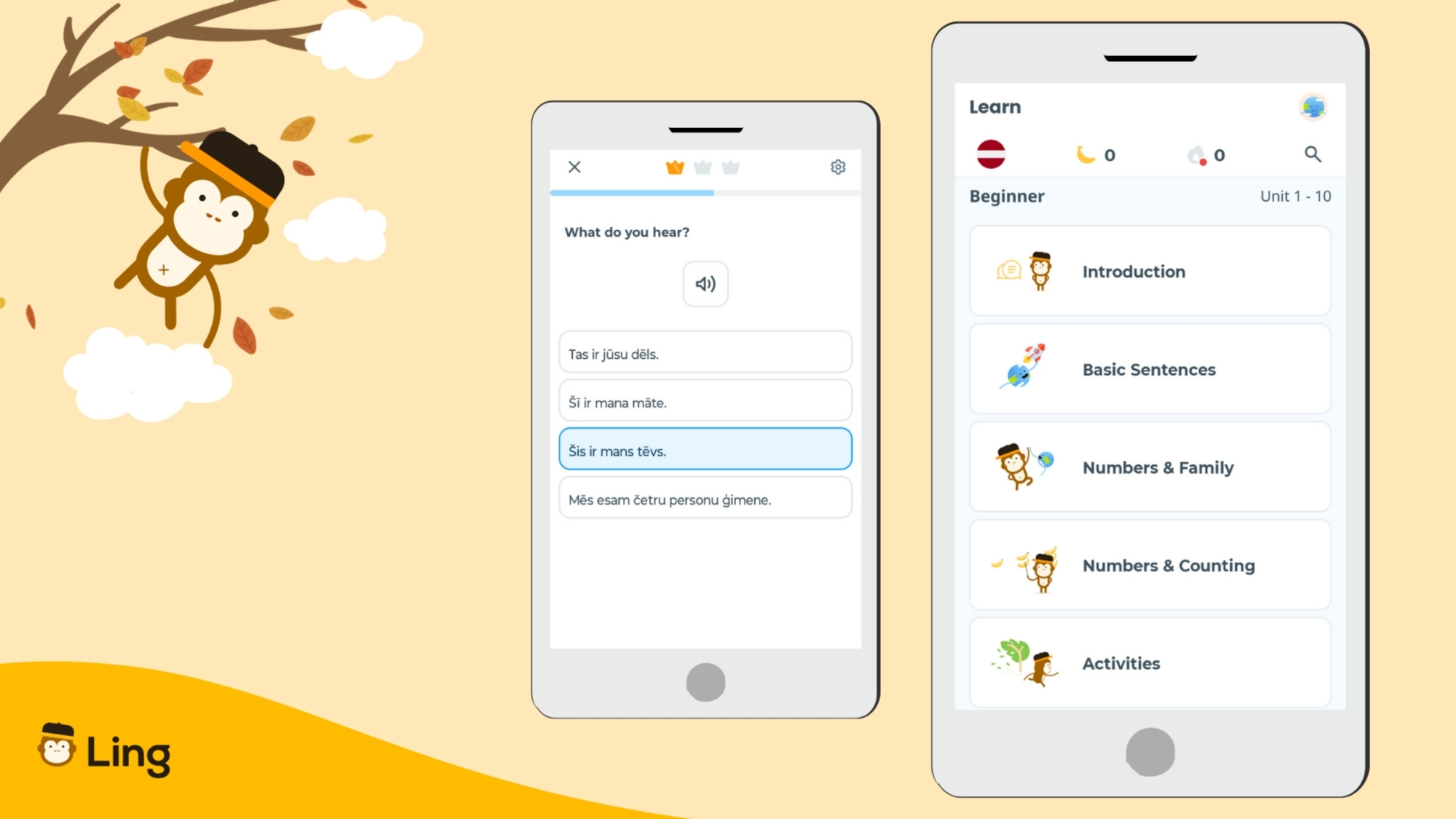
Ling has structured lessons that go from beginner to advanced and are divided into 5 levels:
- Beginner: Units 1-10
- Intermediate: Units 11-20
- Upper Intermediate: Units 21-30
- Advanced: Units 31-40
- Expert: Units 41-50
Plus, all lessons are structured by topics, such as “Basic Sentences,” “Food & Tastes,” “Shapes, Objects And Colors,” “Business Talk,” and more. While Ling does have a structured learning path, it doesn’t force you to follow it; you can jump to any topic you want and focus on whichever subject is more essential for your learning goals.
Babbel’s Course Structure
When it comes to Babbel, lessons are also divided by levels, which are:
- Newcomer I (A1.1)
- Newcomer II (A1.2)
- Beginner I (A2.1)
- Beginner II (A2.2)
- Intermediate (B1)
- Upper Intermediate (B2)
The app lets you take a placement test to figure out which level you’re on, and much like in Ling, lessons are also divided by topic. Some of these are “Introduce Yourself and Others,” “Describe Your City and Say What You Like About It,” “Talk About Restaurants and Your Favorite Dishes,” and more.
What Learning Level Are Ling And Babbel Good For?
Both Ling and Babbel are perfect for beginners and intermediate learners, as they focus on getting you to a conversational level quickly, but they can also be a good option for those looking to polish their skills.
They may not be the best option for really advanced learners, though, as that’s not who they focus on.
Which App Offers More Languages And Better Cultural Context: Ling Or Babbel?
The Ling app offers many more languages than Babbel; it has over 70 languages in its catalog, and Babbel only offers 14. Furthermore, the Ling app includes Culture Notes in many of the languages it teaches, which are short dives into cultural aspects related to the language you’re learning.
Babbel: 14 Languages To Learn
The languages Babbel offers are:
- Spanish, French, German, Italian, Russian, Portuguese, Turkish, Dutch, Polish, Swedish, Norwegian, Indonesian, Danish, and English.
As such, the app mainly focuses on popular languages that many learners seek, like French, Spanish, and Italian, while including some less common options like Norwegian, Danish, and Indonesian.
The Ling App: Over 70+ Languages To Learn
The languages the Ling app offers are:
- East Asia: Taiwanese Hokkien, Mongolian, Korean, Japanese, Chinese Traditional, Chinese Simplified, Cantonese
- Southeast Asia: Sundanese, Javanese, Thai, Vietnamese, Tagalog, Malaysian, Lao, Khmer, Indonesian, Cebuano, Burmese
- South Asia: Punjabi, Urdu, Telugu, Tamil, Sinhala, Pashto, Nepali, Marathi, Malayalam, Kannada, Hindi, Gujarati, Bengali
- Caucasus: Georgian, Armenian
- Middle East: Turkish, Persian, Hebrew, Arabic
- Africa: Yoruba, Swahili, Somali, Amharic, Afrikaans
- Central Asia: Kazakh, Uzbek, Azerbaijani
- Oceania: Māori
- Eastern Europe: Ukrainian, Sorbian, Slovenian, Slovak, Serbian, Russian, Romanian, Polish, Lithuanian, Latvian, Hungarian, Greek, Estonian, Czech, Croatian, Bulgarian, Bosnian, Albanian
- Western Europe: Swedish, Spanish, Portuguese, Norwegian, Italian, Irish, Icelandic, German, French, Finnish, English, Dutch, Danish, Catalan
What’s more, the Ling app specializes in uncommon and rare languages that many other apps, like Babbel, skip over. As you can see from the list, the app teaches languages like Thai, Lao, Cebuano, Irish, Maori, Albanian, Croatian, and many more that you’ll have a hard time finding other apps for.
Cultural Context
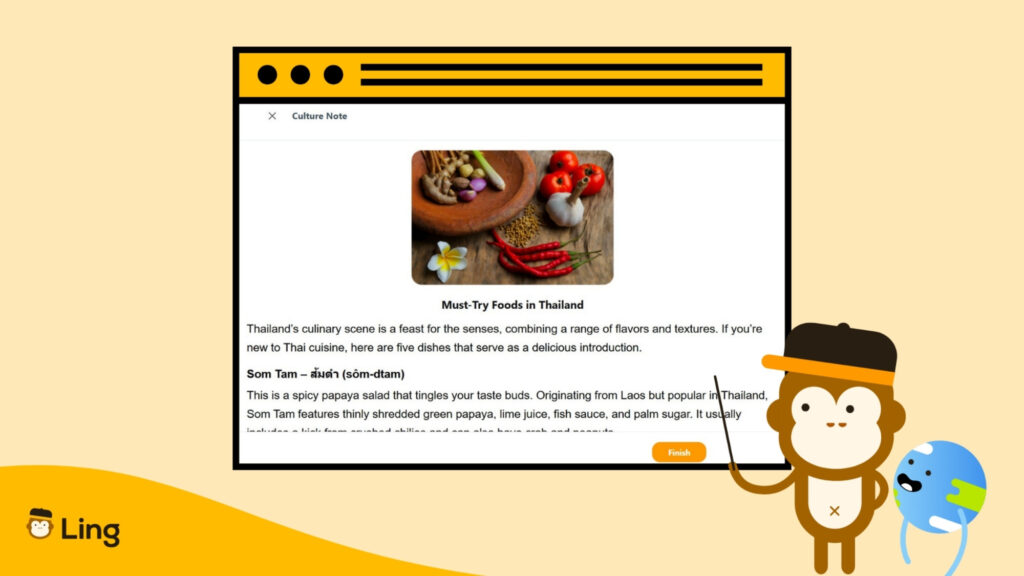
Another advantage the Ling app has over Babbel is that it covers cultural context: it has Culture Notes for several of the languages it offers, and more are on the way. These give you extra context on cultural aspects that are relevant to the language you’re learning.
For example, the Japanese Culture Note in Unit 3 (Numbers & Family) covers the importance of politeness in Japanese culture. As such, it explains formality particles like desu (です) or masu (ます), casual endings for sentences, like da (だ), yo (よ), or ne (ね), and gives you examples of polite and casual speech.
The one in Unit 9 of the Thai course, which is “Eating Out,” delves into Thai cuisine, teaching you about dishes like Som Tam (ส้มตำ), Pad Thai (ผัดไทย), and more.
Several languages in the Ling app have these Culture Notes, including Thai, Tagalog, Albanian, Punjabi, Serbian, Malay, Urdu, and many more. Since language is deeply connected to culture, these short dives can give you a more rounded learning experience and make sure you truly understand the language you’re learning.
Ling Vs Babbel Pricing: Is Ling Worth Paying For?
The Ling app and Babbel have an important difference in pricing: the Ling app costs $16.99 per month, while Babbel costs $9.60 per month. Considering that Ling offers 70+ languages and writing practice for non-Latin scripts, the difference is understandable.
Here’s the pricing and subscription plans of both apps.
| Ling | Babbel |
|---|---|
| 1 Month: $16.99 | 1 month: $9.60 |
| 3 months: $24.45 | |
| 6 Months: $64.99 | 6 months: $43.20 |
| 12 Months: $89.99 (with 7-day free trial) | 12 months: $57.60 (with 7-day free trial) |
| Lifetime: $159.50 |
As you can see, Ling offers monthly, bimonthly, and annual subscriptions, and if you do the math, the longer you subscribe, the less you end up paying.
Babbel follows a similar pattern, with monthly, by-monthly, and annual subscriptions, but it also has a 3-month subscription and a lifetime plan, in which you pay once and get permanent access to the app.
The good thing is that both apps let you try them out for a bit. Babbel has the first lesson unlocked, and both the Ling app and Babbel offer a 7-day free trial.
As such, if you’re wondering which one to download and take a quick look at without paying, the 7-day free trial is the easiest way to compare them.
Why Should I Pay For A Language App In The First Place?
Paying for a language app gets you many things. First and foremost, no ads. Second, no limited features, locked lessons, or time limits. You get access to the full app and all its features, with no disturbances.
And, really, why shouldn’t you pay for a language app?
Companies that make language learning apps work like any other. There’s a team behind them, and the people on that team need a salary just like anyone else. What’s more, apps have many other costs: there’s maintenance, marketing, app store fees, server/hosting costs, and much more.
So it’s only reasonable that many choose to charge for their product, especially if they want to avoid pesky ads.
The question should actually be, “Which language app should I pay for?”
What Do Learner Reviews Say About Ling And Babbel?
Judging by ratings on the App Store and Google Play, learners love the Ling app and Babbel, as they’re both almost at 5 stars. Reviews highlight quick, conversational lessons for Ling, and in-depth lessons and tips for Babbel, among many other things.
Ling’s Rating On Google Play And The App Store
- Google Play: 4.7 stars and 24.1K reviews
- App Store: 4.6 stars and 12K ratings
Babbel’s Rating On Google Play And The App Store
- Google Play: 4.7 stars and 1.11M reviews
- App Store: 4.7 stars and 717K ratings
As you can see, language learners think they’re fantastic. Let’s read a few reviews taken directly from Google Play to see what they wrote:
What One User Loved About Ling
“Ling has been a game-changer for me! I started learning Italian for a vacation to Rome and ended up speaking fluently with locals at cafes. Then, I tackled German for a work trip to Berlin, and it was a breeze! The app is super intuitive, and the lessons feel like you’re just having a fun conversation. I also picked up some Korean before visiting Seoul, and it made the experience so much better. Can’t recommend it enough for anyone looking to learn a language quickly and effectively!”
★★★★★
Khant Zaw Hein
What One User Loved About Babbel
“Switched over to Babbel since other language learning apps were starting to make their lessons with AI and it showed. So far, I really like the lesson structure! It feels more in-depth and the pop-up tips have been very helpful. Lifetime membership was kind of costly, but since it cost me about as much as a couple years of the competition and I can see getting more use out of it than that, was a good deal for a good learning program!”
★★★★★
Brenna Koeppen
What One User Thinks Ling Can Improve
“Its a good app, very thorough in its lessons and no ai which was the main draw for me, but i can’t afford to spend money and you only get 2 free lessons… I’d 100% return to the app if it ever releases free lessons even with adds inbetween lessons, its a shame really. I understand the need to make money but it’s far too expensive for me to continue with. 100% use this over duo if u can afford it.”
★★★☆☆
Dani Ivey
What One User Thinks Babbel Can Improve
“Not a bad app, but very glitchy. Always fails to start at first, needs several attempts. If you have a slightly slower internet connection, it says you are offline. Also the speaking module is messed up – it does not recognize short words and phrases so I always skip them. For the price of 100 euro per year, I expected much more.”
★★★☆☆
Svetlin Levashki
Ling Vs Babbel: Pros And Cons
Still undecided? Here’s a quick breakdown of the most important pros and cons to keep in mind when comparing the Ling app and Babbel.
| Ling | Babbel | |
|---|---|---|
| Pros | • 70+ languages, including uncommon ones • Writing practice for non-Latin scripts • A more gamified design and elements | • In-app podcasts for some languages • Longer conversational practice • Audio recap for lessons • Option to review recent mistakes |
| Cons | • No in-app podcasts or audio recaps • Shorter conversational practice • Grammar instruction is only available for some languages | • Fewer languages • Grammar instruction is only available for some languages |
In essence, Ling offers more languages and a more gamified design, without podcasts and with a bit less conversational practice. Babbel, on the other hand, offers podcasts and longer conversational practice but doesn’t have as many languages.
Which App Should You Choose Based On Your Learning Goal?
In short, go with Ling if you’re looking for a Southeast Asian or Eastern European language (or any language that’s not too popular), if you want writing practice with foreign scripts, and if you prefer a more gamified look and feel. On the other hand, Babbel can be a good choice if you’re more of an auditory learner, prefer a more serious look, and want to focus more on conversations.
That said, the most important thing when choosing a language app will always be your goals and personal preference. There’s often no such thing as a “best app,” just an app that works best for you.
As such, consider your learning goals when deciding. Why do you want to learn this language? Is it to connect with your family or partner? To better understand the locals where you live? Give it some thought before deciding, and try out the app for a bit if you can.
Here are some pointers to help you decide:
Choose Ling If
- You want to learn a Southeast Asian language like Thai, Lao, or Khmer.
- You want to learn an Eastern European language like Albanian, Serbian, or Slovenian.
- You’re interested in not-so-popular languages you probably won’t find in other apps, such as Mongolian, Burmese, Khmer, Lao, or Nepali.
- You like to make learning fun and prefer a more gamified approach to language learning.
- You want to learn to write a non-Latin script like Hindi, Korean, or Thai.
- You want to take a better look at the app before paying.
- You’re a traveler or an expat looking to better connect with the locals.
- You want to connect with your heritage via language.
- You’re curious about languages that many learners skip over.
Choose Babbel If
- You’re looking to study a popular language like French or Portuguese.
- You have an auditory learning style and prefer to learn through podcasts and audio lessons.
- You want to stick with languages that use the Latin alphabet.
- You prefer a bit less gamification in your language apps and a more serious look.
- You want to improve your conversational skills.
Ling Vs Babbel: Frequently Asked Questions
Which Languages Can You Learn In The Ling App Vs Babbel?
With the Ling app, you can learn 70+ languages, many of which are rare or uncommon and are therefore offered on very few apps. Ling also works particularly well with Eastern European and Southeast Asian languages.
On Babbel, you can learn only 14 languages. These are mostly popular languages like French, Spanish, and Italian, but there are a few less common ones, like Norwegian, Indonesian, and Danish.
Can You Use Ling And Babbel For Free?
Only to a limited extent. Ling offers a 7-day free trial, and Babbel offers the first lesson for free. This is because they’re both paid apps, and you need a subscription to access all lessons and features.
Is It Worth It To Buy Subscriptions To Language Apps?
It’s definitely worth it to buy a subscription to a language-learning app like Ling. They offer a good product with no ads and all features always available. Plus, the fact that you paid for them can even give you a bit of extra motivation when it comes to finishing a lesson each day.
What Are The Key Differences Between Ling And Babbel?
The key differences between Ling and Babbel are mainly that Ling offers way more languages than Babbel (70+ vs 14) and writing practice for non-Latin scripts, while Babbel focuses more heavily on audio with in-app podcasts and audio recaps. Ling also has a more gamified feel than Babbel, with points and leaderboards, and Babbel gives you a bit more conversational practice.
Final Verdict: Ling Or Babbel?
We’re not going to tell you that our app is better than Babbel; we’re proud of it, but we know that’s not very objective. Babbel is a great app. We are, though, going to insist on the fact that the Ling app has many features Babbel doesn’t:
Ling has way more languages than Babbel, a more gamified approach, writing practice for non-Latin scripts, didactic and colorful illustrations, and more. It also works particularly well when it comes to Eastern European and Southeast Asian languages, since that’s what it specializes in.
And its biggest flex? Ling offers languages that many other apps skip, including Babbel. Languages like Mongolian, Burmese, Khmer, Lao, Nepali, and more (trust me, do a quick search for those languages on the App Store and you’ll see).
Plus, it’s an ideal app for travelers who want to connect with the locals, expats who seek to be part of a community, learners who want to (re)connect with their heritage, and even curious learners who are interested in languages not many people learn.
So if you’re looking to learn a new language that isn’t that popular, want an app with interactive exercises that makes learning fun, need to practice speaking and having conversations, understand the importance of native-speaker audio, and want to review what you learn as often as you can, the Ling app is your best bet.
Ready to start learning? Download the Ling app and start your language learning journey today. Remember, you can try it out for 7 days for free!