



Can you imagine two languages that share the same roots and the same language family? That’s exactly the relation between Pashto and Farsi. Farsi vs Pashto share a common past as Indo-Iranian languages, but they have grown into two distinct languages, each with its own tone and expressions.
So, is Pashto the same as Persian? No. Let’s explore what makes Farsi vs Pashto different from each other and why they are considered two distinct voices of the same region.
I want to learn even more languages with Ling!
Download now!
Is Pashto The Same As Persian?
No, Pashto and Persian are two separate languages. Farsi is the name for Persian as it is spoken in Iran, and Dari is the Persian spoken in Afghanistan. Pashto belongs to the same Indo-Iranian family, but Pashto and Farsi speakers cannot understand each other without study.
The two languages differ in their alphabets, their sounds, their grammar and many everyday words, as the five points below show.
Pashto Vs Farsi: A Brief Historical Background
Before delving into the difference between Farsi vs Pashto, let’s briefly look at the origin of each language individually:
Pashto
Pashto is one of the oldest Indo-Iranian languages that originated around 2,000 years ago in an area now known as southern Afghanistan and Western Pakistan. What makes Pashto special is that it still retains the old sounds and grammatical rules that other Iranian languages have lost. Over time, Pashto also borrowed words from Arabic, Persian, and English.
Farsi
Farsi, also called Persian (Iranian), originated from Old Persian. It was the language of the Persian Empire, which later evolved into Pahlavi (Middle Persian) and then into Modern Farsi. Farsi, since its origin, has been known as the language of art, poetry, history, and culture. It is due to its poetic nature that other languages, such as Urdu, Turkish, and even Pashto, were greatly influenced.
Key Linguistic Differences Between Pashto And Farsi
Pashto and Farsi are like those two cousins who share the same roots but are brought up in different environments. Let’s see how:
- Both are Indo-Iranian languages of the Indo-European family
- Both are written in scripts based on the Arabic alphabet
- They share several words, mostly borrowed from the Arabic language.
Despite these similarities, Pashto and Farsi are still not mutually intelligible. In fact, they even look and sound different. Below are some of the notable differences between Pashto and Farsi that you should know:
1. Alphabet And Script
Although Pashto and Farsi both use the Arabic alphabet and writing style, Pashto also has extra consonants and vowels that don’t exist in the Farsi language. For instance, letters like sh (ښ). You can read the Pashto alphabet article to learn more about Pashto-specific letters.
2. Pronunciation
Pashto has several retroflex sounds that give the language a sharp and bold tone. Farsi, by comparison, has a softer and more musical tone, which many beginners find easier to pick up.
Let’s look at an example: the word for ‘good’ is khub (خوب) in Farsi but kha (ښه) in Pashto, written with ښ, one of the Pashto letters that Farsi does not have.
3. Grammatical Structure
In terms of grammar, Pashto has more complex grammar rules compared to Farsi. That is:
Pashto has gendered nouns and gender-based verb conjugations, whereas Farsi has no genders. For example:
In Pashto, we say ‘he is good’ as haghah kha day (هغه ښه دی), and in Farsi we say U khub ast (او خوب است). However, if the sentence is ‘she is good’, we replace ‘day’ with ‘dha’ and say haghah kha dha (هغه ښه ده). Yet, it’s not the case in Farsi. U khub ast (او خوب است) is used for everyone.
The same is the case with Pashto tenses and noun cases, which have different rules from Farsi and deserve a separate Pashto grammar section. The main point is that Farsi grammar is simpler and more fluid compared to Pashto’s somewhat complex grammar.
4. Vocabulary
In addition to several Arabic loanwords, most everyday-used words are different in Farsi and Pashto. For example, we say ‘thank you’ in Pashto as manana (مننه) and in Farsi as moteshakeram (متشکرم). Similarly, the Pashto word for ‘love’ is mina (مینه) and the Farsi word is ishq (عشق).
5. Official Status
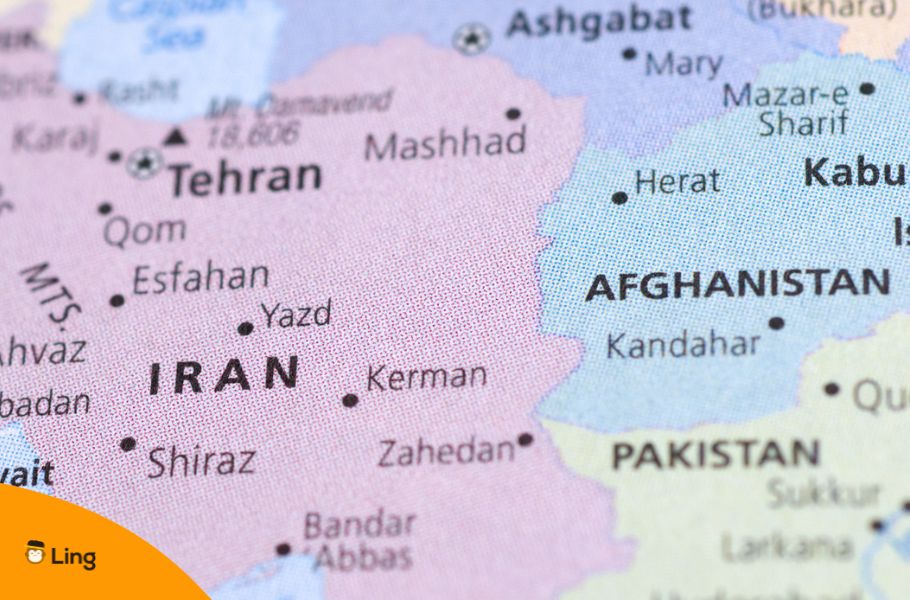
Pashto, as we know it today, is one of the two official languages of Afghanistan (the other is Dari), which is also widely spoken in Pakistan, primarily in Khyber Pakhtunkhwa and Balochistan. Modern Persian, also known as Farsi, is the national language of Iran. Historically, Iran was known as Persia, which is why the language is often referred to as Persian.
How Do You Say ‘Farsi Vs Pashto’ In Pashto And Farsi?
In Pashto, we say ‘Farsi vs Pashto’ as Farsi muqabil Pashto (فارسی مقابل پښتو).
The Farsi way of saying ‘Farsi Vs Pashto’ is farsi dar muqabil pashto (فارسی در مقابل پشتو).
See, both are somewhat similar.
Farsi Vs Pashto: Some Common Words
Let’s take a look at a few words that are common to both Pashto and Farsi.
| English | Farsi | Pashto |
|---|---|---|
| Hello | salaam (سلام) | salaam (سلام) |
| Goodbye | Khoda hafez (خدا حافظ) | Khuda hafiz (خدا حافظ) |
| No | Na (نه) | Na (نہ) |
| Book | Kitaab (کتاب) | Kitaab (کتاب) |
You see, only the pronunciation of goodbye is different: Farsi speakers say Khoda hafez (خدا حافظ). The rest are the same.
Want to learn more words like these, but noticed there’s no Pashto on Duolingo? In fact, Farsi isn’t available on Duolingo either! But don’t worry! The Ling app is here to your rescue!
Easy Tips To Learn Farsi And Pashto Despite The Differences
Even though the two languages are different, you can still learn both Pashto and Farsi. Just keep the following points in mind to avoid confusion:
- If you see retroflex letters like ڼ، ټ، ډ،ړ in the script, know that it’s Pashto. The Persian alphabet adds four letters of its own to Arabic (پ، چ، ژ، گ), but none of these retroflex letters.
- The Pashto language sounds bold, sharp, and proud, while the Farsi language is soft and melodious. You can listen to Allama Iqbal’s Farsi (Persian) poetry to see how romantic and poetic Farsi sounds.
- Pashto has more complex grammar rules, such as noun cases and gender-based verb conjugations, compared to Farsi.
- Farsi has no retroflex sounds, unlike the Pashto language.
Frequently Asked Questions Related To Farsi Vs Pashto
Do Afghans Speak Pashto Or Farsi?
Most Afghans speak Dari, Pashto or both, the two official languages of Afghanistan. Pashto is the native language of the Pashtun people, while Dari is widely spoken in Afghan cities and serves as the lingua franca of Afghanistan.
Dari and Farsi are two varieties of the same Persian language: Dari is the Persian spoken in Afghanistan, and Farsi is the Persian spoken in Iran. They differ mainly in accent and some vocabulary.
Which Language Is Pashto Most Similar To?
Pashto is most similar to other Iranian languages, such as Balochi and Persian (Dari and Farsi), because they belong to the same branch of the language family. Even so, Pashto and Persian are not mutually intelligible.
Can Farsi People Understand Pashto?
Iranian Persian or Farsi speakers often struggle to understand the Pashto language, as its pronunciation, vocabulary, and grammar are different. However, there are some common words derived from the Arabic language that both Farsi and Pashto speakers can understand.
Farsi Vs Pashto: The Part Of The Same Indo-Iranian Family
So, now you know why we’ve written ‘Farsi vs Pashto’ instead of ‘Farsi and Pashto’, right? Even though Pashto and Farsi belong to the same Indo-Iranian branch of the Indo-European language family, they are distinct languages with unique characteristics and some similarities in terms of vocabulary and grammar.
Understanding these prominent differences between Farsi vs Pashto offers valuable insights into the rich linguistic and cultural heritage of both languages. You can also compare Pashto phrases with the Farsi phrases to note the differences between the two by yourself. It will help you understand the languages better.
Why Not Learn Both Pashto And Farsi With Ling?
Congratulations, you now know how to tell Pashto and Farsi apart! Both languages are beautiful and carry a rich heritage, so why choose one when you can learn them side by side?
Ling offers lessons in 70+ languages, with flashcards, native speaker audio, mini-games and Dialog for real conversation practice, all on iOS and Android.
Start learning Pashto or learning Farsi today and enjoy hearing the difference for yourself!

















































































