



There’s no Pashto on Duolingo. But the good news is that you don’t have to give up on learning Pashto just because you can’t find it on Duolingo.
If you’re looking for an affordable and effective way to learn Pashto online, the Ling app offers a convenient alternative. Like Duolingo, Ling uses bite-sized lessons and gamified practice to make language learning more engaging. You can also learn the language at your own pace and actually develop the skills to use Pashto practically in conversations.
In this guide, we’ll look at why Pashto deserves more attention, what makes it challenging to learn, and how Ling can help you learn Pashto online in 2026.
I want to learn even more languages with Ling!
Download now!
Why Is There No Pashto On Duolingo?
There is no Pashto course on Duolingo because the platform has historically focused its course offerings on languages with large learner demand and broad global appeal. So while Duolingo has expanded its catalog over the years, Pashto has yet to make it onto the platform.
Alongside Pashto’s global appeal and demand, here are some more reasons why there’s no Pashto on Duolingo:
- Course development requires significant resources: Creating a quality language course involves developing lessons, grammar explanations, exercises, audio, and other learning materials. Less widely taught languages can therefore require a substantial investment relative to their potential audience.
- Dialect differences: Pashto has several major dialects, including varieties associated with different regions of Afghanistan and Pakistan. Accounting for these differences can make course development more complex.
- The end of the volunteer Contributor Program: Duolingo previously relied on volunteer contributors to help create courses, including courses for less commonly taught languages. However, they ended this program in 2021. This means languages can no longer rely on a community of volunteers to build and maintain a course for the platform.
- Duolingo’s language priorities: The platform has its own criteria for deciding which languages to add and expand. As a result, not every language with millions of native speakers is necessarily included in its catalog.
- Limited global learner demand: Duolingo tends to prioritize languages that attract large numbers of learners. Compared with languages such as Spanish, French, or German, Pashto has a smaller international learner base.
Why Pashto Deserves A Spot On Duolingo
Pashto deserves a place on Duolingo because it has millions of speakers and a rich cultural heritage, yet remains underrepresented on mainstream language-learning platforms. Duolingo has helped make languages such as Spanish, Swahili, and even fictional languages like Klingon accessible to a global audience, so adding Pashto could give more learners an easy way to discover and engage with the language.
Here are a few more reasons why having Pashto on a platform like Duolingo matters:
- Cultural preservation: Learning Pashto goes beyond memorizing greetings and vocabulary; it gives learners a way to connect with centuries of Pashto music, poetry, traditions, and heritage.
- Connecting younger generations: For Pashtun communities living abroad, particularly younger people growing up in countries such as the US, UK, and Canada, an accessible Pashto course could make it easier to learn the language and maintain connections with their cultural heritage.
- Greater global understanding: Pashto is spoken in regions that are often relevant to international, humanitarian, cultural, and geopolitical discussions, making the ability to communicate in the language valuable for people who work or interact in these settings.
- A growing learner community: There are already people around the world interested in learning Pashto, and bringing the language to a mainstream platform could make it more accessible to this community.
- A unique language to explore: Pashto has its own distinctive sounds, writing system, poetry, and linguistic characteristics, giving language enthusiasts another fascinating language to discover.
Why Should You Learn Pashto?
Pashto is worth learning if you want to connect with a language spoken by millions of people and explore a culture with a rich history and distinctive traditions. It is one of Afghanistan’s national languages and is also widely spoken in parts of Pakistan, giving learners plenty of opportunities to communicate with Pashto-speaking communities.
So, what exactly makes Pashto worth adding to your language-learning list? Here are some of the biggest reasons:
- More than 40 million speakers: Pashto has a global community of more than 40 million speakers, making it far from a small or insignificant language. It is widely spoken in Afghanistan and northwestern Pakistan, including Khyber Pakhtunkhwa, Balochistan, and Karachi.
- A rich oral poetry tradition: Pashto has a long history of oral poetry and storytelling, including the tappay, a traditional two-line folk poem that explores themes such as love, betrayal, courage, and honor.
- A fascinating linguistic history: Pashto is thought to have developed from the Eastern Iranian branch of the Indo-European language family, giving it a long and interesting linguistic heritage.
- A strong cultural legacy: Pashto-speaking communities have made significant contributions to South Asian culture, with notable figures such as poet Khushal Khan Khattak and various leaders and artists forming part of that legacy.
Despite all that heritage, Pashto doesn’t always get its due credit on many international language platforms like Duolingo.
Is Pashto Hard To Learn?
Well, learning Pashto may seem initially difficult, but it’s quite doable with the right attitude and tools. Here are the reasons why it might seem difficult to learn:
Unique Sounds
Pashto has some special sounds and letters that do not exist in English. It makes it a bit tricky for first-timers to pronounce it. Here are a few examples:
| Pashto Letter | Sound | Approximate Pronunciation / Equivalence in English |
| خ | kher | Similar to the kh in “Bach” |
| ښ | khaista | A distinctive Pashto sound with no direct English equivalent |
| غ | ghaṛa | A deep sound made toward the back of the throat |
Different Grammar
Pashto grammar has gender-specific nouns and differently conjugated verbs. Plus, it follows a subject-object-verb (SOV) sentence structure, which means the verb generally comes at the end of the sentence. For example:
| English | Pashto | Pronunciation | Literal Structure |
| I read a book. | زه کتاب لولم. | Za kitaab lolam | I book read. |
| I eat bread. | زه ډوډۍ خورم. | Za dodai khwaram | I bread eat. |
Variety Of Dialects
Pashto also has several regional dialects, and differences in pronunciation and vocabulary can sometimes make communication between varieties less straightforward.
The good news is that you don’t need to learn every dialect. If your goal is to communicate with Pashto speakers from a particular region, you can focus on the variety most relevant to you. This gives you a more practical starting point without making the learning process unnecessarily complicated.

What Common Mistakes Do Beginners Make When Learning Pashto?
Beginners learning Pashto often struggle with pronunciation, sentence structure, and the writing system. Most of these mistakes are easy to avoid once you know what to watch out for. Here’s a closer look at the most common ones:
- Ignoring pronunciation: Pashto has several sounds that may be unfamiliar to English speakers. Listen to native-speaker audio and practice aloud from the start.
- Using English sentence patterns: As a beginner, you may instinctively use English’s subject-verb-object structure. Remember that Pashto typically follows a subject-object-verb pattern.
- Skipping the Pashto alphabet: Learning vocabulary without learning the writing system can make reading and writing harder later. Even if you mainly want to speak, the alphabet gives you a stronger foundation.
- Trying to learn too many words at once: Long vocabulary lists can quickly become overwhelming. Focus on common words and phrases and practice using them in context.
- Worrying too much about dialect differences: Regional varieties of Pashto may differ in vocabulary and pronunciation. Focus on the variety most relevant to the people you want to communicate with.
- Not practicing speaking: Grammar and vocabulary alone aren’t enough to build confidence. Practice speaking regularly, even through short conversations or by repeating phrases aloud.
Using a language-learning app like Ling can definitely help you avoid these common mistakes. Its structured lessons give you a clear path to follow, covering everyday conversation words and phrases alongside essential vocabulary. Meanwhile, features like native-speaker audio, writing practice, and interactive exercises help you improve your pronunciation, sentence structure, and speaking skills as you progress.
Duolingo Vs Ling: How Do They Compare, And Which App Supports Pashto?
If you’re deciding between Duolingo and Ling for learning Pashto, the choice is straightforward: Ling currently offers a Pashto course, while Duolingo does not.
If you are still not convinced, let’s do a quick Duolingo vs Ling comparison to help you decide which one is the most suitable choice for you.
| Features | Duolingo | Ling |
|---|---|---|
| Pashto course available | No | Yes |
| Gamified Lessons | Yes | Yes |
| Incorporated Native Speaker Audio lessons | No | Yes |
| App suitable for advanced learners | No | Yes |
| Practice exercises for writing, listening, and speaking skills | Limited | Yes |
| Real-Life Dialogues With a Chatbot | No | Yes |
| Customized Learning Path | No | Yes |
| Stand-alone language learning solution | No | Yes |
| Finger tracing writing exercises | No | Yes |
| Free Version Available | Yes | Yes |
Ling gives you a dedicated Pashto course where you can build your skills from the fundamentals and gradually progress to more practical language use. Duolingo, meanwhile, does not currently offer a Pashto course, leaving Ling as a more suitable option for learners specifically looking to study Pashto.
The Best Alternative For Learning Pashto: The Ling App
Among the language-learning apps available today, Ling is one of the best options for learning Pashto, especially being a non-mainstream language. Unlike many popular language apps, Ling supports learners who want to explore less commonly taught languages like Pashto. And the Ling language course is always detailed, comprehensive and progressively structured.
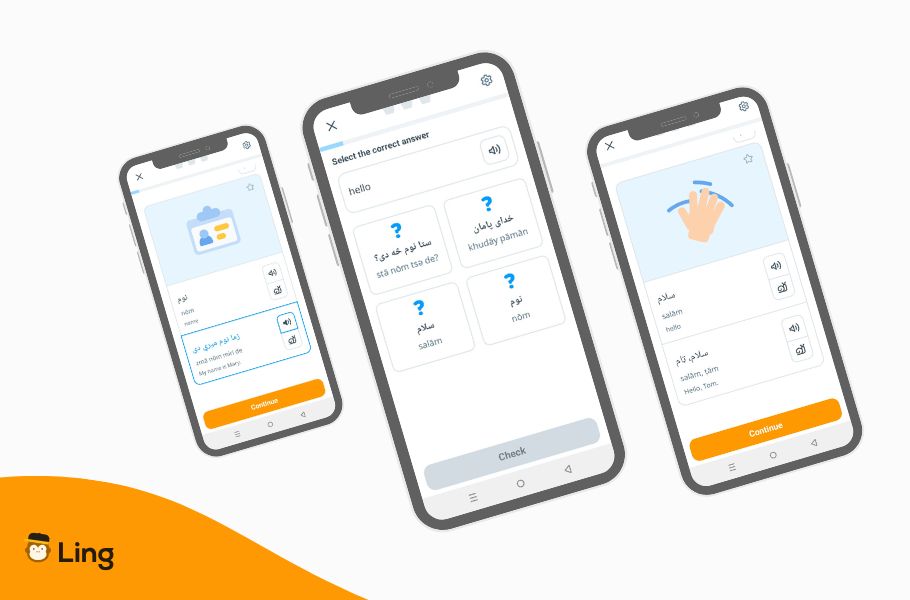
Ling uses short, bite-sized, interactive lessons that combine practical language learning with a gamified approach and a range of learning tools to help learners build their Pashto skills step by step. Some of the key features that make Ling useful for Pashto learners include:
- Gamified lessons to make learning more engaging and motivating.
- Native-speaker audio to help you hear and practice accurate Pashto pronunciation.
- Writing exercises to help you become familiar with the Pashto script.
- Review tools to reinforce vocabulary and phrases you have already learned.
- Interactive dialogues that let you practice Pashto in realistic conversations.
- Voice recognition to help you practice your speaking and pronunciation.
- Reminders and streaks to encourage you to maintain a consistent learning routine.
- Multiple learning levels to help you progress from beginner basics to more advanced Pashto.
Who Is The Ling App Best For?
Ling is a particularly good choice for beginners, travelers, heritage learners, and anyone looking for a structured way to learn Pashto. Ling’s bite-sized lessons and practical exercises make it easy to build your skills gradually, which makes the app a good fit for:
- Complete beginners who want step-by-step guidance as they learn Pashto vocabulary, pronunciation, grammar, and basic conversation.
- Travelers who want to learn useful Pashto words and phrases before visiting Pashto-speaking regions or interacting with local speakers.
- Heritage learners who want to reconnect with the Pashto spoken by their family or community.
- Busy learners who prefer short lessons that can be fitted around work, school, or other daily commitments.
- Language enthusiasts who want to explore a less commonly taught language that isn’t available on many mainstream learning platforms.
- Learners who enjoy interactive learning and want to combine vocabulary, writing, listening, and conversation practice within one app.
Why Do Serious Learners Choose Ling?
Serious language learners choose Ling because it brings the key skills and tools needed to learn a language into one platform. Instead of relying on multiple resources, you can use Ling to work on listening, speaking, reading, and writing through structured, bite-sized lessons.
The app also makes it easy to learn at your own pace. Lessons are divided into manageable sections, allowing you to revisit topics whenever you need to review them. Gamified exercises, quizzes, and clear explanations further help you reinforce what you’ve learned and build confidence with the basics.
Another advantage is Ling’s focus on less commonly taught and regional languages like Pashto, giving learners access to languages they may not find on many mainstream language-learning platforms.
But don’t just take our word for it. Here are some recent Ling app reviews from learners who have used the platform:
“Very epic, grammar tips are actually good, and it’s accurate :3 I recommend it very useful.”
★★★★★
Elbinman43
“I love how quickly I was able to get customer support on account help after the recent app update. I was initially bummed that much got changed & funky for me, but support was great and helped within 24 hours. Pretty amazing! Most of what seemed to change for the worse for me was quickly sorted out. I LOVE the style of Ling that others mention – grateful to jump freely to needed lessons – and the wide language variety. Thanks for the great app & support & care.”
★★★★★
Erika Henson
What You’ll Learn In The First Week Of Joining Ling?
With Ling’s 7-day free trial, you can start building a practical foundation in Pashto within your first week. You’ll progress from basic introductions and everyday phrases to simple sentence structures and your first Pashto dialogue.
Here’s what you can expect to learn each day:
| Days | What You’ll Learn | Examples From Ling Pashto Course |
|---|---|---|
| Day 1 | Basic sentences | A Chinese book – yo chinayi kitab (یو چینایی کتاب) |
| Day 2 | Numbers & Family | I eat three apples – za dhree marhe khoram ( زه درې منې خورم.) |
| Day 3 | Activities | She likes to sing Japanese songs – da de khwakh di chi japani sandhra wayi (د دي خوښ دی چې جاپانې سندره ووايي.) |
| Day 4 | Food & Tastes | We don’t have seafood – mung samandari ghaza na laro (موږ سمندري غذا نلرو.) |
| Day 5 | Vegetables & Fruits | We have vegetable soup – mung da sabo khorwa laro (موږ د سبو ښوروا لرو.) |
| Day 6 | Eating Out | Please order food – mehrabani wakrai da khwarha amar wakrai (مهرباني وکړئ د خواړو امر وکړئ.) |
| Day 7 | Where is it? | The dictionary is between the newspaper and the magazine – qamos da wraz panni ao majlai tar menz ki de (قاموس د ورځپاڼې او مجلې ترمینځ کې دی.) |
Note that you can even achieve more of these in seven days if you increase your learning time per day.
No Pashto On Duolingo: FAQs
Is There Pashto On Duolingo?
No, Pashto is not currently available on Duolingo. However, you can learn Pashto online through alternative language-learning platforms such as Ling, which offers structured lessons, native audio, writing exercises, and conversational practice for Pashto learners.
Which Language App Has Pashto?
There are several language applications that offer online Pashto courses. However, Ling is one of the best language-learning apps for studying Pashto. It combines bite-sized lessons with native-speaker audio, writing exercises, practical vocabulary, grammar explanations, and interactive dialogues to help you develop your Pashto skills.
Can I Learn Pashto Myself?
Yes, you can learn Pashto by yourself with the right resources and consistent practice. An app like Ling can provide a structured learning path, while regularly listening to Pashto and practicing speaking can help you reinforce what you learn and gradually build your confidence.
Is Pashto Easy To Learn?
Pashto can be challenging for beginners, especially English speakers, but it is manageable with consistent practice. Pronunciation, the writing system, grammar, and dialect differences may take time to master, but a structured learning resource can make the process easier.
Can I Learn Pashto Online For Free?
Yes, you can find free resources for learning Pashto online, although the amount of content and learning support can vary. Ling also offers a 7-day free trial, giving you an opportunity to explore its Pashto lessons and features before deciding whether to continue.
Start Learning Pashto With Ling! Try It Now For Free!
You don’t need to worry if there is no Pashto on Duolingo. If you want a structured way to learn Pashto online, Ling offers a dedicated Pashto course with bite-sized lessons, practical vocabulary, native-speaker audio, interactive exercises, and conversation practice.
And you don’t have to commit immediately. Ling currently offers a 7-day free trial with its annual subscription, giving you a chance to explore the platform and see whether its Pashto lessons fit your learning style.
So, if you’re ready to finally start learning Pashto, give Ling a try and see how far you can get in your first week. You can begin with the free trial and decide whether you want to continue your learning journey from there.
Ready to learn Pashto? Download the Ling app today and take the first step toward speaking a new language.

















































































