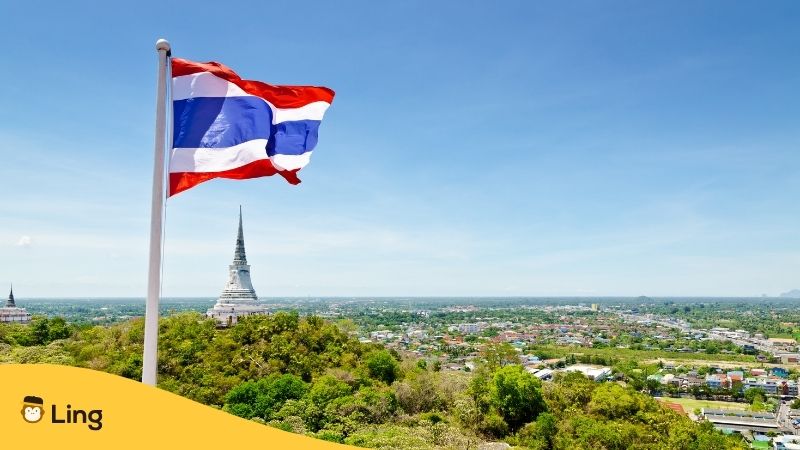
Thailand’s Independence Day, or National Day, is a landmark yearly event for the Thai people. It always takes place on December 5 because it marks the late King Bhumibol Adulyadej’s birthday. For this reason, it’s also Father’s Day, as the King is also seen as the spiritual father of the nation.
Not many know this, but the previous Independence Day of Thailand was celebrated on June 24th. However, following the European method of picking a National Day, they began celebrating when their monarchs were born. So this day in Thailand changed in 1960 from June 24th to December 5th.
In this blog, we’ll go over some cultural insights on Thai National Day, along with some vocabulary, tips, and common questions. Let’s start learning!
Learning Thai is more than memorizing words
Explore more →
Is Thailand’s Independence Day A Public Holiday?
Yes! This is not the day you should plan to renew your visa because government offices and schools will be closed.
However, as modernity has swept over Thailand, many private businesses have chosen to stay open. For example, you will still be able to do your shopping at 7/11.
Why Do Thai People Love Yellow So Much?
If you’re in Thailand on Independence Day, you’ll notice that many people are wearing yellow. In fact, large swathes of Bangkok are alive with it!
According to Buddhist belief, this is because different days of the week have different colors. Monday’s color is yellow, and Monday is also the day of King Maha Vajiralongkorn’s birthday, as well as the late King Bhumibol. Expect also to see flowers of the same color – usually marigolds.
What National Day Celebrations Take Place On December 5?
Thailand’s Independence Day is a mixture of the solemn and the ecstatic.
Usually, the day starts gently with a prayer ceremony at Bhumibol Bridge and a rendition of the royal anthem and national anthem. If you’ve read some of our other blogs on Thai culture, you’ll also remember the importance of merit-making. This includes everyone from a traditional Buddhist on the street to the current King.
Local communities also stage performances featuring traditional Thai theater and musical numbers.
At night, there are fireworks displays in major cities; however, they have been scaled back somewhat since the death of the beloved King Bhumibol.
How Did Thailand Remain Uncolonized By Regional Powers?
A common occurrence in many smaller countries worldwide is that they celebrate their independence on the day they were about to gain independence from a colonial power. The most famous example in the British regard is undeniably the 4th of July, when the United States declared its independence.
However, a curious quirk of history is that Thailand was never colonized, even as its neighbors fell to the British and French. Why was this?
The first thing to note is that at the time, Thailand was not known as Thailand but rather the Kingdom of Siam.
Siam was sandwiched between British Burma and French Indochina, and you might think the next logical step was for one of these great powers to seize the kingdom, but in fact, both appreciated the necessity of a ‘buffer zone.’ In this way, Thailand was like a giant DMZ that you see separating the likes of North and South Korea.
The great King Chulalongkorn realized that if Siam were to retain its independence, it had to try and match European modernization, meaning he set in motion large-scale projects such as reforming the military and school system.
An oft-forgotten modernizing effort was in something as simple as map-making – or topography. Europeans would use maps to define what they owned. Suppose the leaders of Thailand didn’t have a similar example, actually depicting what belonged to them. In that case, the wily Europeans could use this to their advantage and claim parts of the territory.
That isn’t to say that Siam got everything it wanted from the tension at the time. At a few different points, including the Paknam Incident, Siam almost went into an all-out war with the French. And they were also forced to cede control of Laos, which at the time represented a significant amount of Siamese territory.
Some have also speculated about the relationship between the Thai King and the Russian Tsar. Again, we come back to the notion of realpolitik that would also feature heavily during the Cold War 100 years later. The power dynamic in the world was on a knife’s edge, and if one country was seen to be trying to gain an advantage, it could trigger a domino effect into full-scale war at a slight provocation.
How Do You Say Independence Day In Thai?
The direct translation for “Independence Day” in Thai is Wan Chart (วันชาติ).
However, since Thailand was never colonized, the day is more accurately called Wan Chart Thai (วันชาติไทย), which means “Thai National Day.” So, while you might be looking for the word “independence,” a native speaker would most commonly refer to the December 5th holiday as Wan Chart Thai.
Handy Vocabulary For Thailand’s National Day
Want to understand the chatter and celebrations on December 5th? Here’s a quick guide to the essential Thai words and phrases you’ll hear.
| English | Thai | Transliteration | Sound |
|---|---|---|---|
| National Day | วันชาติ | Wan Chât | |
| Father’s Day | วันพ่อ | Wan Phôr | |
| King Bhumibol Adulyadej | พระบาทสมเด็จพระปรมินทรมหาภูมิพลอดุลยเดช | Phra Bât Sŏmdet Phra Poraminthra Maha Bhumibol Adulyadej | |
| King | พระมหากษัตริย์ | Phra Maha Kasat | |
| Father | พ่อ | Phôr | |
| Nation | ชาติ | Chât | |
| Yellow | สีเหลือง | Sĭ Lĕuang | |
| Celebration | การฉลอง | Kan Chà-lŏng | |
| Flag | ธง | Thong | |
| Public Holiday | วันหยุดราชการ | Wan Yùt Râat-chá-gaan | |
| Loyalty | ความจงรักภักดี | Khwam Jong-rák-phák-dii | |
| Merit Making | การทำบุญ | Kan Tham Bun | |
| Fireworks | ดอกไม้ไฟ | Dôrk Máai Fai | |
| National Anthem | เพลงชาติ | Phleng Chât | |
| Long Live the King | ทรงพระเจริญ | Song Phra Jà-roen |
Traveler Tips for Experiencing Thai National Day
Want to join the festivities on December 5th? Here’s how you can respectfully experience the day like a local.
- Wear a Yellow Shirt: This is the simplest way to show respect and join the spirit of the day. Yellow was the color associated with the late King Bhumibol, and you’ll see Thais across the country wearing it.
- Observe the Main Ceremony: Head to the area around the Grand Palace or Sanam Luang in Bangkok to witness the main public ceremony. You’ll see officials laying wreaths and Thai people paying their respects. Remember to be quiet and respectful during solemn moments.
- Stand for the Anthem: At 8:00 AM and 6:00 PM, the Thai national anthem is played in public spaces and on TV/radio. If you are in a public area like a BTS station or a park, simply stop and stand still quietly until it finishes. It’s a key sign of respect.
- Enjoy the Festivities: In the evening, look for cultural performances and smaller firework displays, especially in major cities. It’s a more subdued public celebration than in the past, but the atmosphere is still warm and communal.
- Plan for Closures & Crowds: Remember, it’s a public holiday. Government offices and banks will be closed, and major tourist spots, especially in Bangkok, will be much busier than usual with Thai tourists. Plan your trip accordingly!
Frequently Asked Questions About Thailand’s Independence Day
When Did Thailand Gain Independence?
Thailand does not have an “independence day” in the traditional sense because it was never colonized. It is one of the few countries in Southeast Asia that maintained its sovereignty throughout the colonial era. Its National Day on December 5th celebrates the birthday of the late King, not liberation from a foreign power.
From Which Country Did Thailand Gain Independence?
Thailand never had to gain independence from another country. Through skilled diplomacy and modernization by its kings, the Kingdom of Siam (as it was formerly known) successfully navigated the colonial period, acting as a buffer state between British Burma to the west and French Indochina to the east.
What Was Thailand Called Before 1949?
The country was officially known as the Kingdom of Siam. The name was changed to “Thailand” in 1939 and then briefly back to Siam after WWII, before being permanently restored as Thailand in 1949. The name “Thailand” means “land of the free,” which reflects its uncolonized history.
A Final Look At Thailand’s National Day
To sum up, we know that what’s often called Thailand’s Independence Day is closely linked to Thailand’s Father’s Day. And that another word for the occasion is National Day.
The date is special because it is the birthday anniversary of the late King Rama IX (King Bhumibol). The day blends his birthday, the role of a national father figure, and pride in the country’s uncolonized history into one significant event on December 5th.
From understanding the importance of yellow to knowing how to observe the ceremonies and anthem respectfully, you’re now equipped with the cultural context to appreciate this day fully. It’s a powerful reminder of how Thailand, formerly Siam, skillfully preserved its sovereignty, making its National Day a truly distinctive occasion that honors both its past and its beloved king.
Discover The Thai Language With Ling!
Now that you’re armed with some cultural information, it’s time to level up your Thai with the Ling app.
It’s the number one place on the internet to learn Thai, as you’ll find interactive lessons, native speaker audio, culture and grammar notes, and everything you need to learn the language. You’ll also get plenty of review features, points and streaks to keep you motivated, and a dialog feature to practice conversations.
So don’t wait any longer, download the Ling app and start your Thai learning journey today!