

Thailand is a multicultural country with a mix of cultural and religious practices. It is home to several ethnic groups, each bringing its own Thai beliefs, and those groups are also found in Cambodia, Malaysia, Laos and Myanmar, so they have shaped the traditional culture of the country.
Below are the beliefs behind everyday Thai life, from the three traditions that sit under Thai folk religion to six superstitions you will still hear today, each with the practical reason behind it.
Learning Thai is more than memorizing words
Explore more →
What Are The Common Thai Beliefs?
Thai religion breaks down roughly like this, and the figures come from Thailand’s 2018 pilot census:
- Buddhism, about 94% of the population, almost all of it Theravada
- Islam, about 5%, concentrated in the south near the Malaysian border, and the second largest religious group
- Christianity, about 1%
- Other beliefs, including folk animism, under 1%
If you visit Thailand, you will have plenty of chances to see a Buddhist temple or a statue of the Buddha. Our guide to religion in Thailand goes into each of these in more detail.
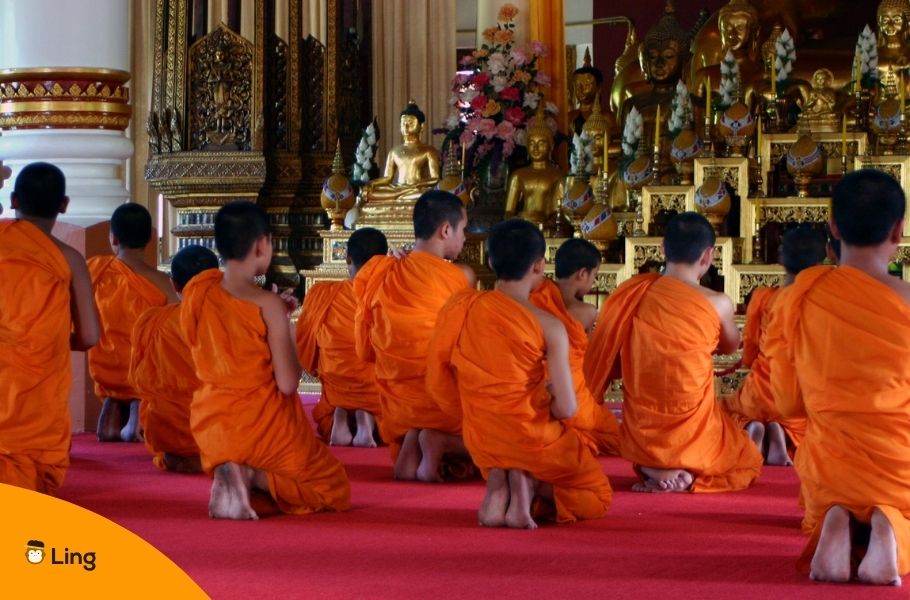
Thai people often visit these places and make offerings at them. Foreigners are welcome, but they must show respect during the ceremonies. Thai Buddhism plays a very important role in the daily lives of Thai people, and that’s why Buddhist monks in the orange cloth are highly respected and play a major role in society.
A few values sit underneath most of this:
- Self-control. Public displays of anger, or being caught in a lie, bring real shame.
- Respect for seniority. Interactions follow social hierarchy, so elders and those in higher positions are deferred to. Doctors, monks, politicians and well-known public figures carry the same weight.
- A non-confrontational attitude. Disagreement is handled indirectly rather than head on.
- Family first. Thai society is built around the family, and although it is male-dominated, women command considerable respect both in custom and in law.
These values show up most clearly at festivals, where respect for elders and for the monkhood is on full display. Our write-up of Songkran, the Thai new year is a good example of how they play out in practice.
Different Thai Beliefs
Thai folk religion is really three traditions layered on top of each other. Each one contributes something different.
Animism
Animism is best described as the worship of spirits, or ghosts. The word Animism comes from the Latin word anima and means breath, spirit, and life. Animists are said to believe that almost everything possesses a spirit including plants, animals, rocks, rivers, wind, sun, and other inanimate natural objects and that the physical world and spiritual world are intertwined.
Brahmanism
Apart from Animism and Buddhism, Brahmanism is another belief system the Thai people have fused with their other practices. It is the strand that brings in deities: Thai people look to these gods to ensure health, prosperity and good luck. Brahma and Indra are two of the popular ones, and you will see shrines to both in Bangkok.
Thai religion blends Buddhism, Animism and Brahmanism, the last of which is closely related to Hinduism, and all three make room for spirits and gods who may or may not carry merit or good karma. These are the core elements of Thai folk religion. Such beings are used by the Thai people to ask for protection, luck, riches, health, and help with moving on to the next life.
What Are The Common Superstitions In Thailand?
Thai beliefs have numerous superstitions and most of them sound creepy if you ask me. Thai people are grown up with superstitious beliefs. Some of them are still believed to be true, even though I don’t really believe in any superstitions, I think these are worth sharing. Here are the most popular superstitions in Thai folk beliefs.
Do Not Sing In The Kitchen Or You Will Get An Old Husband
The real reason: This is a trick that many elder Thai people use to make younger ones focus on what they are doing in the kitchen. One often has to use things like sharp knives and hot utensils, and singing might distract them from what they are doing.
Do Not Sleep Towards The West
“Don’t have your headboard facing the west. It’s the direction of the dead.” This is something you will hear from superstitious Thai folk. It is commonly believed that sleeping with your bed facing the West will bring you bad luck because only dead bodies face West such as at funerals.
The real reason: A wall facing west takes the sun all day, which leaves the room hot and uncomfortable to sleep in at night.
Do Not Play Hide And Seek At Night
This is the most common superstition in the Southeast Asia region, adults tell kids not to play games like hide and seek or catching at night otherwise an extra player who is not invited will join you.
The real reason: At night, it can be dangerous for kids to play without parents’ supervision in the dark. So parents have many concerns, like their kids getting hurt, lost, or even kidnapped. Those who grew up in more rural areas had the risk of encountering dangerous animals too.
Do Not Clip Your Nails At Night
“Clipping your nails at night will bother our ancestors’ souls!” they say, referring to the annoying noise nail clippers make. And if we disturb them, we will get punished.
The real reason: Using sharp objects at night is never a good idea, especially in the past when the lighting was dim at night. People were only afraid of getting hurt by accidentally clipping a finger.
Do Not Knock Your Plate While Eating
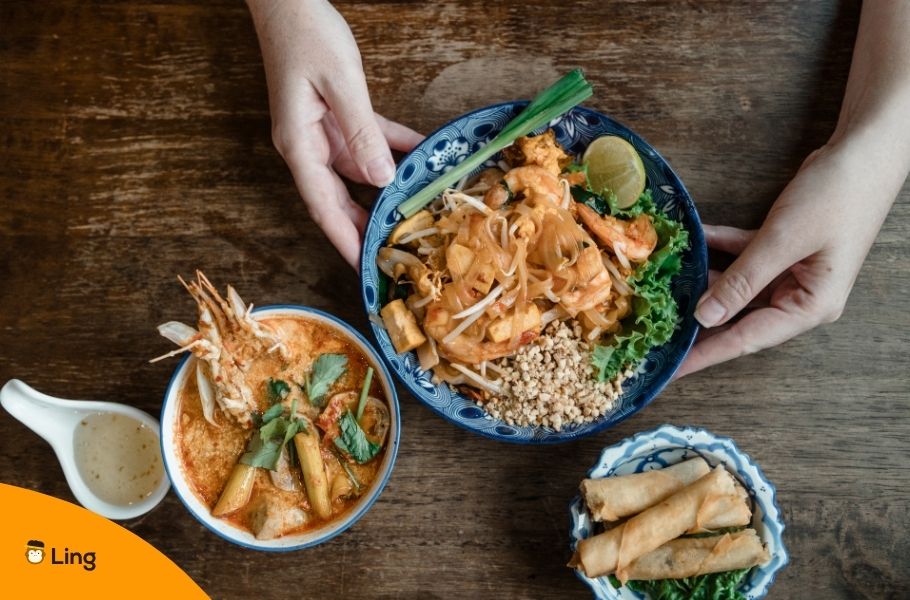
The Thai belief is that knocking on your plates or bowls when eating is a call for spirits to join you for a meal.
The real reason: The secret is plain and simple: good table manners. Parents used this as an excuse to get kids to knock off the habit of making unwanted noise at the table.
Do Not Leave Your Clothes To Dry Overnight
In Thai folklore, Krasue (กระสือ) is an evil spirit that has the form of a floating female head with hanging entrails. She goes hunting for fresh blood and meat at night and cleans her mouth using the clothes that are left to dry outside. Creepy, isn’t it?
The real reason: Leaving your clothes out to dry at night means you may miss it if it rains at night. Also, your clothes could get dusty and dirty.
What Is The Main Religion In Thailand?
Buddhism, at about 94% of the population, and almost all of it Theravada. Islam is second at about 5%, concentrated in the south near the Malaysian border, and Christianity accounts for roughly 1%.
What Are Thai People Superstitious About?
Everyday habits, mostly. Common ones are not singing in the kitchen, not sleeping with your headboard facing west, not playing hide and seek after dark, not clipping your nails at night, not knocking your plate while eating, and not leaving laundry out overnight.
What Is The Krasue In Thai Folklore?
Krasue is a spirit that appears as a floating female head with its entrails hanging below it. She is said to hunt for fresh blood and meat at night, and to clean her mouth on clothes left outside to dry. That is the reason given for bringing laundry in before dark.
Want To Learn Thai? Learn With The Ling App Now!
Beliefs like these are much easier to follow once you can read a shrine sign or ask what a custom means. Thai is a good language to pick up for exactly that reason, and a few minutes a day is enough to start.
- Writing lessons that take you through the Thai alphabet
- Flashcards with images, translations and native speaker audio
- Dialog, for interactive conversation practice
- Mini-games that cover quizzes, matching, listening and sentence sorting
Plans start at $16.99, with $64.99 and $89.99 options, and there is a 7-day free trial if you want to look around first.
If Thailand is on your list, start learning the Thai language with Ling today.