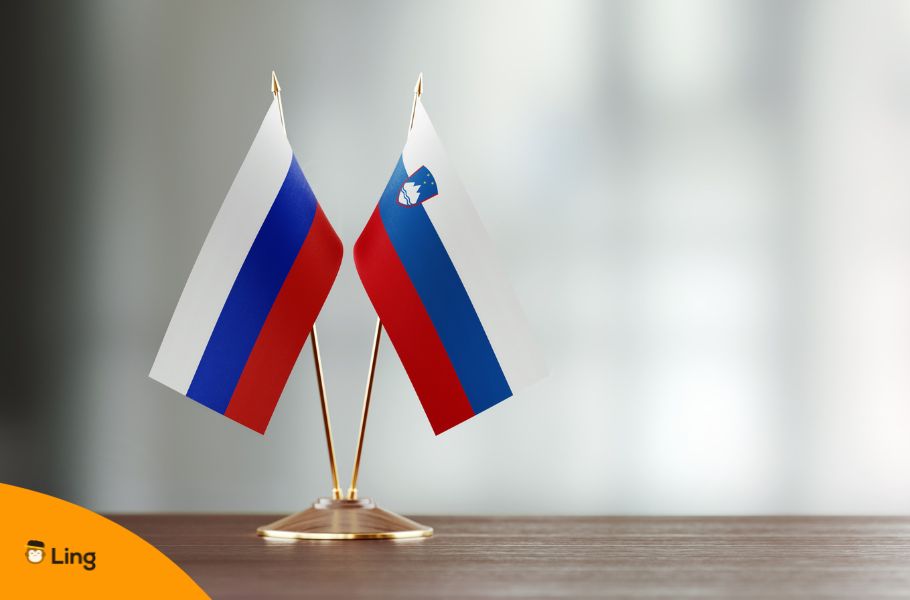
Slovenian and Russian are both Slavic languages, so they share quite a few similarities. But how alike are they really? Despite their common roots, they have some interesting differences in pronunciation, grammar, and even the alphabet they use.
This Slovenian vs Russian guide is for anyone who is curious about what makes these two languages so similar and what sets them apart. We’ll explore six key differences and similarities, with some surprising word comparisons along the way. And if all this sparks your interest in learning Slovenian or Russian, you can explore both languages with the Ling app.
I want to learn even more languages with Ling!
Download now!
Slovenian Vs Russian: Are They Similar?
As a native Slovenian speaker, I’ve lost count of how many times people have asked me if I can understand Russian. The answer? When someone is speaking, barely anything! But some Russian words seem surprisingly familiar to me, and others are even exactly the same.
Today, Russian has over 150 million native speakers worldwide, while Slovenian has only around 2.4 million. But just how similar are these two languages? Here’s a quick comparison:
| Feature | Slovenian | Russian |
|---|---|---|
| Language branch | South Slavic | East Slavic |
| Alphabet | Latin | Cyrillic |
| Grammatical cases | 6 | 6 |
| Grammatical numbers | Singular, dual, plural | Singular, plural |
| Main country | Slovenia | Russia |
Where Do Slovenian And Russian Come From?
Slovenian and Russian both developed from Proto-Slavic, a common ancestor of today’s Slavic languages that existed until the 6th-7th centuries AD. As Slavic-speaking communities spread across Europe, their languages gradually developed in different directions and formed three main branches.
Slovenian belongs to the South Slavic branch, alongside Croatian, Serbian, Bulgarian, and Macedonian. Russian, on the other hand, is an East Slavic language, together with Ukrainian and Belarusian. The third group is the West Slavic languages, which includes Polish, Czech, and Slovak.
So, although Slovenian and Russian belong to different branches of the Slavic family tree, their shared history explains why they still have so much in common.

What Are The Key Differences And Similarities Between Slovenian And Russian?
What exactly makes Slovenian and Russian alike, and where do they differ? Some of their differences include their alphabets, Slovenian’s dual number, and the languages’ sound patterns. Some similarities, on the other hand, are that they both have 6 grammatical cases, some shared vocabulary, and more.
Let’s explore six interesting features of these two languages, including some similarities you might not expect!
1. Alphabet: Latin Vs Cyrillic
Slovenian uses the Latin alphabet, whereas Russian uses the Cyrillic alphabet. The Slovenian alphabet has 25 letters, while Russian has 33.
For example, the word “water” is written as voda in Slovenian and вода (voda) in Russian. The words are basically the same, but the different writing systems make them look quite different.
2. Grammar: Six Cases In Both Languages
Both Slovenian and Russian have six grammatical cases and three grammatical genders: masculine, feminine, and neuter. This means nouns, adjectives, and pronouns change their forms depending on their role in a sentence.
However, the two languages don’t always use cases in the same way, and their grammatical endings can differ considerably. Even international words shared by Slovenian and Russian can have different grammatical genders.
3. Dual Number: A Special Feature Of Slovenian
Unlike Russian, Slovenian has a dual grammatical number, which means it uses special pronouns and verb forms when talking about exactly two things or people. This feature is not found in many other languages.
For example, in Slovenian, jaz grem means “I am going”, midva greva means “we two are going”, and mi gremo means “we are going” (three or more people). Russian uses мы (my) for “we” when talking about either two or more people.
4. Vocabulary: Similar Words And False Friends
Slovenian and Russian share many words thanks to their common Slavic roots. Some have the same meaning, but others are false friends, meaning they look or sound similar but mean something completely different. Here are a few examples:
| Slovenian Word | Russian Word | Meaning In Slovenian | Meaning In Russian |
|---|---|---|---|
| voda | вода (voda) | water | water |
| brat | брат (brat) | brother | brother |
| nos | нос (nos) | nose | nose |
| ponos | понос (ponos) | pride | diarrhea |
| stol | стол (stol) | chair | table |
| mir | мир (mir) | peace | world |
| čas | час (chas) | time | hour |
| nedelja | неделя (nedelya) | Sunday | week |
| slovo | слово (slovo) | farewell | word |
The word ponos is a particularly funny example: something to be proud of in Slovenian has a rather unfortunate meaning in Russian.
5. Sound Patterns: Why Do Slovenian And Russian Sound Different?
Although Slovenian and Russian share the same Slavic roots, they sound quite different because they developed separately for centuries, surrounded by different languages and cultures.
Slovenian was influenced by German, particularly Austro-Bavarian dialects, as well as Italian and Hungarian. Russian, meanwhile, developed through contact with French and Turkic languages. You can hear traces of this history in the way people speak both languages today.
6. Politeness: How Do You Say “You”?
Both Slovenian and Russian have formal and informal ways of saying “you”. In Slovenian, you’d use ti when talking to friends, family, or someone you know well, and vi is used in more formal situations, like when speaking to strangers or older people.
It’s much the same in Russian. Ты (ty) is informal, and вы (vy) is formal. In both languages, the formal version is also used when addressing a group of people, regardless of how well you know them.
Are Slovenian And Russian Mutually Intelligible?
No, Slovenian and Russian are not mutually intelligible. They might belong to the same language family, but that doesn’t mean their speakers can easily understand each other.
Over the centuries, the two languages have developed their own vocabulary and pronunciation. Some words that look or sound familiar may even have completely different meanings, which can easily lead to misunderstandings.
Is Slovenian Harder Than Russian?
Not necessarily, although Slovenian grammar can be a little harder because it has retained the dual number, which Russian has lost. Both languages can also be challenging for English speakers because much of their vocabulary is unfamiliar, unlike Romance languages, which share many Latin-derived words with English.
Ultimately, how hard Slovenian is to learn compared to Russian depends on your native language and previous experience with Slavic languages.
Tips For Learning Slovenian As A Russian Speaker
Knowing Russian gives you a useful head start when learning Slovenian. Here are a few self-study tips for learning Slovenian:
- Learn common beginner Slovenian phrases you can use in everyday conversations.
- Keep a list of false friends, like for example stol, which means “chair” in Slovenian but “table” in Russian.
- Practice the dual by describing things you have two of.
- Compare Slovenian and Russian noun endings in the same grammatical case.
- Read short Slovenian texts and highlight familiar as well as unfamiliar words.
- Use Ling’s Slovenian native speaker audios to get used to natural speech.
- Repeat new phrases aloud to improve your pronunciation.
Frequently Asked Questions About Slovenian Vs Russian
Is Slovenian Closer To Russian Or Croatian?
Slovenian is closer to Croatian than Russian, as they are both South Slavic languages.
Do Slovenian And Russian Share The Same Script?
No, Slovenian uses the Latin script and Russian uses the Cyrillic script.
Can Slovenians Speak Russian?
Most Slovenians don’t speak Russian unless they’ve learned it at some point. Some study it at university or out of personal interest, while a small number speak it because of their Russian family background.
How Similar Are Slovenian And Russian?
Slovenian and Russian are both Slavic languages, so they share some vocabulary and grammatical features. However, Slovenian belongs to the South Slavic branch and uses the Latin alphabet, while Russian is East Slavic and uses Cyrillic. Despite their common roots, the two languages are not mutually intelligible.
Slovenian Vs Russian: Final Thoughts
So, how similar are Slovenian and Russian? They share Slavic roots, six grammatical cases, and some surprisingly familiar vocabulary. However, their different alphabets, pronunciation, and Slovenian’s unique dual number make them quite distinct. Even similar-looking words don’t always mean the same thing!
If you speak Russian and are wondering how to learn Slovenian, your existing knowledge can certainly help. Just remember to pay attention to false friends, practice the dual, and listen to spoken Slovenian regularly. It shouldn’t take long before you can hold a basic conversation.
Start Learning Slovenian With The Ling App
Knowing one Slavic language can be a big plus when learning other Slavic languages. So, if you already speak Russian, why not give Slovenian a try? And even if you’re completely new to Slavic languages, there’s no reason not to explore something new.
You can learn Slovenian with the Ling app through bite-sized lessons, interactive exercises, and fun challenges. Build your vocabulary, practice useful everyday phrases, and learn how to introduce yourself, order food, ask for directions, and much more in Slovenian.
Download the Ling app and start your language journey today!