You’ve probably just discovered that there is no Slovenian on Duolingo. This can feel really frustrating for people trying to learn the language for various reasons.
Luckily, you don’t need to wait for Duolingo to add Slovenian. The Ling app already offers a full Slovenian course aimed at beginners and intermediate learners. With short interactive lessons and native speaker audio, Ling helps you start speaking and understanding Slovenian in real-life situations.
Keep reading to learn more about what it’s like to learn Slovenian and why Ling is currently the best alternative out there!
I want to learn even more languages with Ling!
Download now!
Why Is There No Slovenian On Duolingo?
Duolingo has not publicly explained why it doesn’t offer a Slovenian course. One of the main reasons could be that Slovenian has a smaller global speaking base, so it may not have as many learners as Spanish or French, for example.
Other than that, building a course takes time, expertise, and volunteers, and Duolingo’s volunteer Incubator program is now closed, which leaves them with fewer options for new courses.
Is Slovenian Hard To Learn?
Yes, Slovenian is considered hard for English speakers. According to the Foreign Service Institute (FSI), Slovenian falls into Category IV, which includes languages with significant linguistic and cultural differences from English. They estimate it takes about 44 weeks, or roughly 1,100 hours, to reach general proficiency in speaking and reading.
That said, if you’re already a speaker of another Slavic language, or generally don’t have issues with picking up linguistic nuances, it can be a lot easier. In any case, it’s not impossible to learn and only requires consistent practice and exposure.
How Complex Is Slovenian?
Slovenian has a few grammar features that can be challenging for beginners:
- Six grammatical cases: Word endings change depending on their role in a sentence. For example, ženska (woman) becomes žensko in the accusative case.
- The dual form: Special forms are used when talking about exactly two people or things.
- Three grammatical genders: Nouns are masculine, feminine, or neuter.
Unique Features
Slovenian uses a dual form, which is very rare in world languages. Instead of singular or plural, you use it when talking about exactly two things or people. Slovenian also has three grammatical genders for every noun. Adjectives must match the gender of the noun.
Beginner-Friendly Aspects
The good news is that words in Slovenian are pronounced exactly as they are written, which makes reading predictable once you know the sounds. Slovenian sentence structure is simple and allows you to start speaking quickly. You can start having everyday conversations without mastering all the grammar at once.
What Common Mistakes Do Beginners Make When Learning Slovenian?
Here are the most common mistakes beginners make when learning Slovenian:
- Using the wrong word endings for nouns, adjectives, and pronouns because of the case system.
- Mixing up formal and informal language, which can make you sound rude or overly distant.
- Forgetting to use the dual form when talking about two things or people.
- Pronunciation, especially letters like Č, Š, Ž, and rolling the R.
- Confusing noun genders, which leads to mismatched adjectives.

Duolingo Vs Ling: Which One Supports Slovenian?
Both Duolingo and Ling make language learning fun and accessible. The key difference is that Ling offers a much wider range of languages, including many that Duolingo doesn’t, like Slovenian.
Here’s a quick comparison:
| Feature | Ling | Duolingo |
|---|---|---|
| Slovenian course | Yes | No |
| Languages | 70+ languages | 40+ languages |
| Lesson format | Short, interactive lessons | Short, gamified lessons |
| Audio | Native speaker audio | Text-to-speech and recorded audio |
| Conversation practice | Dialogues and speaking exercises | Speaking and listening exercises |
| Gamification | Games, streaks, and achievements | Streaks, points, and challenges |
| Best for | Slovenian and underserved languages | Widely spoken languages |
Bottom line: If your goal is learning Slovenian, Ling supports it fully, while Duolingo does not. If you want to compare more options, check out our guide to the best apps for learning Slovenian.
The Best Alternative To Duolingo For Learning Slovenian
Since there’s no Slovenian on Duolingo, Ling is the best choice for learners who want a practical, interactive, and fun way to study the language.
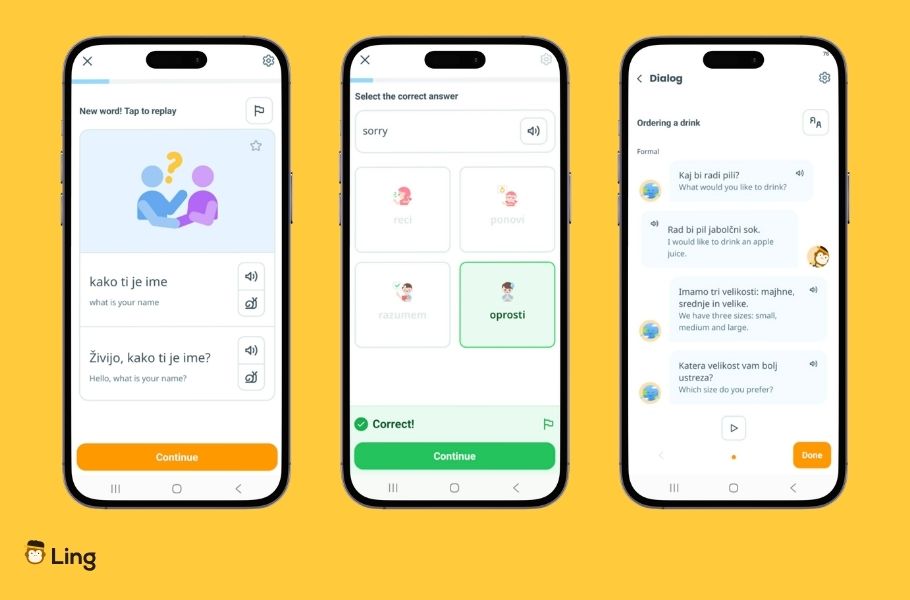
Key Features For Learning Slovenian
- Gamified lessons that make learning easy to stick with.
- Native speaker audio for correct pronunciation.
- A dialog feature for practicing real-time conversations.
- Review tools to reinforce what you’ve learned.
- Voice recognition to help you correct your speaking mistakes.
- Simple grammar lessons.
Who Is The Ling App Best For?
Ling is the best app for anyone who wants to use the language in real life. It was designed for people who want to:
- Communicate with their partner and their family.
- Use the language at work or in professional settings.
- Travel confidently and interact with locals.
- Reconnect with their roots and speak with relatives.
- Learn new languages in a fun way.
Why Serious Learners Choose Ling
These reviews come from people who used the Ling app for travel, work, and everyday conversations, and noticed the difference quickly:
”I’ve been looking for an app to sub out for Duolingo. Instantly, I knew that I made a good choice. The conversational parts are wonderful. To see and hear how people talk, rather than learning random words with little context.”
-Aisling Pedrotti
”Ling has been a game-changer for me! I started learning Italian for a vacation to Rome and ended up speaking fluently with locals at cafes. Then, I tackled German for a work trip to Berlin, and it was a breeze! The app is super intuitive, and the lessons feel like you’re just having a fun conversation. I also picked up some Korean before visiting Seoul, and it made the experience so much better. Can’t recommend it enough for anyone looking to learn a language quickly and effectively!”
-Khant Zaw Hein
What You’ll Achieve In Your First Week Using Ling
Ling offers a 7-day free trial with the annual plan. In such a short time, you can already start learning basic everyday words and phrases along with how they are pronounced. Here is a table of what you can expect in a week while taking Ling’s short lessons:
| Day | What You Can Learn | Examples From Ling’s Slovenian Course |
|---|---|---|
| Day 1 | Basic Slovenian words and phrases | I am from the USA – Sem iz Združenih držav Amerike |
| Day 2 | Basic sentences | I learn German – Učim se nemško |
| Day 3 | Numbers and family | We are a family of four – Smo štiričlanska družina |
| Day 4 | Counting | I live in building number eight – Živim v stavbi številka osem |
| Day 5 | Activities | I like swimming – Rad plavam |
| Day 6 | Food and tastes | This is very sweet – To je zelo sladko |
| Day 7 | Vegetables and fruits | We have vegetable soup – Imamo zelenjavno juho |
After mastering the basics, you can continue on to more challenging aspects and learn harder sentences. All of the courses in Ling are designed to help you speak right away.
Frequently Asked Questions About Duolingo And Slovenian Apps
What Is The Best App To Learn Slovenian?
The best app to learn Slovenian is the Ling app, because it offers structured lessons, pronunciation practice, and interactive exercises designed for beginners and early learners.
What App Is Better Than Duolingo?
Ling is a strong alternative to Duolingo, especially for learners interested in underserved languages. It offers 70+ languages, including Slovenian and many Asian and Eastern European languages that are less commonly supported by mainstream language learning apps.
Is There A Slovenian Course On Duolingo?
Duolingo doesn’t currently offer a Slovenian course. If you want to learn Slovenian with a language app, Ling is a strong alternative, with interactive lessons, native speaker audio, pronunciation practice, and exercises focused on practical language skills.
How Long Does It Take To Learn Slovenian?
The US Foreign Service Institute classifies Slovenian as a Category IV language, which means it can be quite difficult for English speakers. It typically takes around 44 weeks, or roughly 1,100 hours of study, to reach general proficiency. That’s a serious time commitment, but consistent practice can help you make steady progress.
Start Learning Slovenian With Ling (7-day Free Trial)
Even though Duolingo doesn’t support Slovenian, there is no reason to wait or compromise. Ling gives you full access to Slovenian with practical lessons, native-speaker audio, real conversation practice, and tools that help you remember what you learn.
You already know the language is not the easiest one, but with the right app, it becomes manageable and even enjoyable!
Try the Ling app with a 7-day free trial (with the annual plan) and see how much you can learn in just a week. Ling is trusted by more than 5 million learners worldwide and is highly rated on both the App Store and Google Play.
Download the Ling app now and start learning Slovenian with confidence today.