

I’ve been living in Thailand for almost four years now, and something finally clicked. For years, I stayed in what we call “the expat bubble,” working in English, socializing in English, ordering food in English. Living here didn’t automatically make me fluent because I didn’t create the conditions for it.
But recently, everything changed when I started being consistent and deliberate about practicing. Now, when I go out and speak to locals in Thai, I’m actually having real conversations, which makes me feel much happier and more comfortable.
Here’s what nobody tells you about remote work language learning: just being in the country doesn’t mean you’ll actually learn the language.
I want to learn even more languages with Ling!
Download now!
In January 2026, I talked to my team at Ling (we’re a language-learning company based in Chiang Mai). Some of us relocated to Thailand from different countries. We’ve been here anywhere from four months to seventeen years.
The results were interesting:
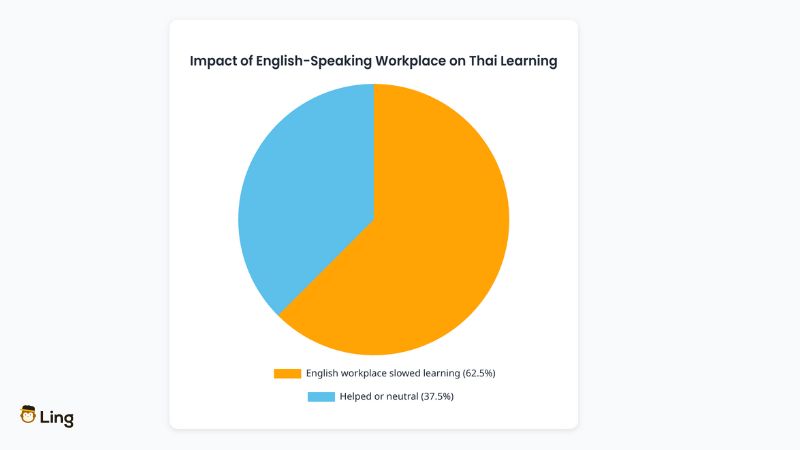
62.5% of us said our English-speaking workplace actually slowed our Thai learning.
— Ling Team Survey, January 2026
Lindsay, our Digital PR Manager, has lived here for seventeen years. She rates her Thai fluency at 3 out of 10.
Meanwhile, our CEO, Simon, reached a 7/10 after ten years, and that is because he has immersed himself in the language quite a lot. He’s married to Khwan, Ling’s Thai co-owner, and deliberately sought out situations where English wasn’t an option.
So, do you learn languages faster abroad? Yes, absolutely. But most people don’t. And understanding why makes all the difference between becoming fluent in months or staying stuck for years.
This article breaks down what actually works based on our team’s real experiences, what slows remote workers down, what accelerates learning, and how to avoid the mistakes that kept me at the beginner level for three years.
What Our Team’s Experience Revealed
Here’s what stood out when talking to Ling team:
- 62.5% said English-speaking workplaces slowed language learning
- Average fluency: 3.8/10 despite years of residence
- 87.5% found apps + daily immersion more effective than either alone
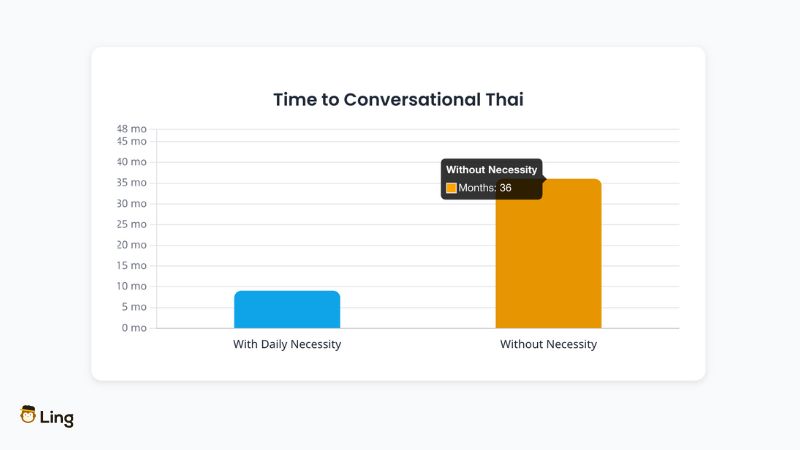
- 6-12 months to conversational with daily necessity
- Years or never without linguistic necessity
What research says: These patterns mirror findings from Collentine & Freed (2004) showing that immersion effectiveness depends heavily on the quality of exposure, not just geographic location.
The English Bubble Is More Comfortable Than You Think
When people dream about moving abroad, they imagine themselves ordering street food in perfect Thai, joking with locals, maybe even dreaming in their new language.
The reality? You’ll probably find yourself in a coworking space surrounded by other foreigners, working for a company that operates in English, and grabbing drinks at expat bars after work.
It’s comfortable. It’s easy. And it’s exactly what keeps you from learning.
Research from the Foreign Service Institute says English speakers need about 1,100 hours to reach professional proficiency in Thai. That’s a Category IV language, one of the harder ones.
But here’s what those numbers don’t account for: whether you actually need to speak Thai (or another language) in your daily life.
And many people don’t.
Why Remote Work Language Learning Requires Extra Intention
Remote workers and expats who work for international companies have a specific advantage: we chose this life. We moved abroad for adventure, for new experiences, for that “living like a local” feeling.
But here’s the reality for most of us working in Thailand: our jobs are in English. Whether you’re a digital nomad freelancing from a coworking space or an expat sent by a multinational corporation, the pattern is the same.
A digital nomad in Thailand works at an English-speaking company. His boss is American. His deadlines are in GMT-8. That’s fine; it’s what allows him to live here in the first place. But it also means Thai won’t just “happen” to him. He has to create opportunities for it outside of work.
The “organizational bubble” affects everyone. It’s a term for expatriates sent by corporations who end up in prearranged housing, international schools, and company social events, all in English.
But we remote workers create the same bubble for ourselves. We choose coworking spaces full of other English speakers. We live in expat neighborhoods. We socialize with other foreigners.
The key insight: This isn’t a problem to solve but a reality to work around. Whether you’re here on a corporate package, startup, building your own business, or working remotely, if your daily work is in English, you’ll need to deliberately create opportunities to practice Thai outside of work hours.
That’s what separates people who learn from people who don’t, intentionality.
When Living Abroad Actually Works: The Necessity Factor
Here’s the truth about learning languages faster abroad: it accelerates when you create a genuine necessity.
Punya joined our team two years ago and moved to Thailand from India nine months ago. Her name sounds Thai, so when Grab drivers call her, they launch into rapid Thai. At first, it shocked her.
“I’d panic and switch to English immediately,” she told me. “But then I realized, they’re giving me free practice. Drivers don’t really care if I make mistakes.”
Now, when delivery agents call, she answers in Thai. Sometimes it’s clumsy. Sometimes she has to ask them to repeat things three times. But she’s learning and trying her best.
Simon, our CEO, figured this out years ago. As he married into a Thai family, his in-laws don’t speak English, and his kids are growing up bilingual. “I had to learn,” he said. “Not for work, for family.”
That’s the difference between people who learn and people who don’t: genuine necessity.
By the numbers: According to Ling’s internal data, 955 users started learning Thai in 2025 specifically because they were moving to Thailand. But wanting to learn and actually learning are different things—as our survey shows, environment matters more than motivation.
The Korean Example Comparison: When Work Forces Fluency
I know something about this because I lived in Korea for almost four years. I was a KGSP (Korean Government Scholarship Program) student, which meant the Korean government paid me to be there, learn the language, get my degree, and then get a job in Korea.
You’d think I’d have amazing Korean skills, right? I don’t. My Korean is embarrassingly basic compared to friends who haven’t been to Korea or people who spent less time there but actually worked at Korean companies. Because in Korea, unlike Thailand, most of the workplace culture demands language proficiency.
Korean companies don’t operate in English. Meetings are in Korean. After-work dinners—hoesik (회식)—are conducted entirely in Korean. If you want to be part of the team, you learn to truly become part of Korean society, and that starts with the language.
I reached TOPIK level 3 out of 6 during my studies (enough for classes and daily survival). But then I met other international students. We became each other’s comfort zone. We spoke English together. We created our own bubble inside Korea.
And day by day, my proficiency in Korean gradually declined.
Now in Thailand, I was watching the same pattern start to form. The difference is, this time I’m aware of it. And awareness is the first step to changing course. So I turned it around to avoid making the same mistake again. This time I will get to fluency.
The Eastern European Wild Card
My friend who moved to Belgrade had a different experience entirely. Serbian isn’t taught in American schools. There’s no Serbian content on Netflix. She couldn’t order food delivery without learning basic phrases. Within six months, she was conversational.
Cities like Belgrade, Tirana, and Zagreb don’t have the English infrastructure that Bangkok has. When you need to rent an apartment, you’re reading Serbian contracts. When you open a bank account, the forms are in Albanian. When you shop at Croatian markets, vendors speak Croatian.
This is the “learn languages faster abroad” that people imagine, the total immersion where necessity drives results.
But it only works in places where English isn’t everywhere.
What Actually Makes You Learn Languages Faster Abroad
After reading all my teammates’ responses and comparing our experiences, I came to the conclusion that three things separate people who learn fast from people who don’t:
1. You Put Yourself In Situations You Can Almost Understand
Adam has been here three years (same as me). His Thai is also basic. But he told me something interesting: “The times I learn most are when Grab drivers call and give me weird directions. I’m panicking, trying to figure out which soi they mean, and somehow my brain just… absorbs it.”
(Soi is Thai for “street” or “alley”—these numbered side streets make up Bangkok’s address system.)
That’s what language researchers call “comprehensible input” (Krashen, 1982)—language that’s challenging but not impossible.
Living abroad gives you this naturally. If you let it.
When your taxi driver gestures at landmarks while explaining directions, your brain connects Thai words to their real meaning faster than any textbook could teach you. When vendors at the market hold up produce and say prices, you’re learning numbers through context.
But only if you don’t immediately pull out Google Translate or other tools!
2. You Stop Caring About Looking Stupid
Every single person I surveyed said the same thing: fear of mistakes was their biggest barrier. And I agree.
Punya put it perfectly: “I waited to use Thai until my tones were perfect. That was a mistake. I should have started speaking immediately. Thai people are kind. They always help you.”
She’s right. I’ve noticed this too. When I try to speak Thai, even badly, locals light up. They don’t laugh at my mistakes. They gently correct me. Sometimes they’ll spend five minutes teaching me the right word, practicing it with me until I get it.
But if I stay silent, I learn nothing.
Research backs this up. Stress inhibits language learning. People who choose to move abroad (rather than being assigned by their company) typically learn faster because they’re excited, not anxious. They have “countryphilia”—genuine love for their adopted home (Krashen, 1982).
That emotional connection? It matters more than grammar rules.
3. You Actually Need The Language To Function
This is the honest truth: when the local language is optional, it’s incredibly easy to skip it.
Lindsay has been in Thailand for seventeen years. When I asked about her Thai learning journey, she told me something that really resonated: “Everyone speaks English or wants to practice English with me.” I imagine that Lindsay and many others haven’t had enough situations where they had to use Thai, or else there was no other way to communicate.
Thailand’s infrastructure, especially in Chiang Mai and Bangkok, is incredibly accommodating to English speakers. You genuinely can navigate everything—work, housing, healthcare, social life—without speaking Thai. It’s not laziness. It’s just reality.
It was, in fact, one of the most shocking things for me when I arrived, as I was used to my daily life in Korea, where no one would understand basic English sentences (unless I was in Itaewon, a more international neighborhood).
Compare that to Dumith’s experience. He joined us from Sri Lanka seven months ago and became friends with locals whose English is basic. When they hang out, Thai is the only option. “I have no choice,” he told me. “If I want to be part of the group, I have to speak.”
The difference isn’t effort or ability; it’s necessity.
Lindsay’s environment made Thai optional for seventeen years. Dumith’s or Simon’s environment made it necessary from day one. Neither is right nor wrong. But if you want to learn faster, you need to mimic a situation where you are forced to speak the local language every single day, even if your environment naturally gives you an option.

How Long Does Learning Languages Faster Abroad Actually Take?
The FSI says 1,100 hours for Thai. That’s approximately two to three years if you study one hour per day.
But that assumes classroom learning. Remote work language learning is different because you’re (theoretically) surrounded by the language constantly.
What Our Team’s Experience Shows
Here’s the reality from eight people actually living it:
Average fluency rating: 3.8 out of 10
Time in Thailand: 4 months to 17 years
Average study time: 2-3 hours per week
Time to handle basic daily tasks: 1-12+ months (wildly variable)
The pattern we found:
With daily necessity (Thai workplace, Thai partner, non-English-speaking neighborhood):
- 6-12 months to conversational
- Actually use the language multiple times per day
- Can’t avoid practicing
Without daily necessity (English workplace, expat neighborhood):
- 2-3+ years to basic conversation
- Many never reach conversational level despite years of residence
- Easy to avoid using Thai entirely
The App-Plus-Immersion Sweet Spot
Here’s what actually works: apps plus deliberate daily practice.
87.5% of us said this combination beat either method alone.
— Ling Team Survey, January 2026
I’ll be honest, I haven’t been using Ling every day as I should. That’s changing now. Because apps give you the structure (grammar, vocabulary, writing systems), and then living abroad gives you the practice field.
Simon uses Ling plus Anki, practices with his wife and nanny, who are Thai, and took some classes. His biggest regret? “Not using the app every single day. Consistency matters more than intensity.”
Expected learning timelines based on FSI data and immersion research:
For Category IV languages like Thai:
- FSI classroom estimate: 1,100 hours = 2-3 years at 1 hour/day
- Living here WITH necessity: 6-12 months to conversational
- Living here WITHOUT necessity: Many never reach conversational level
- Apps + immersion + intention: 6-10 months to functional speaking
For Category V languages like Korean:
- FSI classroom estimate: 2,200 hours = 3-4 years at 1 hour/day
- Living in Korea (Korean workplace): 8-15 months to business proficiency
- Living in Korea (English workplace): Significantly longer
Data sources: Foreign Service Institute Language Difficulty Rankings and Ling Team Survey (January 2026)
The Mistakes We All Make (And How To Stop Making Them)
The Expat Bubble Is Real And Powerful
Every single one of us admitted that we stayed in expat bubbles at some point.
Bangkok and now even Chiang Mai have neighborhoods where you never hear Thai. Coworking spaces full of digital nomads speaking English. Restaurants with English menus. Gyms with English-speaking trainers.
You can live here for years without speaking Thai. It’s not a matter of being bad at learning languages, just that there’s not enough opportunity to practice.
Adam realized this and moved to a different neighborhood far from expats. “Living away from other foreigners was probably the second most impactful choice I made,” he said.
More than avoiding other expats all the time, it’s about deliberately diversifying your circle.
Join Thai sports leagues. Volunteer at community centers. Shop at local markets instead of expat grocery stores. Yes, it can be uncomfortable at first. But discomfort is where learning happens.
We Ignore The Script
Many expats speak decent conversational Thai but can’t read a single Thai letter.
This seems fine until you need to:
- Read addresses
- Navigate BTS stations in neighborhoods without English
- Understand government documents
- Text with Thai friends
- Read restaurant menus at local places
Learning to read opens up a whole new level of independence.
Ling teaches the Thai script with interactive tracing exercises. It takes maybe 2-3 weeks to learn the basics if you practice 15 minutes daily. That’s nothing compared to the years you’ll live here.
(Same for Korean Hangul, Serbian Cyrillic, or any other script that seems intimidating at first.)
We Wait For Perfect Before We Start Speaking
This is the killer. I waited. I wanted my tones to be right. I wanted to know enough words to have a “real” conversation. I didn’t want to embarrass myself.
All that waiting did was keep me at a beginner level for three years.
Punya just started speaking. Messy, imperfect, wrong-tone Thai. And you know what happened? People helped her. They appreciated the effort, and she learned even faster.
Your mistakes are not embarrassing. They’re evidence you’re trying.
And that’s what locals respond to, not perfection, but effort.
Why This Matters Beyond Just Language
Learning the local language changes everything.
Research shows that multilingual workers earn about 20% more than their monolingual counterparts. For highly educated professionals, that premium can reach 50% (Language wage premium data).
But honestly? That’s not why it matters to me.
It’s About Belonging
Different research on expatriate mental health shows that expats experience higher rates of depression and loneliness compared to people in their home countries. I’ve felt this. The loneliness of being foreign, even in a country you love.
Learning Thai is one of the fastest ways to combat that feeling.
When I speak Thai with the cleaning staff in my building, even just basic greetings and “how are you,” I feel less like a foreigner. When I can ask vendors at the market about their products, I’m not just a transaction anymore.
Punya told me, “Learning Thai boosted my confidence so much. Living in a new country isn’t intimidating anymore because I can handle challenges. That impacts your mental health more than you’d think.”
She’s right.
Language creates what sociologists call “social capital”—the relationships and networks that make life richer (Portes, 1998).
When you speak the language:
- Locals treat you differently (better)
- You make real friends, not just acquaintances
- You discover the “secret” Thailand that tourists never see
- You feel like you actually live here, not just visit for an extended period
Lindsay put it simply: “You don’t get ripped off. Locals treat you nicer. You learn there are secret menu items at every restaurant.”
Those small things add up to a completely different life. It’s like a whole new world opens to you when you finally understand, as the locals do.
It’s About Career Security Too
During COVID-19, expats with local language skills kept their jobs at much higher rates than English-only speakers (IOM World Migration Report, 2022).
For remote workers, this matters. What happens if your remote contract ends? If you speak Thai, you have access to the entire Thai job market. If you don’t, you’re limited to international companies and positions specifically for foreigners.
Language proficiency is career insurance.
In Korea, for example, KGSP graduates who speak fluent Korean have dramatically more job options than those who stayed in English-speaking bubbles during their studies.

What You Can Actually Do About This
If you’re planning to move abroad, or you’re already living abroad and feeling stuck:
Before You Go: Build A Foundation
Don’t arrive with zero language knowledge.
The first few weeks are stressful enough, finding housing, setting up utilities, and navigating a new city. If you can’t even say “where is” or “how much,” you’re making everything harder.
Spend 3-6 months with the Ling app before your flight.
Learn:
- Greetings and basic politeness (khrap/ka in Thai, 감사합니다 in Korean)
- Numbers (for prices, addresses, phone numbers)
- Essential questions (“Where is…?” “How much?” “Do you speak English?”)
- Transportation vocabulary
- Food basics
Ling’s lessons take 10-15 minutes. If you practice daily for three months before moving, you’ll arrive able to handle basic survival. That confidence makes everything else easier.
Punya’s advice: “Start by watching videos in your target language. Just listening to the sound helps you recognize words later. You’ll be more equipped to identify a few words in sentences when you’re a complete beginner.”
After You Arrive: Create Necessity
This is the fun part. You get to engineer situations that force you to practice.
Make rules for yourself:
- Speak Thai at markets (even if vendors speak English)
- Take Thai taxis instead of Grab (where you can message in English)
- Join Thai hobby groups, not expat versions
- Live in neighborhoods with fewer foreigners
- Make Thai friends who don’t speak perfect English
Adam moved to a neighborhood with almost no expats. It forced him to figure things out in Thai.
Daily Practice Without “Studying”
The beauty of living abroad is that every activity can be practiced:
Join LINE groups (in Thailand) or KakaoTalk groups (in Korea) for language exchange. Many locals want to practice English, trade 30 minutes of Thai for 30 minutes of English.
Consume local media: Thai series on Netflix, Korean variety shows, podcasts, YouTube channels. Put on subtitles in the target language, not English.
Keep a tiny notebook. When someone says a word you don’t know, write it down phonetically. Look it up later. Use it in your next conversation.
Talk to service workers. Building security, 7-Eleven cashiers, motorcycle taxi drivers; they’re paid to be there anyway. Ask them questions. Most people are happy to help you practice.
Use Ling’s gamified lessons. Seriously. 10-15 minutes per day adds up. Simon’s biggest regret was not doing this consistently.
The 87.5% Solution
Remember that stat from our survey? 87.5% of us said apps plus daily immersion with locals worked better than either method alone.
You need both:
- Apps give you structure: grammar, vocabulary, writing systems, and pronunciation practice
- Immersion gives you application: real conversations, context, cultural understanding, and motivation
Neither alone is enough for remote work language learning. Together, they’re powerful.
Real Talk: It’s A Process
I’m not going to pretend this is easy. After almost four years in Thailand, I’m still working on my Thai. And I’m still in the process.
But here’s what I’m doing differently now:
I’m using Ling every single day. 15 minutes in the morning with coffee. Non-negotiable.
I’m actively seeking opportunities to practice. Yesterday I went to a local restaurant with no English menu and ordered in Thai. I got half of what I wanted. But the server was so patient and helpful, and I learned three new food words.
I’m talking to my partner in Thai as much as I can. It’s a commitment to practicing speaking Thai rather than English to remove the convenience.
I’m writing down every Thai word I hear that I want to learn. My phone is full of random vocabulary notes now. gin laew (กินแล้ว – “have you eaten?”)—the most common Thai greeting. pai nai (ไปไหน – “where are you going?”)—what Thais say instead of “how are you.”
Small things. But they’re adding up.
The Team Is Doing It Too
Several of us are recommitting. We’re holding each other accountable.
Simon is back to daily Anki. Punya is watching Thai series with Thai subtitles. Adam joined a local football league where most players don’t speak English.
Because we all realized the same thing: three years from now, we’ll wish we had started today.
Your Questions Answered
Can I Really Learn Languages Faster Abroad Than In A Classroom?
Yes, but only with intention. You’ll get 3-5 hours of daily exposure compared to 1 hour in class. But you have to actively use that exposure. Our survey showed 62.5% of people in English workplaces learned more slowly than expected because they didn’t create a necessity outside of work.
How Long Does It Take To Get Conversational In A Place Like Thailand?
With daily necessity: 6-12 months. Without necessity but with consistent app practice plus deliberate conversations: 6-10 months. Without either: years, or never.
Do I Need To Know Thai To Work Remotely In Thailand?
Technically, no, if you’re working for international clients. Practically, yes, it transforms your experience. Navigation, housing, friendships, culture, mental health, and career options. Every person we surveyed said Thai improved their daily life dramatically.
What If I’m Too Old To Learn A Language?
This is a myth. Research on adult language learning shows that adults can be highly effective language learners, often outperforming children in certain aspects due to better metacognitive strategies, stronger motivation, and more life experience to draw connections. Our survey showed no correlation between age and learning speed. Motivation and consistency mattered way more.
What It All Comes Down To
Do you learn languages faster living abroad?
You can. But most people don’t.
Our survey showed a clear pattern: people who created genuine necessity—through Thai partners, local friendships, non-English workplaces, or deliberately choosing harder situations—reached conversational level in 6-12 months.
Those who stayed in environments where Thai was optional? Many never reached conversational level, regardless of how long they’ve been here.
It’s not about talent. It’s about necessity.
Our team members who joined Thai sports leagues, have Thai partners, or moved to local neighborhoods—they had to learn.
If you want to learn fast, you have to engineer necessity into your life.
Join groups where English isn’t spoken. Make friends who can’t translate for you. Move to neighborhoods with fewer foreigners. Take the harder route on purpose.
Use the Ling app to build your foundation; it teaches all the Asian and Eastern European languages that mainstream apps ignore. 10-15 minutes daily. Then immediately use what you learn in real conversations.
Make mistakes. Push through the discomfort.
Because here’s the truth I’ve learned after almost four years: the expat bubble is comfortable, but it’s also lonely.
Real belonging comes when you can joke with your building’s security guard in Thai. When you can chat with vendors at the market about their families. When you stop being “the foreigner” and become “that person who’s learning Thai.”
That’s when Thailand stops feeling like an extended vacation and starts feeling like home.
And it’s never too late to start. I’m starting now. For real this time.
Want to join me?
Survey Methodology
We surveyed 8 Ling team members who moved to Thailand for work between 2015 and 2025. They represent 5 nationalities (Ecuador, Sri Lanka, Canada, USA, Germany, and India) and have been here from 4 months to 17 years. Responses were collected via Google Forms in December 2025–January 2026. This is a small sample focused on international workers at an English-speaking tech company, which gave us specific insights into how workplace language affects learning speed.