How many people speak Croatian worldwide? Around 5.1 million people speak Croatian as a native language, according to Ethnologue’s 2025 edition as cited on Wikipedia, and another 1.3 million speak it as a second language. Censuses in six countries count about 4.28 million mother-tongue speakers, 86% of them in Croatia.
The gap comes from what each source counts. Censuses ask about mother tongue in one country in one year, Ethnologue estimates speakers worldwide, and some countries group Croatian with Serbian in their tables. This guide sets the figures side by side, shows where Croatian speakers live, and uses Ling’s learner data to show who is learning the language now.
I want to learn even more languages with Ling!
Download now!
Key Takeaways
- 5.1 million native speakers and 1.3 million second-language speakers (Ethnologue 28th edition, 2025, cited on Wikipedia, 2021 to 2023 and 2012), while worlddata.info says 5.5 million.
- About 4.28 million mother-tongue speakers in the latest censuses of Croatia (3,687,735), Bosnia and Herzegovina (515,481), Slovenia (54,079), Serbia (12,048), Hungary (8,232) and Montenegro (2,193).
- 95.25% of Croatia’s residents named Croatian as their mother tongue in 2021, more than the 91.6% who declared Croat ethnicity (Croatian Bureau of Statistics).
- 46,960 people in the United States speak Croatian at home (U.S. Census Bureau, 2017-2021), and Germany counted 413,480 Croatian citizens (Destatis).
- 14,820 people chose Croatian on Ling in the 12 weeks to Nov 15, 2026, 5% more than in the 12 weeks before, the third most of the seven Eastern European languages Ling tracks. Croatian is not on Duolingo.
How Many People Speak Croatian Worldwide?
Estimates of Croatian speakers run from about 4.28 million mother-tongue speakers in six national censuses to 5.1 million native speakers in Ethnologue’s 2025 edition, as cited on Wikipedia, and 5.5 million on worlddata.info. Adding Ethnologue’s 1.3 million second-language speakers gives about 6.4 million, but that second figure dates from 2012.
What The Data Shows
| Source | What it counts | Figure | Year |
|---|---|---|---|
| Wikipedia language infobox, citing Ethnologue (28th edition) | Native speakers (L1) worldwide | 5.1 million | 2021 to 2023 |
| Same infobox | Second-language speakers (L2) | 1.3 million | 2012 |
| worlddata.info | Mother tongue worldwide, with 3.5 million of them in Croatia and 904,000 in Bosnia and Herzegovina | 5.5 million | Not stated |
| Pimsleur’s Croatian course page | Speakers: 4.5 million in Croatia and one million in other parts of Europe, the US and Canada | 5.5 million | Not stated |
| National censuses in six countries (sum of the table below) | Mother tongue | About 4.28 million | 2002 to 2023 |
Note: The census total is a floor, not a worldwide count: it covers six countries and leaves out the diaspora elsewhere. Pimsleur’s 4.5 million for Croatia is more than the 3,871,833 people the 2021 census counted in the whole country, so that figure cannot be a count of residents who speak Croatian.
Why The Numbers Differ
Five things move the count up or down.
- Different census years. Croatia’s count is from 2021, Bosnia and Herzegovina’s from 2013 and Slovenia’s from 2002, so the six-country total mixes years.
- Grouped categories. Montenegro’s 2023 tables list Croatian (2,193) and Serbian-Croatian (12,999) as separate mother tongues, so the count depends on which categories are added (MONSTAT, 2024). The release’s own text attributes 12,999 to Croatian.
- Language is not ethnicity. In Croatia, 3,687,735 people named Croatian as their mother tongue while 3,547,614 declared Croat ethnicity. In Serbia, 12,048 named Croatian while 39,107 declared Croat ethnicity.
- Native or total. Ethnologue’s 1.3 million second-language speakers are dated 2012, a decade older than its native-speaker figure.
- Sources are dated and disagree. worlddata.info gives 904,000 speakers in Bosnia and Herzegovina with no year, while the 2013 census counted 515,481.
Where Do Croatian Speakers Live?
About 3.69 million people in Croatia, 95.25% of its 3.87 million residents, named Croatian as their mother tongue in the 2021 census (Croatian Bureau of Statistics). Bosnia and Herzegovina adds 515,481 (2013), so the two countries hold 98% of the speakers the censuses below count.
Croatian Speakers By Country
| Country | Croatian speakers | What is counted | Census year | Source |
|---|---|---|---|---|
| Croatia | 3,687,735 (95.25% of 3,871,833) | Mother tongue | 2021 | Croatian Bureau of Statistics |
| Bosnia and Herzegovina | 515,481 (14.6% of 3,531,159) | Mother tongue | 2013 | Agency for Statistics of Bosnia and Herzegovina |
| Slovenia | 54,079 (2.8% of 1,964,036) | Mother tongue | 2002 | Statistical Office of the Republic of Slovenia |
| Serbia | 12,048 | Mother tongue | 2022 | Statistical Office of the Republic of Serbia |
| Hungary | 8,232 | Mother tongue | 2022 | Hungarian Central Statistical Office |
| Montenegro | 2,193 (0.35% of 623,633) | Mother tongue | 2023 | MONSTAT |
Note: Slovenia’s figure is from 2002 because no newer data was available easily. Kosovo’s 2024 census lists no Croatian category.
Croatia
Croatia’s 2021 census counted 3,687,735 people with Croatian as their mother tongue. Serbian was the mother tongue of 45,004 people, Bosnian of 17,531, Romani of 15,269, Albanian of 13,503 and Italian of 12,890 (Croatian Bureau of Statistics). Croatian is the official language of Croatia, and it became an official language of the European Union on 1 July 2013 when Croatia joined (Wikipedia).
Bosnia And Herzegovina
Bosnia and Herzegovina’s 2013 census lists Croatian (515,481) alongside Bosnian (1,866,585) and Serbian (1,086,027) as separate mother tongues. By entity, 478,624 Croatian speakers lived in the Federation of Bosnia and Herzegovina, 20,104 in Republika Srpska and 16,753 in Brcko District. 544,780 people declared Croat ethnicity (Agency for Statistics of Bosnia and Herzegovina). According to Wikipedia, Croatian is an official language in the country’s two entities.
Croatian Speakers Abroad
About 46,960 people aged 5 and over in the United States speak Croatian at home, with a margin of error of 2,543, and 12,230 of them speak English less than very well (U.S. Census Bureau, 2017-2021 American Community Survey). The same table lists Serbo-Croatian separately, with 19,040 speakers.
England and Wales cannot be split out: the 2021 census groups Bosnian, Croatian, Serbian and Montenegrin into one category, with 17,798 people in England and 208 in Wales giving it as their main language (Office for National Statistics, via Nomis). In Germany, 413,480 Croatian citizens were counted in the latest Destatis table, but citizenship does not show which language people speak.
The roughly 0.8 million gap between the six-country census total (4.28 million) and Ethnologue’s 5.1 million is about twice the number of Croatian citizens in Germany, but those sources cannot tell us how many of them speak Croatian.
What Makes Croatian Different From Serbian And Bosnian?
Croatian is the standard variety of Serbo-Croatian mainly used by Croats, and it is set apart by ijekavian pronunciation, the sole use of the Latin alphabet and a number of everyday word differences, according to Wikipedia. Educated speakers of Croatian, Bosnian, Serbian and Montenegrin can understand each other, with only some everyday words and technical terms in the way (Britannica).
Dialects Inside Croatia
Standard Croatian is based on the Shtokavian dialect. Two other main supradialects, Chakavian and Kajkavian, are spoken in Croatia (Wikipedia). Croatian uses the ijekavian pronunciation, so the word for milk is mlijeko in Croatia, Bosnia and Herzegovina and Montenegro, and mleko in Serbia (Britannica).
The Latin Alphabet
Croatian is written in Gaj’s Latin alphabet, which Ljudevit Gaj standardized between 1830 and 1850 (Wikipedia). Ling’s Croatian alphabet guide shows how to read the letters, and Ling’s Croatian vs Serbian vs Bosnian guide compares the three side by side.
Why Are People Learning Croatian?
Ling’s data points to people looking for a place to learn: Ling’s page on Croatian not being on Duolingo earned 18,164 search impressions between Aug 20 and Nov 17, 2026, 67% of the impressions on the three Croatian pages in Ling’s top 500 pages (Google Search Console, ling-app.com). Ling has no survey data on motives, so this is an inference from behavior, not a stated reason.
What Learners Look For First
No Croatian On Duolingo drew 1,016 clicks, Croatian jokes drew 259 from 2,309 impressions, and Croatian love words and phrases drew 121 from 6,467. The most-seen searches that name Croatian were “how to say cheers in croatian” with 4,262 impressions and “how are you in croatian” with 3,777, but they earned only 4 and 1 clicks. “duolingo croatian” drew 1,777 impressions and 164 clicks.
Together the three pages earned 26,940 impressions and 1,396 clicks on the Ling blog.
Who May Be Learning It
The Croatian-speaking diaspora suggests that some learners are heritage speakers: about 46,960 people in the United States speak Croatian at home (U.S. Census Bureau, 2017-2021). Ling cannot tell how many of its learners are heritage speakers or have Croatian-speaking family.
How Many People Are Learning Croatian With Ling
14,820 people chose Croatian as the language they want to learn on Ling in the 12 weeks to Nov 15, 2026, 5% more than the 14,166 in the 12 weeks before. That is the third most of the seven Eastern European languages Ling tracks (Ling learner data, Amplitude). Another 14,704 people with Croatian as their target language started a lesson in the same 12 weeks.
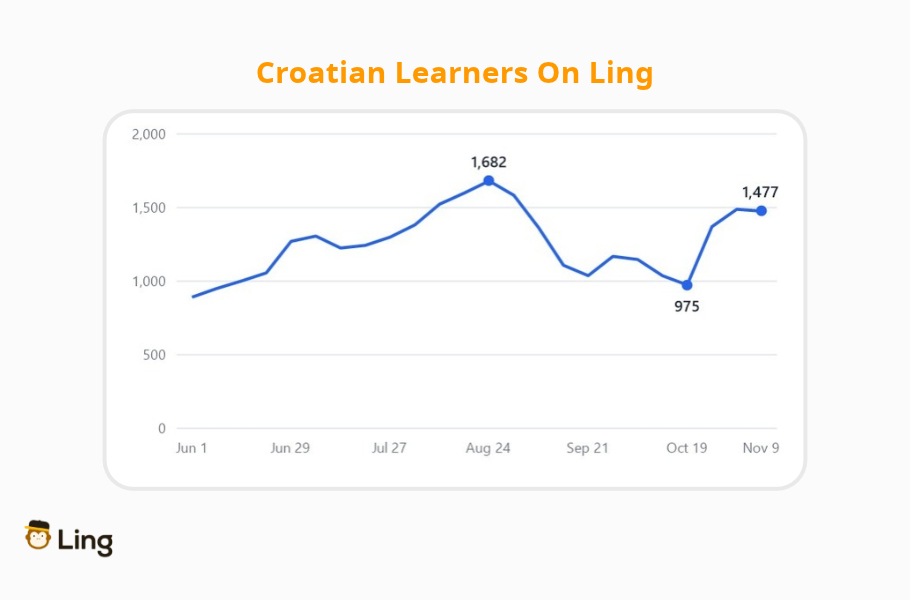
Weekly selections climbed from 892 in the week of Jun 1 to a peak of 1,682 in the week of Aug 24, fell to 975 in the week of Oct 19, and have been between 1,371 and 1,489 a week since Oct 26.
Is Croatian Hard To Learn?
The U.S. Foreign Service Institute lists Serbo-Croatian in Category III, the “hard languages” group, at about 44 weeks or 1,012 class hours for English speakers (U.S. Department of State). The list does not name Croatian separately. The category covers languages with significant linguistic or cultural differences from English.
The grammar has three genders, seven cases and two numbers (Wikipedia). Croatian is written in the Latin alphabet, so learners can read the letters from day one. Starting with everyday phrases gives you usable words before the grammar. Ling’s guide on whether Croatian is hard to learn goes into detail, and its how to learn Croatian guide lays out a beginner roadmap.
Which Apps Teach Croatian?
As of Nov 25, 2026, Mondly’s App Store listing and Pimsleur’s course page include Croatian, while Duolingo’s own course list for English speakers does not. Babbel’s language list has no Croatian, and Memrise offers only user-made word lists.
| App | Croatian? | What we checked | Checked |
|---|---|---|---|
| Duolingo | No | Duolingo’s course page, “I speak English” | Nov 24, 2026 |
| Babbel | No | Babbel’s “Foreign languages” page | Nov 25, 2026 |
| Mondly | Yes | Mondly’s App Store listing, which names Croatian among its 41 languages | Nov 24, 2026 |
| Pimsleur | Yes | Pimsleur’s Croatian course page, which says it teaches the standard dialect, Shtokavian | Nov 25, 2026 |
| Memrise | Only user-made word lists | Memrise’s “Learn Croatian” page | Nov 25, 2026 |
| Ling | Yes | Ling’s App Store & Google Play Store listing | Nov 25, 2026 |
For the details on Duolingo, read No Croatian On Duolingo?
Common Myths About Croatian Speakers
Myth 1: Croatian Is Only Spoken In Croatia
Mostly, but not only. Croatia holds 86% of the 4.28 million mother-tongue speakers that national censuses count. The rest live in Bosnia and Herzegovina (515,481), Slovenia (54,079), Serbia (12,048), Hungary (8,232) and Montenegro (2,193), and 46,960 people in the United States speak Croatian at home.
Myth 2: Croatian Is The Same As Serbian
Not quite. Croatian, Bosnian, Montenegrin and Serbian are four national standards usually grouped under the term Serbo-Croatian in English, a term that is controversial among native speakers (Wikipedia). Educated speakers can converse with full understanding, hindered only by a few everyday words and technical terms (Britannica), but Croatian uses ijekavian pronunciation and only the Latin alphabet (Wikipedia). Ling’s Croatian vs Serbian vs Bosnian guide compares them.
Myth 3: Everyone In Croatia Speaks Croatian As A Mother Tongue
Nearly everyone, but not all. In the 2021 census, 95.25% of residents named Croatian as their mother tongue. Others named Serbian (45,004), Bosnian (17,531), Romani (15,269), Albanian (13,503) or Italian (12,890) (Croatian Bureau of Statistics).
What Do These Numbers Mean?
Croatian has about 4.28 million census-counted mother-tongue speakers in six countries and an Ethnologue estimate of 5.1 million native speakers worldwide, so the right figure depends on whether you count residents or speakers anywhere. For learners, the practical points are the Latin alphabet, the ijekavian pronunciation and a grammar with seven cases (Wikipedia).
FAQs: How Many People Speak Croatian
How Many People Speak Croatian In The World?
About 5.1 million people speak Croatian as a native language and another 1.3 million as a second language, according to Ethnologue’s 2025 edition as cited on Wikipedia. Censuses in six countries count about 4.28 million mother-tongue speakers, so the right figure depends on whether you count residents or speakers worldwide.
How Many People Speak Croatian In Croatia?
The 2021 census counted 3,687,735 people with Croatian as their mother tongue, 95.25% of Croatia’s 3,871,833 residents (Croatian Bureau of Statistics). Serbian was the mother tongue of 45,004 people and Bosnian of 17,531. The count is from 2021, so it may no longer match today’s population.
Is Croatian The Same Language As Serbian?
Croatian, Bosnian, Montenegrin and Serbian are national standards usually grouped as Serbo-Croatian in English, a term that is controversial for native speakers (Wikipedia). Educated speakers understand each other (Britannica). Croatian is set apart by ijekavian pronunciation, the Latin alphabet and some everyday words (Wikipedia).
Is Croatian Written In Cyrillic Or Latin?
Croatian is written in Gaj’s Latin alphabet, which Ljudevit Gaj standardized between 1830 and 1850 (Wikipedia). Wikipedia lists Glagolitic and Bosnian Cyrillic as historical scripts only, so learners need only the Latin letters. Ling’s Croatian alphabet guide shows how to read them.
Is Croatian Hard To Learn For English Speakers?
The U.S. Foreign Service Institute lists Serbo-Croatian in Category III, hard languages, at about 44 weeks or 1,012 class hours for English speakers, and it does not name Croatian separately (U.S. Department of State). The grammar has three genders, seven cases and two numbers (Wikipedia).
Is Croatian On Duolingo?
No. Duolingo’s own course list for English speakers does not include Croatian as of Nov 24, 2026, and neither does Babbel’s language list. Ling offers a complete learning course. Other than that, Mondly’s App Store listing and Pimsleur’s course page include Croatian, and Memrise has only user-made word lists.
Start Learning Croatian With Ling!
Croatian has about 4.28 million census-counted speakers in six countries, and neither Duolingo nor Babbel offers a course in it. 14,820 people chose Croatian on Ling in the last 12 weeks, 5% more than in the 12 weeks before. If you want to be one of them, here is what you get and how to start.
Ling has a Croatian course for beginners. Read the complete beginner’s roadmap to learning Croatian first.
Ling’s Croatian course is a structured beginner course with native-speaker audio lessons. It brings vocabulary, grammar, pronunciation and conversation practice together in one app, so you do not have to piece them together from word lists and videos. Lessons are written and reviewed by native speakers, and the app is on iOS and Android.
Sources
- Wikipedia, Croatian language. Infobox: 5.1 million native speakers (2021 to 2023) and 1.3 million second-language speakers (2012), both citing Ethnologue’s 28th edition (2025). Also used for the Latin alphabet, dialects, official status and EU status. Read Nov 25, 2026.
- worlddata.info, Croatian. 5.5 million mother-tongue speakers worldwide, 3,543,000 in Croatia and 904,000 in Bosnia and Herzegovina; no data year or source stated. Accessed Nov 25, 2026.
- Pimsleur, Learn Croatian. Course page, which gives 4.5 million speakers in Croatia plus one million elsewhere and says it teaches Shtokavian. Accessed Nov 25, 2026.
- Croatian Bureau of Statistics, 2021 census, population by mother tongue and by ethnicity, tables 1 and 3.
- Agency for Statistics of Bosnia and Herzegovina, Census of Population, Households and Dwellings 2013, Final Results, June 2016, tables 3.1 and 5.1, PDF hosted by the UN Statistics Division.
- Statistical Office of the Republic of Serbia, 2022 census, ethnicity and mother tongue, religion and ethnic affiliation, release of 16 June 2023.
- MONSTAT (Montenegro), 2023 census, second release, No. 135/2024, 15 October 2024, tables 1, 3 and 4.
- Statistical Office of the Republic of Slovenia, 2002 census, population by mother tongue.
- Hungarian Central Statistical Office, 2022 census, table 1.1.6, mother tongue.
- citypopulation.de, Kosovo, 2024 census; lists no Croatian category.
- U.S. Census Bureau, 2017-2021 American Community Survey, Table 1, languages spoken at home.
- Office for National Statistics, Census 2021, TS024 Main language (detailed), read through Nomis.
- Destatis, foreign population by sex and selected citizenships. Citizenship only.
- Britannica, Bosnian-Croatian-Montenegrin-Serbian language. Accessed Nov 25, 2026.
- Wikipedia, Serbo-Croatian grammar. Accessed Nov 24, 2026.
- U.S. Department of State, Foreign Language Training. Accessed Nov 23, 2026.
- Duolingo, Courses, list for English speakers. Checked Nov 24, 2026.
- Babbel, Foreign languages. Checked Nov 25, 2026.
- Apple App Store, Mondly: Learn 41 Languages, language list. Checked Nov 24, 2026.
- Memrise, Learn Croatian. Checked Nov 25, 2026.
- Ling learner data (Amplitude, project Ling Production): 12 weeks Aug 24 to Nov 15, 2026 compared with Jun 1 to Aug 23, 2026.
- Google Search Console, ling-app.com: Aug 20 to Nov 17, 2026 compared with the previous 90 days.