



There is no Croatian on Duolingo? Fortunately, there’s a solution!
The Ling app offers a full Croatian course with interactive lessons, real-life dialogues, and exercises that actually help you speak, read, and understand the language. Ling has become the go-to alternative for anyone serious about learning Croatian without waiting for Duolingo to catch up.
Read on to find out why Duolingo doesn’t offer Croatian, what to look for in a language learning app teaching the language, and what the Ling app has to offer for anyone looking for resources to learn Croatian!
I want to learn even more languages with Ling!
Download now!
Why Is There No Croatian On Duolingo?
Duolingo doesn’t offer a Croatian course likely because the language has a smaller global learner base, and the platform is no longer adding community-built courses through its former volunteer program. The company hasn’t provided an official statement, but these are the most probable reasons.
Here are some other key reasons why Croatian is still missing from Duolingo:
- Popularity: While languages like French or Spanish attract millions of learners, Croatian is still relatively niche. In fact, oddly enough, many people prefer learning fictional languages like Klingon or High Valyrian on Duolingo rather than picking up a full course of core Croatian phrases.
- Demand: Another factor is demand. Fewer students and teachers are looking to learn or teach Croatian, so it has not become a priority. Even online communities for Croatian are smaller, though still supportive.
- End of Volunteer Program: Duolingo’s volunteer contributor program, which previously allowed new languages to be added by volunteers, has ended. Without that community-driven support, adding Croatian might not be something they can focus on right now.
This is where Ling stepped up and chose to invest in Croatian, build lessons with native speakers, and give learners a complete path, even without the popularity numbers other platforms want. So, the lack of a Duolingo course should not hold you back at all, because a full Croatian learning experience already exists on Ling.
Is Croatian Hard To Learn?
According to Language Testing International (LTI), Croatian falls into a higher difficulty category for English speakers, meaning it takes 6 to 9 months to develop everyday conversational skills and 10 to 12 months of intensive study to reach a professional working level.
So, Croatian can be hard to learn, depending on your prior knowledge. Learners who already speak a Slavic language find it easier, while English speakers and others can find it more difficult.
To give you a better idea of what to expect, let’s look at some of the most common areas that learners find challenging when learning Croatian.
Pronunciation
Croatian pronunciation is generally consistent because words are pronounced as they are written. However, some letters, such as č, ć, ž, š, and đ, don’t exist in English and can take time to master. Listening to native speakers and practicing out loud can, however, make a big difference.
Let’s look at some examples to give you an idea of how these letters sound:
| Letter | Example | Pronunciation |
|---|---|---|
| č | čaj (tea) | Similar to the ch in chair |
| ć | kuća (house) | A softer ch sound than č |
| Š | škola (school) | Like sh in shoe |
| ž | žena (woman) | Like the s in measure |
| đ | đak (student) | Similar to the j in judge |
Grammatical Cases
One of the biggest hurdles for beginners is Croatia’s seven grammatical cases. These cases change the endings of nouns, pronouns, and adjectives depending on their role in a sentence. It may seem overwhelming at first, but you’ll become more comfortable with them through regular exposure and practice.
For example, the word for book changes depending on how it’s used in a sentence:
| English | Croatian | Case | Why it changes |
|---|---|---|---|
| I have a book. | Imam knjigu. | Accusative | The book is the object of the sentence. |
| The book is on the table. | Knjiga je na stolu. | Nominative | The book is the subject of the sentence. |
Noun Gender And Agreement
Every Croatian noun is either masculine, feminine, or neuter, and adjectives, pronouns, and some verbs must agree with that gender. Learning these patterns early will help you build grammatically correct sentences more naturally.
For example, “Good” is used differently in the table below, based on pronoun gender:
| English | Croatian | Gender |
|---|---|---|
| Good Man | Dobar muškarac | Masculine |
| Good Woman | Dobra žena | Feminine |
| Good Village | Dobro selo | Neuter |
Verb Conjugations And Aspect
Croatian verbs change depending on the subject, tense, and whether an action is completed or ongoing. This concept, known as the verb aspect, is unfamiliar to many English speakers but becomes easier to understand as your vocabulary grows.
For example:
| English | Croatian | Aspect | Meaning |
|---|---|---|---|
| I am writing. | Pišem. | Perfective | The action is ongoing. |
| I wrote (and finished). | Napisao/Napisala sam. | Imperfective | The action has been completed. |
Formal And Informal Speech
Croatian distinguishes between informal (“ti“) and formal (“vi“) forms of address. Knowing when to use each is important, especially when speaking with strangers, elders, or in professional settings.
For example:
| Situation | Croatian | English |
|---|---|---|
| Speaking to a friend | Kako si? | How are you? |
| Speaking to a teacher or stranger | Kako ste? | How are you? (Formal) |
What Common Mistakes Do Beginners Make When Learning Croatian?
The biggest challenges when learning Croatian are mastering pronunciation, understanding grammatical cases, using the correct noun gender, and knowing when to use different verb forms.
Of course, not everyone is looking to be 100% fluent. Some people may just be curious, or want to learn the basics. Regardless, you should keep these challenges in mind, as they are the most common mistakes learners make when learning Croatian, at least in the beginning.
Let’s take a closer look at the challenges:
- Pronunciation: Letters like č, ć, ž, š, and đ do not exist in English.
- Grammatical cases: Croatian uses seven cases that change word endings.
- Noun gender and agreement: Every noun has a gender. Adjectives must match it.
- Verb conjugations and aspect: Some verbs change meaning depending on aspect.
- Flexible word order: Sentence structure is not always fixed.
- Formal and informal speech: You need to know when to use ti or vi.
- Regional variation: Accents and vocabulary differ across regions.
So yes, Croatian can be hard to learn, but with the right approach, it’s not impossible. Overall, motivation and prior experience with other languages make the biggest difference in how hard it feels.
Why Should You Learn Croatian In 2026?
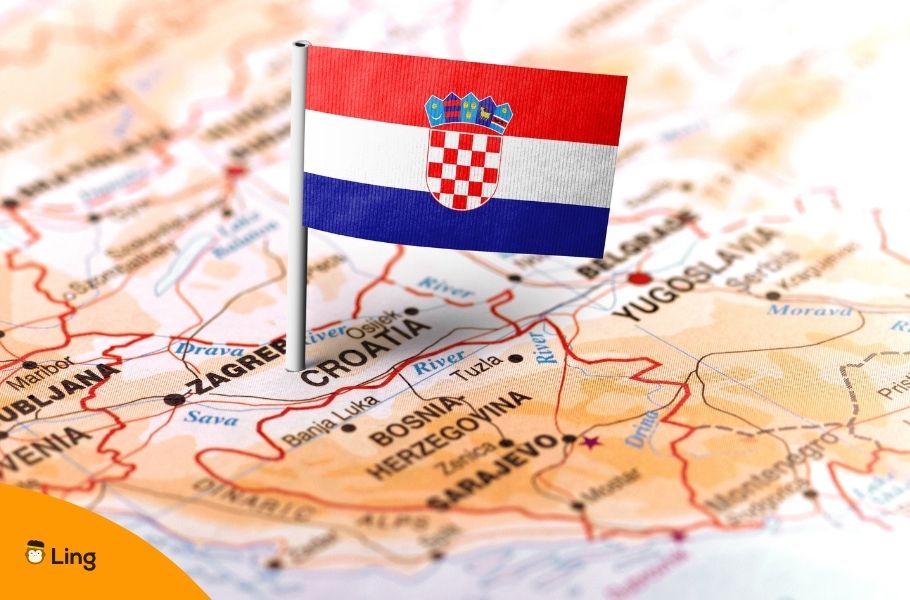
Learning Croatian can be helpful if you want to connect with the local Croatian culture, travel to a Croatian-speaking region, communicate with native speakers more confidently, or just to explore a new language.
Here’s a more detailed explanation of why you should learn Croatian, as well as more reasons to:
Travel Croatia Like A Local
Croatia is one of Europe’s most popular travel destinations. It’s known for its beautiful coastline, historic cities, and national parks. While many Croatians speak English, knowing a few Croatian phrases can make it easier to navigate, order food, ask for directions, and connect with locals.
Connect With Croatian Family And Friends
If you have Croatian relatives or friends, learning the language is a meaningful way to strengthen those relationships. Even speaking a little Croatian can help you feel more connected to them, their traditions, everyday life, and have conversations with them.
Explore Croatia’s Culture
Learning Croatian gives you a deeper appreciation of the country’s history, literature, music, and traditions. You’ll also be able to enjoy local books, films, and media without relying entirely on translations.
Study Or Work In Croatia
Croatia is home to several respected universities and growing industries, particularly in tourism, technology, healthcare, and business. Learning Croatian can make it easier to study, work, or build professional relationships in the country.
Challenge Yourself With A New Language
Croatian is a rewarding language to learn because it introduces you to a new way of thinking about grammar and communication. So, if you’re planning to learn a new language, consider making that language Croatian.
Duolingo Vs. Ling: How Do They Compare, And Which App Supports Croatian?
If you’re specifically looking to learn Croatian, Ling is the better choice because it offers a dedicated Croatian course, while Duolingo doesn’t support the language at all.
Beyond Croatian, the two apps take different approaches to language learning. Ling focuses on practical communication through real-life conversations, speaking practice, native-speaker audio, mini games, and quizzes.
Here’s a side-by-side comparison of how Duolingo and Ling stack up:
| Feature | Duolingo | Ling |
|---|---|---|
| Learning style | Gamified exercises, fun challenges | Practical, real-life lessons and review tools |
| Speaking practice | Limited | Full practice with speech recognition |
| Listening practice | AI audio | Native speaker recordings |
| Price | Free with ads, Plus for premium features | Free trial, then subscription |
| Bite-sized lessons | Yes | Yes |
| Number of languages | 38 | 70+, including ones that are hard to find elsewhere |
| Available for Croatian | No | Yes |
Ling offers practical, full-featured language learning with Croatian support, while Duolingo focuses on gamified lessons and does not include Croatian.
The Best Alternative For Learning Croatian: The Ling App
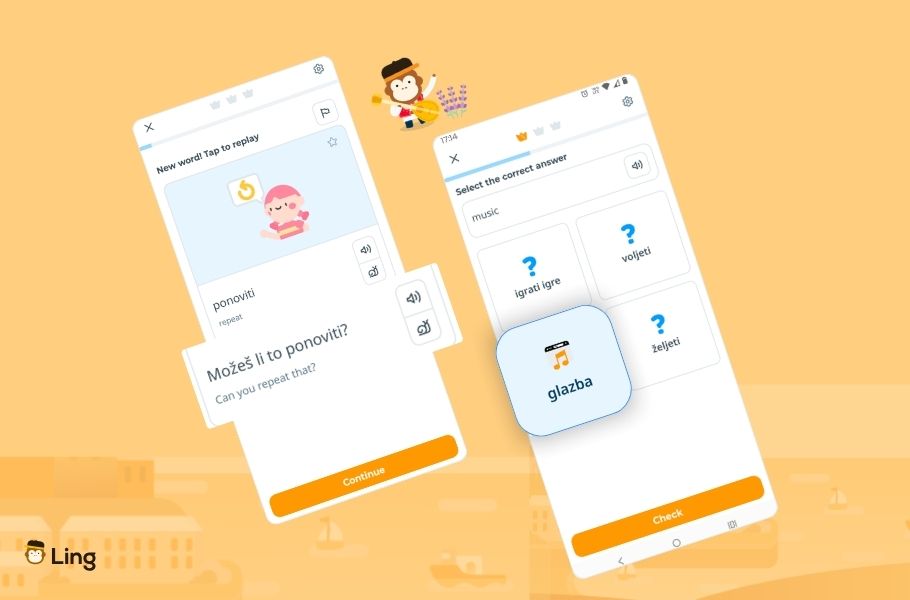
Ling is a language app designed to help beginners through short, interactive lessons. It addresses the most common pain points learners face with features every language app should have. Instead of memorizing random phrases or relying on repetitive exercises, Ling focuses on practical, immersive, and gamified learning.
Key Features For Learning Croatian With Ling
- Gamified lessons
- Native-speaker audio for correct pronunciation
- Review tools like flashcards and a vocabulary bank
- Dialogs for practicing real-time conversations
- Voice recognition to correct speaking mistakes
- Five levels: beginner, intermediate, upper intermediate, advanced, and expert
What You’ll Achieve In Your First Week Using Ling
By the end of your first week with Ling, you’ll have the confidence to understand and use essential Croatian words and phrases in everyday situations.
Ling will not just help you memorize random Croatian vocabulary. Instead, you’ll build practical language skills that you can use while traveling, meeting native speakers, or continuing your learning journey.
Here’s a glimpse of what you can learn by completing your first series of lessons on the Ling app:
| Day | What You’ll Learn | Example |
|---|---|---|
| Day 1 | Greetings | Bok! – Hello Bok, Tome! – Hello Tom |
| Day 2 | Personal Introductions | Kako se zoveš? – What is your Name Bok, kako se zoveš? – Hello, what is your Name Moje ime je Marija – My name is mary |
| Day 3 | Greetings | Doviđenja! – Goodbye Doviđenja, vidimo se uskoro! – Goodbye, see you soon |
| Day 4 | Basic Numbers & Counting | Jedan, dva, tri – One, two, three Koliko je to? – How much is it? |
| Day 5 | Useful Phrases / Politeness | Molim – Please Hvala vam lijepa – Thank you very much Nema na čemu – You’re welcome |
| Day 6 | Food & Cafe Dining | Kava, molim – Coffee, please Ukusno je! – It’s delicious! |
| Day 7 | Fundamental Questions | Gdje je…? – Where is…? Govorite li engleski? – Do you speak English? |
You can, in fact, get a feel for how the Ling app works by taking advantage of its 7-day free trial before committing to a subscription.
Who Is The Ling App Best For?
Ling is best for beginners, travelers, heritage learners, and anyone who wants to learn Croatian through practical, real-life lessons. Thus, the Ling app is a great fit for:
- Complete beginners who want step-by-step guidance in reading, listening, speaking, and building everyday Croatian vocabulary.
- Travelers who want to communicate confidently while visiting Croatia, whether ordering food, asking for directions, or chatting with locals.
- Heritage learners hoping to reconnect with their Croatian language, family, or cultural roots.
- Expats, international students, and long-term visitors preparing to live, study, or work in Croatia.
- Busy learners who prefer bite-sized lessons that fit easily into a packed daily schedule.
- Language enthusiasts looking to a language that isn’t available on many popular language-learning apps like Duolingo.
Why Are People Choosing Ling?
People are already using Ling to learn Croatian. Here’s what our users recently wrote about it:
“A great app, especially for more obscure languages. I’m using Ling to learn Croatian and I like it very much. The pronunciations and dialogues are done by real speakers, not just AI, which really sets the app apart from other Croatian learning apps. There can be a few hiccups here and there with the speech recognition, but I reported the issues and support contacted me within hours with a successful workaround as well as a timeline of when the issue would be fixed. I highly recommend Ling.“
⭐⭐⭐⭐⭐
– Peaches Pan Tao
“I’ve been using Ling for a month and love it. It offers many languages, including rare ones. Lessons are interactive and gamified, with varied sentences that teach vocabulary and grammar intuitively. Each ends with a short dialogue. You can save new or important words and review them. I also reported a few bugs and got helpful feedback within days – they really work on improving the app.“
⭐⭐⭐⭐⭐
– Martin Zlatev
No Croatian On Duolingo: Frequently Asked Questions
Where Is Croatian Spoken?
Croatian is mainly spoken in Croatia, where it’s the official language. Besides that, it has official status in Bosnia and Herzegovina. Smaller communities use it in parts of Serbia, Montenegro, and Slovenia. Beyond the Balkans, Croatian is spoken by diaspora communities in countries like the US, Canada, Australia, and Germany.
Is There Croatian On Duolingo?
No, Duolingo does not currently offer a Croatian course. If you want to learn Croatian, you’ll need to use another language-learning app. One of the best alternatives is Ling, which offers a complete Croatian course with interactive lessons, native-speaker audio, speaking practice, and real-life dialogues to help beginners build practical language skills.
Is There A Free App To Learn Croatian?
Yes, there are free apps that can help you learn Croatian. However, while many of these apps offer limited free content, Ling lets you explore its Croatian course with a 7-day free trial before choosing a subscription. This gives you access to interactive lessons, native-speaker audio, and speaking exercises to see if the app is right for you.
What Is The Best App To Learn Croatian As a Beginner?
Ling is the top choice for beginners because it offers a dedicated comprehensive Croatian course with interactive lessons, speaking practice, native-speaker audio, and real-life dialogues.
How Long Does It Take To Learn Croatian?
The time it takes to learn Croatian depends on your language background and how often you study. Most beginners can learn basic conversational Croatian within a few months of consistent practice. But reaching professional proficiency typically takes much longer.
Download Ling And Start Learning Croatian Today
So there is no Croatian on Duolingo? No problem! You can download the Ling app today and start your 7-day free trial to learn Croatian and other niche languages with real-life practice and interactive lessons.
Millions of learners worldwide trust Ling to study 70+ languages. And with 10M+ downloads and an impressive 4.7/5 rating across the Google Play Store and Apple App Store, it’s become one of the most trusted apps for learning both popular and lesser-known languages like Croatian.
Start your free trial today and see for yourself why Ling works so well for mastering even the less common languages.

















































































