


It is almost impossible to have an entire conversation in Portuguese without using verbs. Verbs are the part of a sentence that indicate the topic or the action that is taking place in your expression. If you want to learn how to speak Portuguese, you must start by learning some common Portuguese verbs that you can use daily.
Let’s do an exercise: try to have a conversation in your native language without using verbs. Hard, right? If I start writing this article without using verbs, I bet it is not only not very enjoyable, but also it will be a real challenge to understand.
Verbs good. Important sentences. Important Portuguese. Fundamental. Common verbs next. For you – Did you imagine these sentences with a robot voice? Because I did! Not using verbs makes your speech robotic and, frankly, just weird. Verbs represent actions, both external, such as jump, run and laugh, and internal, like think, love and hate. Without verbs, you don’t do anything, you don’t feel anything, you are not even anything.
I want to learn even more languages with Ling!
Download now!
Verbs are the heart and soul of speech and the only type of word that’s absolutely necessary to make a sentence.
What Is A Verb?
Let’s start with the basics from 1st grade: what is a verb? Verbs, or verbos in Portuguese, represent actions or just the act of existing, of being. Every sentence needs a verb to explain to the receiver of the sentence the thing that is being done or what is being felt by the protagonist of the sentence. If a sentence doesn’t have a verb, then it will be incomplete.
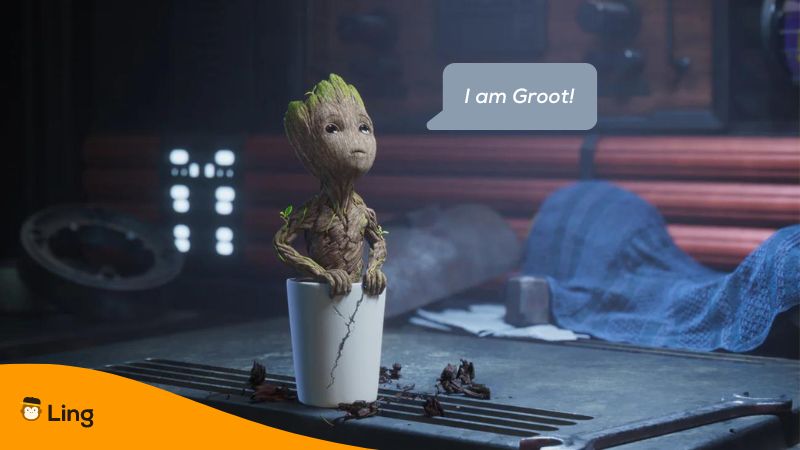
Just to understand the importance of a verb in a sentence, think about the funny character Groot from Guardians of the Galaxy. He only knows 3 words: I. Am. Groot. Notice how one of them is a verb! 1/3 of his whole vocabulary is a verb!
I am Groot – Groot from Guardians of the Galaxy
Most Common Portuguese Verbs
Verbs in Portuguese have different infinitive versions; however, they most commonly end in four different ways: -ir, -er, -ar, and -or.
But what are some of Portuguese’s most important or commonly used verbs? Let’s look at some of these Portuguese verb conjugations, along with a few examples of them being used in a sentence.
To help you really grasp how these Portuguese verb tenses are used, along with the example, is a little blue play button that you can press and listen to the pronunciation of both the verb and the entire sentence so that you can practice your pronunciation.
- To Be / ser
The verb to be, or ser in Portuguese, is simply the way to say that someone, or something, exists and is like something or is somewhere.
| Portuguese | English | Sound |
| Eu sou | I am | |
| Tu és | You (singular) are | |
| Ele/Ela é | He/She is | |
| Nós somos | We are | |
| Vós sois | You (plural) are | |
| Eles/Elas são | They are | |
Example: Eu sou a Carolina – I am Carolina
- To Be / Estar
This verb also means “to be” in English; however, in Portuguese, it is used for temporary conditions and locations.
| Portuguese | English | Sound |
| Eu estou | I am | |
| Tu estás | You (singular) are | |
| Ele/Ela está | He/She is | |
| Nós estamos | We are | |
| Vós estáis | You (plural) are | |
| Eles/Elas estão | They are | |
Example: Eu estou de férias – I am on vacation
- To Have / Ter
- Eu tenho
- Tu tens
- Ele/Ela tem
- Nós temos
- Vós tendes
- Eles/Elas têm
Example: Eu tenho um carro azul – I have a blue car;
Eles têm muito trabalho – They have a lot of work.
- To do, make / Fazer
- Eu faço
- Tu fazes
- Ele/Ela faz
- Nós fazemos
- Vós fazeis
- Eles/Elas fazem
Example: Eu faço o jantar todos os dias – I make dinner everyday.
Eu faço tudo o que posso – I do everything I can.
- To go / Ir
- Eu vou
- Tu vais
- Ele/Ela vai
- Nós vamos
- Vós ides
- Eles/Elas vão
Example: Eu vou a casa amanhã. – I’ll go home tomorrow.
- Can / Poder
- Eu posso
- Tu podes
- Ele/Ela pode
- Nós pudemos
- Vós podeis
- Eles/Elas podem
Example: Eles podem sair. – They can leave.
- To Know / Saber
- Eu sei
- Tu sabes
- Ele/Ela sabe
- Nós sabemos
- Vós sabeis
- Eles/Elas sabem
Example: Ele sabe mais do que tu pensas. – He knows more than you think.
- To Put / Pôr
- Eu ponho
- Tu pões
- Ele/Ela põe
- Nós pomos
- Vós pondes
- Eles/Elas põem
Example: Nós poems tudo em cima da mesa. – We put everything on top of the table.
- To Like / Gostar
- Eu gosto
- Tu gostas
- Ele/Ela gosta
- Nós gostamos
- Vós gostais
- Eles/Elas gostam
Example: Ela gosta de café. – She likes coffee.

- To Love / Amar
- Eu amo
- Tu amas
- Ele/Ela ama
- Nós amamos
- Vós amais
- Eles/Elas amam
Example: Eu amo a minna mulher. – I love my wife.
- To Talk, Speak / Falar
- Eu falo
- Tu falas
- Ele/Ela fala
- Nós falamos
- Vós falais
- Eles/Elas falam
Example: Tu falas Uma lingua diferente – You speak a different language.
- To Say / Dizer
- Eu digo
- Tu dizes
- Ele/Ela diz
- Nós dizemos
- Vós dizeis
- Eles/Elas dizem
Example: Eles dizem que tu mudaste o canal – They say you changed the channel.
- To Want / Querer
- Eu quero
- Tu queres
- Ele/Ela quer
- Nós queremos
- Vós quereis
- Eles/Elas querem
Example: Eu quero ir a Paris. – I want to go to Paris.
- To See / Ver
- Eu vejo
- Tu vês
- Ele/Ela vê
- Nós vemos
- Vós vides
- Eles/Elas veêm
Example: Ela vê bem com os óculos. – She sees well with glasses.
- To Give / Dar
- Eu dou
- Tu dás
- Ele/Ela dá
- Nós damos
- Vós dais
- Eles/Elas dão
Example: Tu dos abraços sempre que o vês. – You give hugs every time you see him.
- To Find / Encontrar
- Eu encontro
- Tu encontras
- Ele/Ela encontra
- Nós encontramos
- Vós encontreis
- Eles/Elas encontram
Example: Eles encontram sempre lugar para estacionar. – They always find a place to park.
- To Bring / Trazer
- Eu trago
- Tu trazes
- Ele/Ela traz
- Nós trazemos
- Vós trazeis
- Eles/Elas trazem
Example: Eu trago o jantar. – I bring dinner.
- To Take / Levar
- Eu levo
- Tu levas
- Ele/Ela leva
- Nós levamos
- Vós levais
- Eles/Elas levam
Example: Tu levas o saco cheio. – You take a full bag.
- To Stay, To Be, To Become / Fica
- Eu fico
- Tu ficas
- Ele/Ela fica
- Nós ficamos
- Vós fiqueis
- Eles/Elas ficam
Example: Eu fico aqui à tua espera. – I stay here waiting for you.
Eu fico triste quando me tratas mal – I am sad when you treat me wrong.
- To Need / Precisar
- Eu preciso
- Tu precisas
- Ele/Ela precisa
- Nós precisamos
- Vós preciseis
- Eles/Elas precisam
Example: Eu preciso de ti. – I need you.
- To Come / Vir
- Eu venho
- Tu vens
- Ele/Ela vem
- Nós vimos
- Vós vindes
- Eles/Elas vêm
Example: Nós vimos de Portugal. – We come from Portugal.
As a quick note, this is the Portuguese verb conjugation for European Portuguese. If you plan on speaking Brazilian Portuguese, some of these verbs may be a bit different in terms of their verb conjugation.
Wrapping Up!
Learning some Portuguese verbs was just the first step in speaking this beautiful language. If you want to explore more about Portuguese, we at Ling App have a blog filled with incredible articles that explore many topics around the Portuguese language, such as basic expressions you should know, how to say thank you, or Portuguese gastronomy.
Learn More Portuguese With Ling App
With just a few verbs, you’re ready to start exploring the Portuguese language and can start to compose your sentences. There are many great resources out there, but I have the best one for you to learn Portuguese fast and efficiently.
It is called Ling app, and it is a language learning application where you can learn, improve and practice your Portuguese through fun and proven methods, games, quizzes, and puzzles that will engage your brain and allow you to master Portuguese in a blink of an eye.
What are you waiting for? Improve your Portuguese with the help of Ling app!