



If you’ve tried learning a language with an AI-only app, you probably know how it goes: the lessons are quick, efficient, and sometimes even impressive, but something feels off. There’s no real emotion, no cultural depth, and no human touch. Additionally, some of them aren’t good for learning specific languages yet.
Then you travel. Someone greets you with a warm smile, speaks quickly, or makes a gesture. Suddenly, those AI lessons feel flat. This is the gap AI can’t fill, at least, not yet.
So why are human-crafted apps different? The reason why Ling beats AI language apps isn’t just advanced technology; it’s the real people behind the lessons.
I want to learn even more languages with Ling!
Download now!
What Are The Limits Of AI-Only Language Apps?
Despite their efficiency, AI-based language apps often miss key elements that make language learning a truly immersive experience. Learning with them tends to be surface-level, they’re not very accurate with unpopular languages, and they lack an emotional connection.
Still, these apps are popping up everywhere, promising to help you learn quickly with minimal effort.
1. Surface-Level Learning
AI-driven apps can give you the basics, such as greetings, vocab lists, and simple sentences, but they don’t go beyond that yet, as they often prioritize speed. They usually don’t teach you the why or when behind the words.
For instance, AI doesn’t care whether you know how to address someone formally or informally in Japanese or whether you understand the cultural context of saying “no” in Vietnamese. Without this cultural depth, AI lessons can leave you feeling stuck when having real-world conversations. You might be able to say the words, but you’ll miss the nuances that make you sound natural.
2. Accuracy Issues With Less Common Languages
AI language apps pull data from large datasets, books, subtitles, and websites, so they still struggle with languages that have limited digital resources. For major languages like English, Spanish, or French, that’s not a problem. But for lesser-known languages like Lao, Javanese, or Amharic, the data is often sparse or inaccurate.
This means AI can give you lessons that are incomplete, incorrect, or culturally insensitive. Imagine learning the wrong word for something because the AI has never encountered it in a quality source. Or worse, learning something outdated or inappropriate because the AI doesn’t understand cultural changes.
3. No Emotional Connection
Perhaps the biggest issue with AI apps is the lack of emotional intelligence. AI can’t tell when you’re frustrated, proud, or motivated, and it can’t offer meaningful feedback or adjust to your personal learning style.
This leads to a disconnect. Language learning isn’t just about memorizing words; it’s about connecting with others. And that’s something AI just can’t replicate.
Are Ling’s Lessons Human-Crafted?
Ling offers a variety of courses crafted by members of the Ling team and real native speakers, not AI. That’s because at Ling, we believe that learning a language should be an emotional, real-world experience.
1. Native Voices, Not Robots
Unlike AI apps that use synthetic voices, every word you hear in Ling is recorded by a real person. These native voices give you the correct pronunciation, intonation, and rhythm, so you can speak like a local from day one.
2. Cultural Insights Built-In
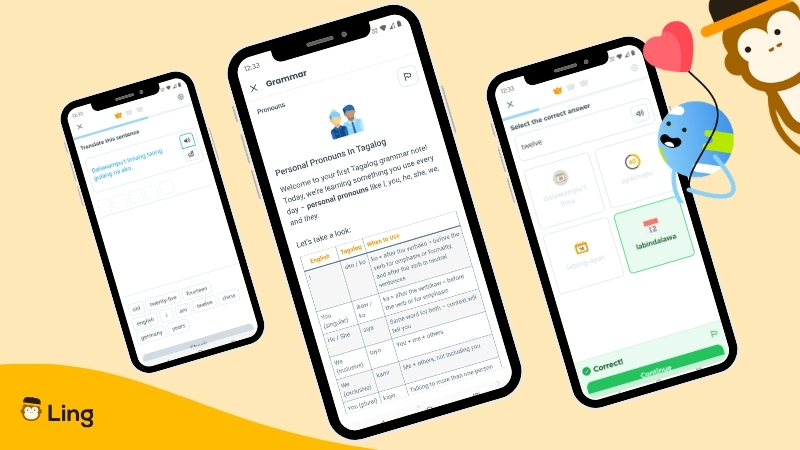
For several languages on the Ling app (we’re working on adding more!), lessons come with cultural and grammar notes that teach you how language works in context. After all, language isn’t just vocabulary; it’s culture. That’s why Ling goes beyond the basics.
For example, in Thai, the words you use depend on the age and familiarity of the person you’re speaking to. AI apps often miss these details, leaving you sounding unnatural.
The Ling app teaches you not just the words, but also the meaning behind them. You’ll learn when to speak formally, when to use slang, and how to express yourself in a way that’s culturally respectful.
3. Human Expertise Makes All The Difference
Ling doesn’t just rely on data. We work with native speakers and linguists to ensure that each lesson is accurate, natural, and culturally relevant. Every phrase is reviewed, refined, and recorded by real people, so you can trust that you’re learning the language as it’s truly spoken.
Our goal is to bridge the gap for learners of rare and endangered languages, hence why we have recently launched even more languages, such as Māori, which we carefully worked on with native speakers.
The Power Of Emotional Connection When Learning Languages
Language learning isn’t just about grammar rules; it’s about building connections. Research highlights the importance of language in creating bonds between communities, and that’s an essential goal for the Ling app.
Take it from our users: one learner used Ling to prepare Nepali wedding vows, making a deep, emotional connection with his fiancée’s family. Another learned Khmer to speak with his relatives at family gatherings, finally. These aren’t just language milestones; they’re personal achievements that AI apps can’t offer.
Ling helps you connect with people and culture as we not only offer culture notes for specific languages, but we’re also building a Discord community for language learners interested in practicing together. We don’t stop at our app alone; we strive to have a strong community of Lingers with our same goal of connecting people through language.
How Ling Combines AI Efficiency With Human Expertise
While AI-only apps work on efficiency, Ling blends AI’s speed with human insight for the best of both worlds. Here’s how it works:
- AI drafts workflows, briefs, or content drafts, and helps organize review schedules.
- Native speakers and linguists refine the content for accuracy and authenticity. Or they create the content entirely from scratch.
- Voice actors record real, human audio in their native tongue.
- Cultural experts add context and nuances that AI can’t pick up in the form of notes available for specific languages.
- Designers create an easy-to-use, engaging experience.
This hybrid approach ensures that you get lessons that are both efficient and authentic. AI handles the heavy lifting, while humans add the heart.
Learning a difficult language doesn’t have to be overwhelming; that’s why Ling simplifies even the most difficult languages to become more accessible and enjoyable.
Why Ling Beats AI Language Apps
The reason why Ling beats AI language apps is that lessons are crafted by the Ling team along with real native speakers, it offers cultural and grammar notes for several languages, and it includes native-speaker audio and words and phrases you can use in real life.
AI language apps, on the other hand, lack input from real speakers, have limited cultural context, use AI voices, and have accuracy issues, among many other things.
| Feature | Ling | AI-Only Language Apps |
|---|---|---|
| Native Speaker Involvement | Every lesson is crafted and reviewed by native speakers for accuracy and cultural relevance. | Relies on AI-generated content, often lacking input from real native speakers. |
| Cultural Insights | Provides built-in cultural and grammar notes to teach the context behind the language (for some languages). | Limited cultural context; AI misses important cultural nuances. |
| Voice Quality | All audio is recorded by real native speakers, ensuring authentic pronunciation and intonation. | Uses AI-generated voices, which often sound robotic and lack the natural flow of human speech. |
| Language Accuracy | Every lesson is reviewed by experts, ensuring it’s both linguistically accurate and culturally appropriate. | Accuracy can be an issue, especially with lesser-known or endangered languages. AI may provide incomplete or incorrect data. |
| Learning Approach | Focuses on real-world language usage and relies on the depth and authenticity of human expertise. | Relies entirely on AI for lesson generation, which may lack depth, flexibility, and personalization. |
| Human Interaction | Frequent updates based on real user feedback; focuses on building genuine relationships with users; Discord and social media help build a community. | AI responses are often impersonal and do not adapt to individual learner needs. |
| Language Range | Supports over 70 languages, with a focus on Eastern European and Asian ones, as well as less commonly taught or endangered languages. | Primarily supports major languages; less focus on smaller or regional languages. |
While AI-only apps or ChatGPT can seem like an easy and fast way to get started with language learning, they fall short when it comes to real-world conversations. As shown in the table, Ling goes beyond basic vocabulary and provides a comprehensive, human-centered experience that emphasizes real-world cultural understanding and authentic communication.
Frequently Asked Questions: Why Ling Beats AI Language Apps
Is the Ling App AI?
No, the Ling app is not AI, nor is it AI-based. All its lessons are designed and created by the Ling team along with real native speakers. Even the dialog feature has predesigned conversations instead of an AI chatbot, ensuring users learn real language use from the people who use the language every day, not from AI.
What Makes The Ling App Different From AI Language Apps?
Ling relies on human expertise. All lessons are created with and recorded by native speakers, ensuring cultural depth, natural speech, and authentic pronunciation.
Can AI Teach Languages Effectively?
AI is great for drills and vocabulary, but it struggles with nuance, tone, and real conversations. Ling fills that gap with human-guided content, delivering a more engaging, real-world experience.

Why Ling Is The Future Of Language Learning
The future of language learning isn’t about choosing between AI and humans; it’s about using both to create a richer experience. We shouldn’t disregard AI; we must use it for our benefit, but at the same time, humans still are the most essential touch when it comes to language learning. AI apps may be able to speed things up, but they can’t replace the human touch.
Ling already blends the power of AI with the expertise of native speakers, giving you lessons that are not only fast and efficient but also accurate for lesser-known languages, culturally rich, emotionally engaging, and relevant to real-life conversations.
Because at the end of the day, language is about human connection. It’s about speaking with someone in their mother tongue, understanding their culture, and building meaningful relationships.
Ready To Learn The Ling Way?
With Ling, you won’t just memorize words; you’ll learn to communicate authentically, respectfully, and confidently. You’ll be ready to connect with people, explore new places, and experience different cultures in ways that AI-only apps can’t match.
Start learning with Ling today and make every word count!

















































































