

Respect is a core part of Filipino culture. It’s woven into how we speak, greet, and connect. And when it comes to the LGBTQ+ community, it’s imperative to use the right words. It’s not just about being polite. It’s honoring our identity, showing care, and celebrating our differences.
And, if you’re travelling to the Philippines soon, it’s a must that you know the Tagalog words for LGBTQ! Together, we’ll explore what words reflect inclusivity with daily Filipino expressions related to it. Whether slang or formal, learning the Tagalog language with gender-inclusive terms is a step closer to celebrating our shared culture.
15 Most Common Tagalog Words For LGBTQ
If you have heard the word bakla or tomboy in a Tagalog conversation, chances are you wondered what they meant. Filipino LGBTQ+ vocabulary is not only rich with expression, but also with history and emotion.
Learning Tagalog is more than memorizing words
Explore more →
While some Tagalog words for LGBTQ are widely accepted, others are used with humor, caution, or only in select social circles. To help you understand them better, let’s break down these commonly used LGBTQ+ Tagalog words by category:
Respectful Tagalog LGBTQ Words
This set of Tagalog words for LGBTQ is generally acceptable in both formal and informal settings, especially if you use them with the right tone and intent.
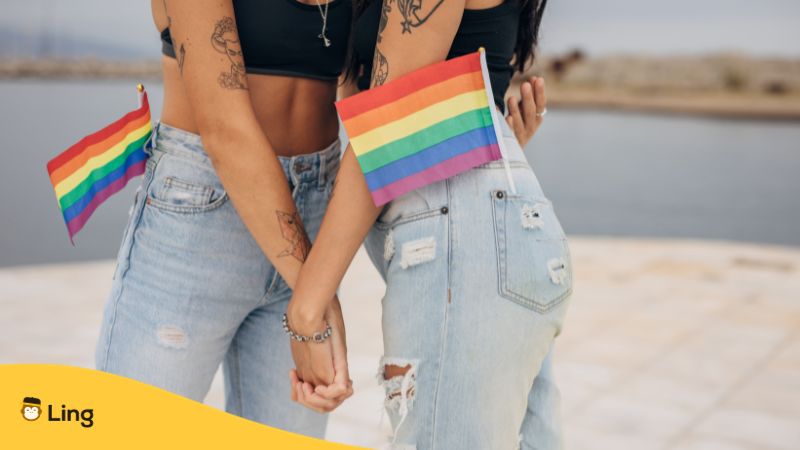
Lesbian – Lesbyana
Lesbyana is Tagalog’s clever twist on the English word ‘lesbian.’ It is a more formal Tagalog term that refers to women romantically drawn toward other women.
Homosexual Or Gay Man – Bading
No firm origin for this one, but within Filipino borders, this term denotes a gay or homosexual man. It is often used interchangeably with bakla, but it is slightly more modern and neutral.
You can frequently hear this in TV shows and daily Tagalog sentences in LGBTQ+ circles.
Bisexual Man – Silahis
Of Cebuano root, silahis is metaphoric for the sun’s rays piercing through the clouds. Its usage has evolved in Tagalog-speak to refer to bisexual men.
Though less commonly used today, it still exists in older media and some Filipino communities. Younger people now prefer to use “bi” (pronounced bay)” or “bisexual,” especially online.
Butch Lesbian – Tibo
Tibo is the Tagalog term referring to masculine-presenting lesbians or butch women. Most Filipinos understand its meaning and its often reclaimed with pride by queer women.
However, it can be offensive if used in a mocking tone, similar to bakla.
Tomboy – Tomboy
Tomboy in Tagalog is the same as “tomboy” in English. It’s used for gals who feel more like guys or dress in that style. It is not used to describe straight girls with boyish behavior.
Fun fact, this word has been kicking around since the Victorian era!
Colloquial And Slang LGBTQ Tagalog Words
These Tagalog words for LGBTQ are usually used in informal, often humorous settings within the LGBTQ circles and the younger generation.
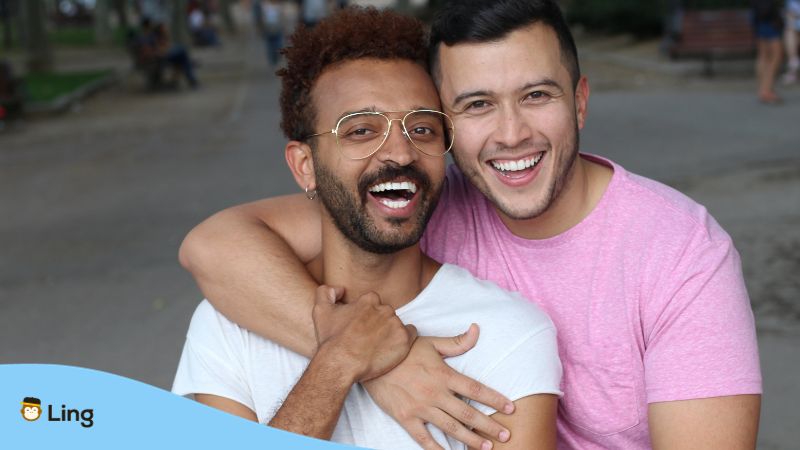
Modern Gay Man – Vaklush/Vaklushii
/
Refreshing alternatives to bakla, both vaklush and vaklushii are playful references to modern, flamboyant gay men. These inclusive phrases put forth the idea that everyone, regardless of gender expression, adds a unique sparkle to the world’s diversity.
Young Effeminate Man – Baklita
Baklita is an endearing term for young boys who exude feminine charm and is often used affectionately. This term proudly features in the limelight of modern Filipino cinema, as seen in the film Ang Pagdadalaga ni Maximo Oliveros.
Feminine Man – Biniboy
Biniboy is a delightful cocktail of two separate cultures. Originating from the word binibini (translating to “Miss” in English) and ‘boy,’ it was used to kindly refer to gay or feminine men with a gentle demeanor in the Philippines during the 50s and 60s.
Reclaimed Or Sensitive Tagalog Words For LGBTQ
This set of Tagalog words for LGBTQ comes from complicated histories. They were once derogatory, but have been reclaimed by the community. However, outsiders must use these LGBTQ Tagalog words cautiously and with respect.
Queer – Bakla
Bakla is like the umbrella term that gathers everyone who doesn’t fit snugly into society’s traditional gender and sexual orientation boxes. It’s a word full of pride, embracing uniqueness and diversity.
The term itself is as unique as the Philippines, originating from a combo of babae (woman) and lalaki (man). It can refer to a gay man, a queer person, or an effeminate man.
Made A Woman – Binabae
Binabae comes from the words bina- (to make), and bae (woman). It is a crafty combo that may refer to transgender women or men who identify or present themselves as women.
While some dictionaries consider it synonymous with bakla, looking closely reveals that it translates to “made a woman.”
Constructed Male – Binalaki
Binalaki is a jazzed-up way to paint a picture of a tomboyish female or a lesbian. This term is a mix of bina-, meaning “constructed,” and -laki, a snippet from lalaki, which signifies “man.”
So, binalaki is like you saying – “Hey, she’s rockin’ the masculine vibe.”
Other Words For LGBTQ With No Direct Tagalog Translation
When it comes to expressing diverse identities, the English language often introduces us to terms that don’t have a direct counterpart in Tagalog.
Non-Binary
Think of gender as a spectrum, and non-binary is the cool superhero who doesn’t adhere strictly to “male” or “female” categories. Non-binary individuals might feel like a little bit of both, somewhere in between, or completely off the spectrum. They’re like the unicorns of gender, bringing a magical touch to the way we understand it.
Gender Fluid
Being gender fluid is a bit like a river that doesn’t follow a set path, but bends and flows freely. People who identify as gender fluid might feel more masculine on some days, more feminine on others, or anywhere in between.
Transgender
Imagine feeling like your true self doesn’t quite match the body you were born with. That’s the journey of a transgender person. Some of them transition to align their appearance with their gender identity. Think of it as a beautiful metamorphosis, like a butterfly emerging from a cocoon.
Pansexual
Love knows no bounds for a pansexual person. Pansexuals are like love’s free spirits, embracing connections with people regardless of gender. They appreciate the beautiful souls inside, no matter how they identify on the gender spectrum.
How Do You Say LGBTQ In Tagalog?
In the Philippines, LGBTQ is often used as it is in English and Tagalog conversations. But it can also refer to the community as a whole.
Thus, you can literally translate it to komunidad ng LGBT (LGBT community) or LGBT in casual speech.
List Of Tagalog Words For LGBTQ
| English | Tagalog | Pronunciation | Sound |
|---|---|---|---|
| Lesbian | Lesbyana | les-BYA-nah | |
| Gay man | Bading | bah-DING | |
| Bisexual man | Silahis | see-LAH-his | |
| Butch lesbian | Tibo | tee-BOH | |
| Lesbian (masculine-presenting) | Tomboy | TOM-boy | |
| Flamboyant gay man (slang) | Vaklush/Vaklushii | vak-LOOSH/vak-loo-SHEE | |
| Young effeminate gay boy | Baklita | bak-LEE-tah | |
| Feminine boy | Biniboy | bee-nee-BOY | |
| Gay man (umbrella term) | Bakla | BAK-lah | |
| Male presenting as female | Binabae | bee-nah-BAH-eh | |
| Female presenting as male | Binalaki | bee-nah-LAH-kee |
Frequently Asked Questions About Tagalog Words For LGBTQ
Is Bakla A Slur In Tagalog?
Saying 'bakla' in Tagalog can be tricky depending on who said it, the tone, and overall context. It is often used with pride when members of the LGBTQ+ community, particularly gay men, say it. It’s like their badge of identity. But when used by someone outside of the community in a mocking or judgmental tone, it can be offensive or hurtful. Hence, if you’re not part of the community, it’s always best to use 'bakla' only after you observe how the locals use it.
What Is Gender Neutral In Tagalog?
There is no exact term for “gender neutral” in Tagalog. But since Tagalog has words and pronouns that are already gender neutral, you can use them in conversations to be more inclusive, both online and in person. Examples of these gender neutral words and pronouns include 'siya' (he/she), 'sila' (they), 'kapatid' (sibling), 'asawa' (spouse), and 'anak' (child).
What Is Babaeng Bakla?
'Babaeng bakla' refers to a woman who’s like a gay man. It is often an affectionate yet playful Filipino pop culture term that refers to a cisgender woman who has expressive behavior, or one who loves beauty and comedy. It may also refer to cisgender women who has close connections with gay men and shares their interests and humor. It’s not an official LGBTQ+ label, but is used socially to describe women with a 'bakla' personality.
Tagalog Words For LGBTQ: Wrapping Up
Now that you know the different Tagalog words for LGBTQ, you can have a blast understanding the Philippines’ vibrant and diverse culture. You’ll be amazed by how the Philippines—a country famous for its daring mix of Islamic, Christian, and American influences—concocts inclusive Tagalog words for LGBTQ.
Some of these words may feel lighthearted or even cheeky. They can even sound like a sweet Tagalog compliment. But, a rule of thumb before using any LGBTQ Tagalog words: listen first to how the locals use them before speaking. If you’re in doubt, ask away!
Language is evolving, and showing respect is always the best place to start. In the end, isn’t that what it’s all about? Love, acceptance, and the freedom to simply be: exactly as you are, exactly who you are.
Learn Tagalog The Smart Way With Ling!
Learning the Tagalog language doesn’t have to be overwhelming or boring. With Ling, you can get practical lessons on how Filipinos really speak. Aside from practicing real-life conversations with Dialogs, you’ll also get grammar tips and cultural notes. All these are to help you connect with the locals beyond just vocabulary.
And, with its Streak Saver, you won’t have to worry about restarting your progress just because you missed a day or two of studying.
Ready to give Tagalog a go? Download the Ling app and start your free 7-day trial to discover how fun this language can be.