

I asked a Serbian friend and a Croatian friend separately whether they could understand each other. My Serbian friend said “of course.” But my Croatian friend paused for a while and, then said “mostly, yes, but they’re different languages.” Neither of them was wrong.
But that made me realize, that’s the thing about the Serbian vs Croatian language question: the answer really depends as much on who you ask as it does on the linguistics. Not even native speakers of these languages might always be on the same page about the answer.
Key Insights You Should Know About Serbian Vs Croatian
It’s a topic that trips up linguists, language learners, and casual travelers alike. If you’re trying to decide whether to learn Serbian or Croatian, or you’re just curious after watching a Balkan film and noticing the subtitles switch between the two, this is the guide I wish I’d had.
I want to learn even more languages with Ling!
Download now!
Not a diplomatic non-answer about how they’re “basically the same,” and not a politically charged argument about national identity. Just a clear, honest breakdown of what’s actually different and what that means for you.
- Serbian and Croatian are mutually intelligible: a Serbian and Croatian speaker can have a full conversation without translation, similar to American and British English, though some vocabulary gaps run deeper.
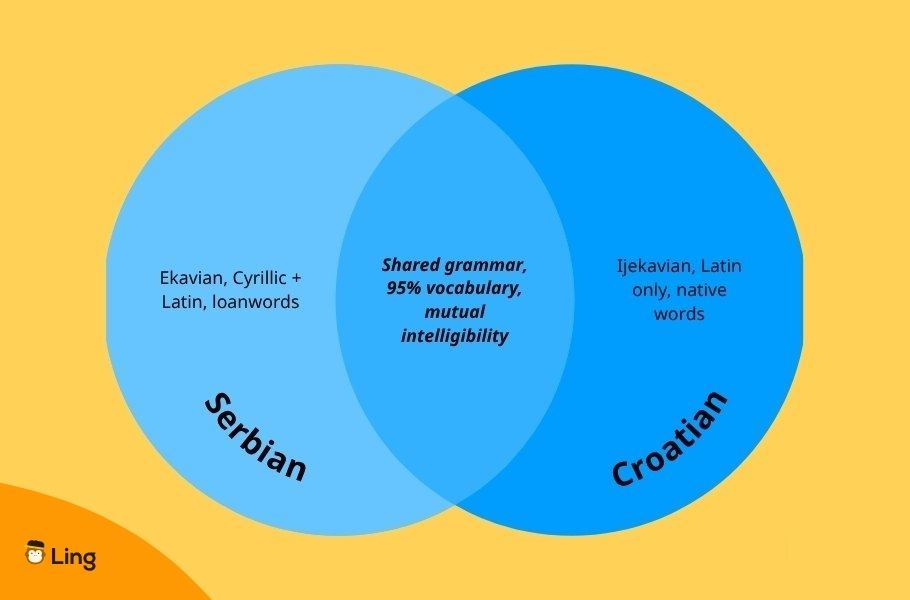
- Script is the most immediately visible difference: Serbian uses both the Cyrillic alphabet and the Latin alphabet. Croatian uses only the Latin script.
- Vocabulary is where learners notice the most day-to-day variation: Croatian prefers native Slavic words and avoids foreign words while Serbian adopts more internationalisms and loan words.
- The yat reflex creates the characteristic sound difference: standard Serbian uses Ekavian (mleko), standard Croatian uses Ijekavian (mlijeko).
- Grammar is nearly identical — same case system, same verb conjugations, same core structure across both standard languages.
How Serbian And Croatian Ended Up As Two Languages
To understand why Serbian and Croatian are treated as separate languages today, you need to understand where they came from. Both belong to the South Slavic language family, and both are based on the Shtokavian dialect; the same dialect that also forms the basis for Bosnian and Montenegrin. That’s four countries, four standard languages, one shared dialect foundation.
The Serbo-Croatian language — srpskohrvatski or hrvatskosrpski, depending on which side of the border you were on, was the official language of Yugoslavia for most of the 20th century. It served as the lingua franca of a unified state, and speakers from Belgrade to Zagreb to Sarajevo communicated without much difficulty.
The term “Serbo-Croatian” itself dates back to the 19th century. Jacob Grimm used it in 1824, and the standardization effort began formally with the Vienna Literary Agreement of 1850, signed by Croatian and Serbian writers and philologists before any Yugoslav state existed.
After the breakup of the former Yugoslavia in the 1990s, everything changed politically.
- Croatia standardized Croatian.
- Serbia standardized Serbian.
- Bosnia and Herzegovina recognized Bosnian as a third official standard.
- Montenegro eventually codified Montenegrin as a fourth.
The International Criminal Tribunal for the former Yugoslavia used the designation “Bosnian/Croatian/Serbian” (BCS) for translation work; a practical acknowledgment that the languages differ from each other but not so much that separate translators are needed.
So when you ask whether Serbian and Croatian are the same language or separate languages, the honest answer is: they share a single linguistic base, but are recognized today as distinct standard languages with their own literary traditions, standardization bodies, and national identities. Calling them totally different languages is linguistically wrong. Calling them identical would be politically and culturally wrong too.
The nuance sits somewhere in between, and that’s actually a fascinating place to sit if you’re a language learner.
Keep reading to learn about all the differences and similarities.
The Core Differences Between Serbian And Croatian
Script: The Gap You See Before You Hear A Word
This is the single most visible difference between the two languages.
- Serbian officially uses both the Cyrillic alphabet and the Latin script. In practice, Cyrillic is considered the traditional and more formal script in Serbia, while Latin is widely used in informal writing, online communication, and much of everyday signage. Both are correct. Both are taught in Serbian schools.
- Croatian uses only the Latin alphabet, the same one you’re reading now, with a few additional characters using diacritics (č, ć, š, ž, đ). There is no Croatian Cyrillic tradition in modern standard use.
The Serbian Cyrillic alphabet was reformed and standardized by linguist Vuk Stefanović Karadžić in the 19th century on a strict phonemic principle: one letter, one sound. The Croatian Latin alphabet was standardized around the same period by Ljudevit Gaj, who incorporated diacritics to handle sounds that the basic Latin script couldn’t represent cleanly.
For a learner, this is a practical decision. If you’re learning Serbian, learning Cyrillic is worth the investment, it takes a few hours and immediately opens up a significant amount of written text. If you’re learning Croatian, Latin script is all you need.
Vocabulary: The Differences You Actually Run Into Every Day
This is where the Serbian vs Croatian language gap feels most concrete. Croatian language policy has historically been more purist, preferring to coin new words from native Slavic roots rather than borrow from foreign languages. Serbian is more open to internationalisms and loan words, particularly from Turkish, French, and Greek origin, a legacy of different historical influences.
The result is a set of common everyday words that differ between the two standards:
| English | Croatian | Serbian |
| bread | kruh | hleb |
| milk | mlijeko | mleko |
| train | vlak | voz |
| factory | tvornica | fabrika |
| theatre | kazalište | pozorište |
| January | siječanj | januar |
| February | veljača | februar |
| March | ožujak | mart |
Month names are the starkest example of this divide. Croatian months are entirely native Slavic words — siječanj comes from an old word related to cutting wood, veljača relates to the great cold. Serbian months are the internationalized Latin-origin names used across most of Europe: januar, februar, mart.
A learner who memorizes Croatian months will need to relearn all twelve for Serbian. That’s a real, concrete difference, not just a few words here and there.
That said, context usually saves you. If you say januar in Zagreb, people know what you mean. If you say vlak in Belgrade, no one is confused. The vocabulary differences are real, but they don’t break communication.
If you’re weighing your options for structured study, there are solid free tools to get started with Croatian vocabulary before committing to a full course.
Pronunciation: The Yat Reflex
This is the difference that gives Serbian and Croatian their characteristic sounds, and it has a specific linguistic name: the yat reflex. In Old Church Slavonic, there was a vowel sound written as jat. Over centuries, that sound evolved differently in different regional dialects.
Standard Serbian (based on the Belgrade dialect) uses the Ekavian reflex: the old jat became a plain e.
Standard Croatian uses the Ijekavian reflex: the old jat became ije or je depending on syllable length.
Examples:
| Meaning | Serbian (Ekavian) | Croatian (Ijekavian) |
| milk | mleko | mlijeko |
| song | pesma | pjesma |
| child | dete | dijete |
| time / weather | vreme | vrijeme |
| place | mesto | mjesto |
| faith | vera | vjera |
One thing that surprises a lot of people: not all Serbian speakers use Ekavian. Speakers in Bosnia, Montenegro, and parts of western Bosnia use Ijekavian in their colloquial speech, meaning the pronunciation divide does not map neatly onto national borders. The standard Serbian language is primarily Ekavian, but you’ll encounter Ijekavian Serbian speakers regularly. Croatian is consistently Ijekavian in the standard.
Grammar: Nearly Identical
Here is where the Serbian vs Croatian comparison gets genuinely reassuring for learners. Grammar is almost entirely shared.
- Both languages use the same seven-case system: nominative, genitive, dative, accusative, vocative, instrumental, locative.
- The same verb conjugation patterns.
- The same core sentence structure, with the same flexible word order that characterizes South Slavic languages generally.
The differences that do exist are stylistic rather than structural.
- Croatian more commonly uses the infinitive form (hoću raditi — I want to work).
- Serbian more frequently uses the da + present tense construction (hoću da radim — literally “I want that I work”).
Both constructions exist in both languages and are understood by speakers of either standard. It’s a preference, not a rule.
The local dialects in both countries add further variation — Zagreb’s Kajkavian-influenced speech sounds different from Split’s coastal accent, and Belgrade’s urban dialect differs from the regional dialects you’d hear in Novi Sad or southern Serbia. But at the level of the standard language taught in schools and used in media, Serbian and Croatian grammar is close enough that learning one gives you the overwhelming majority of the other.
How Mutually Intelligible Are Serbian And Croatian In Practice?
I find the American and British English comparison useful up to a point. Both Serbian and Croatian speakers understand each other in the same way, the grammar is the same, most vocabulary is shared, and communication rarely breaks down. But the analogy understates a few things. Month names, certain everyday vocabulary items, and the script difference go beyond anything that separates American English from British English.
A better frame might be this: if you learn Serbian, you can understand Croatian. If you learn Croatian, you can understand Serbian.
- The vocabulary you’ll need to relearn is specific and learnable.
- The grammar transfers completely.
- The script is an extra skill for Serbian learners, but it’s not a major obstacle.
Both Serbian and Croatian are what linguists call standard languages, formally codified, with their own dictionaries, grammars, and standardization bodies.
Serbian linguists and Croatian linguists will argue passionately about the distinctness of their national language. That argument is real and worth understanding if you’re engaging with the culture. It just doesn’t change the linguistic reality that mutual intelligibility between the two is high.
Practical Tips For Serbian And Croatian Learners
If you’re visiting Serbia or Croatia:
- Start with greetings, transport, and food vocabulary because most of these are either shared or close enough to guess from context.
- Learn Cyrillic basics before visiting Serbia; street signs and menus are often in Cyrillic in smaller cities.
- Focus on the spoken language first, the vocabulary differences matter more in reading than in conversation.
If you’re living in the region long-term:
- Learn the standard of wherever you’re based: using Croatian vocabulary in Serbia and vice versa is understood but noticed.
- Master the month names for your country from day one; you’ll use them constantly in paperwork, scheduling, and conversation.
- Don’t avoid colloquial speech just because it doesn’t match the standard Serbian or standard Croatian you studied; local dialects are how people actually talk!
- For a structured approach to daily-life Serbian vocabulary, this guide on learning Serbian as an expat covers exactly what to prioritize.
If you’re reconnecting with heritage:
- Listen to which variant your family uses, Ekavian or Ijekavian, Cyrillic or Latin, and orient your learning to that.
- Pay attention to vocabulary choices in family conversation; they’ll tell you more about regional and generational background than any grammar book.
- Start with the Ling app’s Serbian course or Croatian course for structured vocabulary with native speaker audio if you’re building from scratch.
If you’re a language enthusiast:
- The yat reflex is worth studying in depth, it’s a live example of how a single historical sound produces divergent modern standards across four countries.
- Compare Croatian and Serbian month names as a case study in linguistic purism: one system deliberately avoided foreign words, the other absorbed them.
- Explore the academic debate around whether Serbian, Croatian, Bosnian, and Montenegrin constitute one pluricentric language or four separate languages, Croatian linguist Snježana Kordić argues for the former; the Serbian Board for Standardization officially contests it.
Hopefully these tips can help you get started and help you know why either Croatian or Serbian is worth adding to your language list this year.
Frequently Asked Questions About Serbian Vs Croatian Language
What Is The Difference Between Serbian And Croatian Language?
Serbian and Croatian are mutually intelligible South Slavic languages that share the same Shtokavian dialect base and nearly identical grammar. The main differences are script, vocabulary, and a pronunciation pattern called the yat reflex. Both are officially recognized as separate standard languages following the breakup of Yugoslavia in the 1990s.
Can Croatians And Serbians Understand Each Other?
Yes, easily. Serbian and Croatian speakers can hold a full conversation without translation. The degree of mutual intelligibility is high, often compared to American and British English, though some vocabulary differences (especially month names) go further than that analogy suggests. Communication rarely breaks down between speakers of the two languages.
Are Serbian And Croatian The Same Language?
Linguistically, they derive from the same Shtokavian dialect base and were officially a single language — Serbo-Croatian, until the 1990s. Today they are recognized as distinct standard languages by their respective countries, each with its own standardization bodies and official dictionaries.
Whether you consider them varieties of one pluricentric language or two separate languages is partly a political and identity question as much as a linguistic one.
Should I Learn Serbian Or Croatian?
Learn the one most relevant to your purpose. If you’re spending time in Croatia, learn Croatian. For Serbia, learn Serbian.
The grammar transfers almost entirely between the two, so learning one gives you a strong foundation for the other. The vocabulary differences are real but limited and learnable, the core difference to prepare for is month names and a set of everyday words that diverge between the two standards.
Is Croatian Harder To Learn Than Serbian For English Speakers?
Neither is significantly harder than the other. Both are FSI Category III languages, estimated at about 44 weeks (1,012 class hours) to professional working proficiency for English speakers. The main practical difference is that Serbian learners also need to learn the Cyrillic alphabet alongside Latin, which adds some early effort. Beyond that, the difficulty is equivalent.
Do Serbian And Croatian Use Different Alphabets?
Serbian officially uses both the Cyrillic alphabet and the Latin alphabet. In practice, Cyrillic is used more formally and in traditional contexts; Latin is widely used in everyday digital communication. Croatian uses only the Latin alphabet. A learner studying Serbian will benefit significantly from learning Cyrillic, it’s a separate skill that takes a few hours to grasp but opens up a large amount of written text.
Serbian Vs Croatian: What Serbian And Croatian Actually Are (And Aren’t)
Serbian and Croatian are closely related South Slavic languages with high mutual intelligibility, nearly identical grammar, and a shared history that makes them genuinely difficult to separate on purely linguistic grounds. The real differences, script, vocabulary choices, the yat reflex, are concrete and learnable. They don’t prevent communication between speakers; they reflect different histories, different cultural trajectories, and different national identities.
If you’re trying to learn Serbian or Croatian and wondering whether studying one makes the other redundant: it doesn’t, but it does make it significantly easier. The grammar is yours either way. What changes is a set of vocabulary, the script you read in, and the pronunciation pattern you internalize.
Both languages are far less covered by mainstream language apps than they deserve to be. Finding structured lessons with native speaker audio matters more than which standard you start with.
Start Learning Serbian With Ling!
Ling covers Serbian with a full structured course, native speaker audio, 200 lessons across 50 units, and content built by speakers who actually use the language. If you’re starting from scratch or picking it back up, download the Ling app and start learning Serbian with a 7-day free trial.