

Chinese is a beautiful language, but it can be challenging to learn. One of the most difficult things about learning Chinese is the different ways it uses words to describe relationships. So, if you’re looking for a simple guide to relationship vocabulary in Chinese, then this is the article for you! Here, we’ve put together a list of the most commonly used terms for relationships in Chinese so that you can start building your vocabulary and communicating with your Chinese-speaking friends and family!
Relationships are incredibly important in Chinese culture and are often viewed as the foundation of a fulfilling life. From familial ties to friendships, relationships play a central role in shaping an individual’s identity and sense of belonging. In fact, the Chinese language is filled with specific words for various family members and non-blood-related relationships, reflecting the value placed on these connections.
But here’s the thing: relationships in Chinese culture are not just about social hierarchies or obligations! They are about finding joy and meaning in life through connections with others. Whether it’s sharing a meal with loved ones, celebrating festivals with friends, or supporting one another through difficult times, relationships are the key to happiness in Chinese culture. So, whether you’re a native Chinese speaker or just beginning to learn the language, understanding the importance of relationships and the terms involved is essential to truly appreciate the richness and depth of Chinese culture.
I want to learn even more languages with Ling!
Download now!
Romantic Relationships In Chinese
Romantic relationships can be tricky, especially when cultural differences and language barriers are involved. And let’s face it; if you’re dating someone who speaks Chinese, you’re going to need to brush up on your vocab. But fear not! Here are some commonly used terms for romantic relationships in Chinese.
Husband – 丈夫 (Zhàng Fū)
This term is used to describe the man who is lucky enough to call you his wife. He’s your partner in crime, your rock, and your forever love.
Wife – 妻子 (Qī Zi) / 太太 (Tài Tai)
妻子 Qī Zi refers to the woman who stole your heart and became your partner in life. She’s the one who puts up with your quirks and loves you unconditionally.
Fiance (Male) – 未婚夫 (Wèi Hūn Fū)
未婚夫 Wèi Hūn Fū is a word used to describe the man who has put a ring on it and is ready to commit to a lifetime of love and happiness with you.
Fiancé (Female) – 未婚妻 (Hūn Qī)
未婚妻 Hūn Qī refers to the woman who said yes to your proposal and is ready to embark on a journey of love and commitment with you.
Boyfriend – 男朋友 (Nán Péng Yǒu)
男朋友 Nán Péng Yǒu is used to describe the man who is currently stealing your heart and making you swoon with his sweet words and actions.
Girlfriend – 女朋友 (Nǚ Péng Yǒu)
女朋友 nǚ péng yǒu refers to the woman who is currently making your heart skip a beat with her beauty, charm, and amazing personality.
Ex-boyfriend – 前男友 (Qián Nán Yǒu)
前男友 qián nán yǒu refers to Chinese men who used to hold a special place in your heart but are no longer a part of your life.
Ex-girlfriend – 前女友 (Qián Nǚ Yǒu)
前女友 qián nǚ yǒu refers to Chinese women who used to make your heart race but are now just a memory.

Immediate Family Relationships
When it comes to relationships in Chinese, it’s not just about romantic love. Family relationships are just as important, if not more so. So let’s dive into the vocabulary you’ll need to navigate Chinese culture’s complex web of family ties.
Mother (Formal) – 母亲 (Mǔqin)
母亲 Mǔqin is the term used to refer to a mother in a formal or official setting, like in a business or legal document.
Mom (Informal) – 妈妈 (Māma)
妈妈 Māma is the queen of all moms, the one who can make everything better with a warm hug and a plate of dumplings.
Father (Formal) – 父亲 (Fùqin)
Similar to 母亲, this is the more formal term for a father.
Dad (Informal) – 爸爸 (Bàba)
This is a common term for a father, often used in casual settings and daily life.
Older Brother – 哥哥 (Gēge)
This big brother will always have your back and ensure you’re safe, even if it means getting into a few scrapes.
Older Sister – 姐姐 (Jiějie)
This is the sister who will always be there to share secrets with and give advice.
Younger Brother – 弟弟 (Dìdi)
This is the little bro you can play pranks on but still look up to you as an example of what it means to be a man.
Younger Sister – 妹妹 (Mèimei)
This is the little princess of the family, the one who will always look up to you and admire your every move.
Son – 儿子 (Érzi)
This is the little guy who always makes you proud and will one day take over the family business.
Daughter – 女儿 (Nǚ’ér)
This is the little girl who will always be a special part of your heart.
Extended Family Relationships
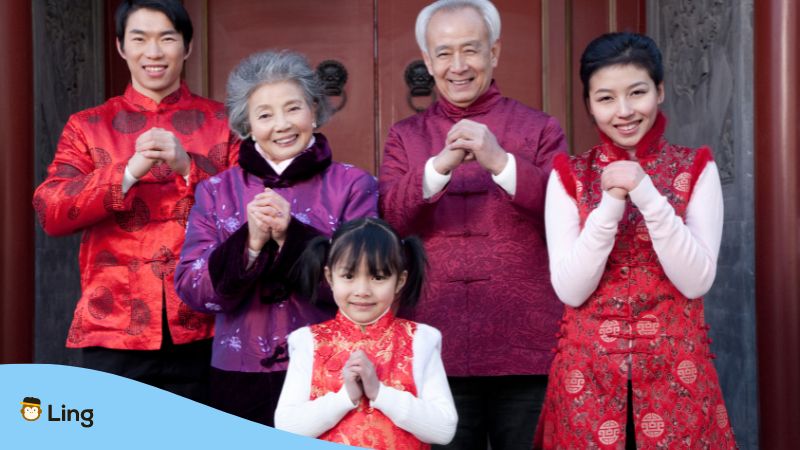
Here are other terms in the Chinese language you can use to talk about your extended family members.
| English | Chinese | Pinyin | Sound |
| Grandpa (on the father’s side) | 爷爷 | Yé ye | |
| Grandma (on the father’s side) | 奶奶 | Naǐ nai | |
| Grandpa (on the mother’s side) | 外婆 | Waì pó | |
| Grandpa (on the mother’s side) | 外公 | Waì gōng | |
| Aunt (mother’s sisters) | 阿姨 | ā yí | |
| Aunt (father’s sisters) | 姑姑 | Gū gu | |
| Uncle (father’s younger brothers) | 叔叔 | Shū shu | |
| Uncle (father’s older brothers) | 伯伯 | Bó bo | |
| Uncle (mother’s brothers) | 舅舅 | Jìu jiu | |
| Aunt (mother’s sister-in-law) | 舅妈 | Jìu mā | |
| Cousin (younger female cousin on mother’s side) | 表妹 | Biǎo mèi | |
| Cousin (older female cousin on mother’s side) | 表姐 | Biǎo jiě | |
| Cousin (older male cousin on father’s side) | 堂哥 | Táng gē | |
| Cousin (younger male cousin on father’s side) | 堂弟 | Tāng dì | |
| Brother’s daughter | 侄女 | Zhínǚ | |
| Sister’s daughter | 外甥女 | Wàishengnǚ | |
| Brother’s son | 侄子 | Zhízi | |
| Sister’s son | 外甥 | Wàisheng |
Casual Relationships
Here are some common ways to refer to people you know casually but aren’t romantically or biologically related to you.
| English | Chinese | Pinyin | Sound |
| Friend | 朋友 | Péng Yǒu | |
| Acquaintance | 熟人 | Shú Rén | |
| Classmate | 同学 | Tóng Xué | |
| Teacher | 老师 | Lǎo Shī | |
| Colleague | 同事 | Tóng Shì | |
| Boss | 老板 | Lǎo Bǎn | |
| Manager | 经理 | Jīng Lǐ | |
| Employee | 雇员 | Gù Yuán | |
| Assistant | 助理 | Zhù Lǐ | |
| Client | 客户 | Kè Hù | |
| Roommate | 室友 | Shì You | |
| Landlord | 房东 | Fáng Dōng | |
| Neighbor | 邻居 | Lín Jū |
Master Relationship Vocabulary In Chinese
If you’re ready to take your Chinese language skills to the next level and impress your friends, family, and potential love interests, we hope you learned much from this guide! It may seem super simple, but mastering these relationship terminologies in Chinese will impress your Chinese friends and colleagues and help you quickly navigate any social or professional situation. And if you want to learn more about the Chinese language, then be sure to check out the Ling app!
Learn Chinese With Ling App
Looking to learn a new language? Look no further than the Ling app! Our app is designed to make learning a new language engaging, fun, and effective. With interactive lessons, games, and quizzes, you’ll be speaking a new language in no time.
Plus, with various languages to choose from, you’ll never run out of new linguistic adventures to embark upon. So why settle for boring language classes? Join the Ling app party and start your language-learning journey today. Download Ling App on Play Store and App Store to try it out now!