

Let me guess: you searched for Telugu on Duolingo and came back empty-handed. Well, there’s currently no Telugu on Duolingo, which might seem surprising, as it’s a language spoken by over 90 million people worldwide.
One very good alternative that does offer a dedicated Telugu course, though, is Ling. The Ling app combines short, interactive lessons with features designed to help you build vocabulary, practice pronunciation, and develop practical language skills.
In this post, we’ll go over why there is no Telugu on Duolingo, explore some of the unique characteristics of the language, and explain why Ling is your best bet for mastering it. Let’s get started!
I want to learn even more languages with Ling!
Download now!
Why Is There No Telugu On Duolingo?
The short answer is that Duolingo hasn’t officially explained why it doesn’t offer a Telugu course. So, while we can point to several factors that may explain its absence, we can’t say for certain that any one of them is the reason.
That said, here are some likely possibilities:
- Resource Constraints: Creating a quality language course takes time, money, and a team of linguists and educators. Duolingo has to decide which languages to prioritize, and it may have focused its resources on languages with greater demand or a larger potential user base.
- The Complexity of Telugu: The script and grammatical structure of Telugu can be a challenge for course creation. For example, simple words sometimes require about 10 letter combinations. These could make Telugu more demanding to develop than some other courses.
- No Community Support: Duolingo previously relied heavily on volunteers through its Incubator program, but that program was discontinued in 2021. This means all new courses come directly from the Duolingo team, which has reduced the release of new languages significantly.
Unlike Duolingo, Ling has invested in a dedicated Telugu course, working with native speakers to create practical, interactive lessons. So, the lack of a Duolingo course shouldn’t hold you back. A complete Telugu learning experience is already available on Ling, which gives you everything you need to start learning the language.
Why Telugu Deserves A Spot On Duolingo
With more than 90 million speakers worldwide, Telugu is far from a niche language. Its large number of speakers, impressive cultural heritage, and growing global presence make a strong case for the language gaining a place on Duolingo.
Here’s why Telugu deserves to be on the platform:
- To Connect With More People: Learning Telugu can help users communicate more naturally with Telugu-speaking friends, family, colleagues, and communities around the world.
- To Explore Telugu Culture: A Telugu course would give learners a way to engage more deeply with Telugu culture, from music and literature to Tollywood movies, food, and festivals.
- To Travel With More Confidence: For anyone visiting Andhra Pradesh, Telangana, or other Telugu-speaking communities, learning some Telugu could make everyday interactions easier.
- For Professional Reasons: Telugu could be a useful skill in fields such as business, technology, healthcare, education, and customer service, particularly when working with Telugu-speaking communities.
- To Learn Something Different: Telugu would also give Duolingo users the chance to learn a language that is quite different from English, including a new script, vocabulary, and ways of expressing ideas.
Telugu: A Pillar Of Indian Culture
The Telugu language serves as the cornerstone for numerous traditions, festivals, and artistic expressions in India. Part of the Dravidian language family, Telugu is mostly spoken in the states of Andhra Pradesh and Telangana. It’s recognized as a classical language by the Government of India, and it certainly has a lot of history.
The oldest Telugu words are in inscriptions from around the 4th century BCE, and it has been an official language for over 1,400 years. But that doesn’t mean it’s languishing in the past!
On the contrary, the number of Telugu speakers is on the rise. In fact, due to a great number of box office hits from the Telugu movie industry, it’s gaining more momentum than any other Indian language. So much so that at one point, Telugu was the fastest-growing language in the US.

Is Telugu Difficult To Learn?
Telugu can be challenging for English speakers, but it isn’t necessarily as difficult as it first appears. Its script, sentence structure, and grammar may take some getting used to, but Telugu also has several beginner-friendly features that can make the learning process easier.
To give you a better idea of what to expect, let’s look at some of the areas learners may find challenging when learning Telugu.
The Telugu Abugida Script
Telugu uses an abugida script that has 54 letters with consonants and vowels combined to form syllables. The script may look unfamiliar at first, but learning the basic characters gives you a foundation for reading Telugu words.
The table below will give you an idea of how the abugida script works:
| Telugu | Pronunciation | Meaning |
| క | ka | A basic consonant |
| కా | kā | ka + long a |
| కి | Ki | ka + short i |
| కీ | kī | ka + long i |
Once you understand how these combinations work, you can start recognizing and reading new words without having to memorize every word individually.
Different Sentence Structure
English typically follows a subject-verb-object (SVO) structure, while the Telugu sentence structure generally follows subject-object-verb (SOV) order.
For example, the sentence “I am reading a book,” when translated literally from Telugu, will read “I book am-reading.”
| English | Telugu | Pronunciation | Literal Structure |
| I am reading a book. | నేను పుస్తకం చదువుతున్నాను. | Nēnu pustakaṁ caduvutunnānu. | I book am-reading. |
So, instead of putting the verb in the middle of the sentence as you would in English, Telugu usually places it at the end.
Postpositions Instead Of Prepositions
Another difference you’ll notice is that Telugu often places words that indicate relationships after the noun rather than before it, unlike English.
For example:
| English | Telugu | Pronunciation | Literal Structure |
| After me | నా తర్వాత | nā tarvāta | me + with |
| Before the house | ఇంటి ముందు | iṇṭi mundu | me + after |
| With me | నాతో | nātō | house + in |
So, while an English speaker might naturally think “with + me,” Telugu uses the equivalent of “me + with.”
Complex Grammar Rules
Telugu grammar has several features that may take some practice, including case markers, verb conjugations, and different forms used depending on who you’re speaking to. Words can change depending on their role in a sentence, who is being spoken to, and when an action happens.
For example, the verb form can change depending on the subject:
| English | Telugu | Pronunciation |
| I am going. | నేను వెళ్తున్నాను. | Nēnu veḷtunnānu. |
| You are going. | నువ్వు వెళ్తున్నావు. | Nuvvu veḷtunnāvu. |
| He is going. | అతను వెళ్తున్నాడు. | Atanu veḷtunnāḍu. |
As you would have noticed, the verb “going” changed (from veḷtunnānu to veḷtunnāvu, and then veḷtunnāḍu), depending on the usage of ‘I,’ ‘You,’ and ‘He,’ although the basic action of ‘going’ stays the same.
Formal And Colloquial Telugu
Another thing that can make Telugu confusing for beginners is that the way you write or speak can change depending on the situation. That is, there’s formal and colloquial Telugu.
Formal Telugu is more common in writing, official settings, or when speaking respectfully. Colloquial Telugu is what you’ll hear more often in everyday conversations with friends and family.
For example, “What are you doing?” can be expressed differently depending on who you’re talking to:
| Situation | English | Telugu | Pronunciation |
| Speaking respectfully | What are you doing? | మీరు ఏమి చేస్తున్నారు? | Mīru ēmi cēstunnāru? |
| Speaking casually | What are you doing? | ఏం చేస్తున్నావు? | Ēṁ cēstunnāvu? |
The meaning is essentially the same, but the wording changes with the level of formality and the person you’re speaking to.
So, of course, learning Telugu can be a bit of a challenge. However, Telugu also has several features that can make it easier for beginners to pick up. For example:
- Pronunciation Is Relatively Consistent: Telugu has fairly consistent spelling-to-sound patterns, so once you learn the sounds represented by its letters, reading unfamiliar words becomes more manageable.
- No Articles: Unlike English, Telugu doesn’t have direct equivalents of “a,” “an,” and “the.” So you don’t need to worry about deciding whether to use “a” or “the” before the noun.
- No Grammatical Gender For Every Noun: Telugu does have grammatical gender distinctions, particularly in pronouns and certain noun categories, but learners don’t have to assign masculine or feminine gender to every ordinary noun in the way they might in some other languages.
- English Loanwords Are Common: If you already speak English, you may occasionally come across familiar English words that have been adopted into everyday Telugu speech. For example, words such as bas – bus (బస్) and phōn – phone (ఫోన్) may look different in Telugu script but are recognizable once you learn how the script works.
- Telugu verb conjugation follows predictable patterns: Telugu verbs can look complicated at first because their forms change according to tense, person, and number. However, once you learn common conjugation patterns, you can apply them to many verbs
So, the best approach is to start small and focus on the basics. Once you get comfortable with the basics, you can gradually take on more advanced concepts. Telugu has its own set of patterns, and the more you practice them, the more naturally they’ll start to make sense.
Having a reliable language-learning resource like Ling can also make that process easier by giving you a structured way to learn and practice along the way.
What Common Mistakes Do Beginners Make When Learning Telugu?
The most common mistakes beginners make when learning Telugu are trying to learn too much at once, relying too heavily on English, and not practicing the language enough. Let’s take a closer look at the mistakes:
- Trying to learn everything at once: Start with the basics and gradually build your Telugu vocabulary, grammar, and speaking skills.
- Ignoring the Telugu script: Don’t rely entirely on transliterations, as learning the script early will make reading and pronunciation easier later.
- Translating directly from English: Remember that Telugu generally follows a subject-object-verb structure, so word-for-word translations may not work.
- Focusing too much on grammar: Learn useful words and phrases alongside Telugu grammar instead of waiting until you understand every rule before speaking.
- Not listening to native speakers: Regularly listening to natural Telugu can help you get used to pronunciation, rhythm, and everyday expressions.
- Being afraid of making mistakes: Making mistakes is a normal part of learning, so focus on practicing consistently rather than trying to be perfect.
This is exactly why having the right language-learning app like Ling can make a difference. Ling offers structured, comprehensive but bite-sized Telugu lessons that let you build your skills step by step. With the Ling app, you can also learn the Telugu script alongside its pronunciation, listen to native-speaker audio, and practice useful vocabulary and sentences in context.
Duolingo Vs Ling: How Do They Compare, And Which App Supports Telugu?
Both Duolingo and Ling offer engaging, gamified ways to learn languages, but there’s one important difference for Telugu learners: Ling has a dedicated Telugu course, while there’s no Telugu on Duolingo.
Beyond Telugu, the two apps also differ in the features and learning tools they offer. Here’s a quick comparison:
| Features | Duolingo | Ling |
|---|---|---|
| Learning approach | Gamified lessons and challenges. | Structured gamified lessons with practical language practice. |
| Speaking practice | Available, but more limited. | Speech recognition and dedicated speaking practice. |
| Listening practice | Audio-based exercises. | Native-speaker audio and listening exercises. |
| Bite-sized lessons | Yes | Yes |
| Price | Free with ads, Plus for premium features. | Free trial, then subscription. |
| Number of languages | 38 | 70+, including less popular and niche languages. |
| Points and achievements | Yes | Yes |
| Streaks | Yes | Yes |
| Android and iOS apps | Yes | Yes |
| Telugu Course | No | Yes |
| Thai, Punjabi, Somali, and several other less mainstream languages. | No | Yes |
If you’re looking to learn Telugu, Ling has the clear advantage because it gives you a dedicated course with tools designed to help you learn the language from the basics onward. On the other hand, there is no Telugu on Duolingo.
The Best Alternative For Learning Telugu: The Ling App
Among all the language-learning apps out there, the best option for learning Telugu is Ling. Along with its bit-sized and interactive lessons, Ling takes a gamified approach to language learning that makes it fun and motivating. It also has all the features users are looking for in a language-learning app. These include:
- Gamified lessons to keep learning engaging and motivating.
- Native-speaker audio to help you hear and practice accurate Telugu pronunciation.
- Telugu script and pronunciation.
- Review tools like flashcards and vocabulary exercises.
- Dialogues that let you practice Telugu in realistic conversations.
- Voice recognition.
- Reminders
- Multiple learning levels from beginner basics to more advanced Telugu.
Who Is The Ling App Best For?
The Ling app is a good option for learners who want a structured Telugu course rather than having to piece their learning together from different resources. It can be particularly useful for:
- Beginners who want to start with the basics and gradually build their Telugu vocabulary and grammar.
- Travelers heading to Andhra Pradesh, Telangana, or other Telugu-speaking areas who want to handle everyday conversations more comfortably.
- Heritage learners who want to reconnect with Telugu spoken by their family or community.
- Culture enthusiasts interested in Telugu movies, music, literature, and traditions who want to experience them through the language.
- Learners who prefer short, flexible lessons they can fit into their own schedule.
With Ling offering a dedicated Telugu course, it gives learners a clear alternative to Duolingo. But how does Ling compare with Duolingo as a language-learning app overall? Let’s take a closer look.
Why Serious Learners Choose Ling?
Millions of language learners worldwide trust Ling to study 70+ languages. And with more than 10 million downloads and an impressive 4.7/5 rating across the Google Play Store and Apple App Store, it’s clear that the app has become a popular choice for language learners.
But numbers only tell part of the story. So, what do learners actually like about Ling? Let’s take a look at what some users have to say:
“I love how easy it is to learn my family language through this app. I have always used YouTube tutorials and different learning apps, but this has to be the best one!”
★★★★★
Ruby
“Nice app! I’m currently learning Burmese, Cantonese, Urdu, and Lao with it. And the lessons are very understandable! I’m slowly becoming fluent. In some aspects it is even better than Duolingo. Thanks for reading!”
★★★★★
Thegamingaddict91
What You’ll Achieve In Your First Week Using Ling
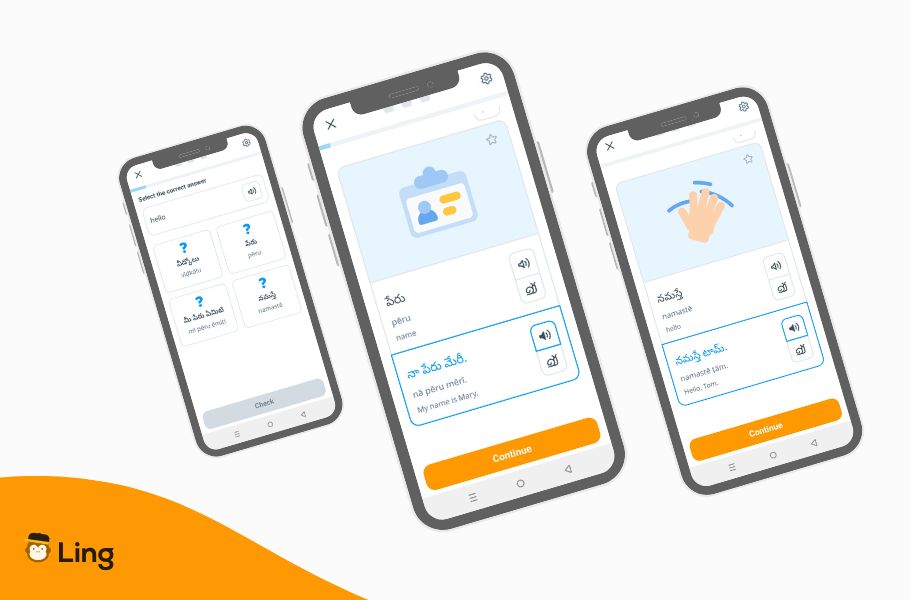
By the end of your first week using Ling, you will have built a useful Telugu foundation by learning everyday greetings, introductions, numbers, basic questions, and practical phrases. You won’t be fluent in seven days, of course, but you’ll have enough vocabulary to start recognizing and using simple Telugu.
Here’s an example of what that first week could look like:
| Day | What You’ll Learn | Examples From Ling’s Telugu Course |
|---|---|---|
| Day 1 | Greetings | Hello – Namastē (నమస్తే) Hello Tom – Namastē Tām (నమస్కారం టామ్) |
| Day 2 | Personal Introductions | My name is Mary – Nā pēru Mērī (నా పేరు మేరీ) Hello, what is your name? – Namastē, mī pēru ēmiṭi? (నమస్తే, మీ పేరు ఏమిటి?) |
| Day 3 | Greetings | Goodbye – Vīḍkōlu (వీడ్కోలు) Goodbye, see you soon – Vēḷi vastānu, tvaralō kaluddām (వెళ్తాను, త్వరలో కలుద్దాం) |
| Day 4 | Basic Numbers & Counting | One, two, three – Okaṭi, reṇḍu, mūḍu (ఒకటి, రెండు, మూడు) How much is it? – Dāni dhara enta? (దాని ధర ఎంత?) |
| Day 5 | Useful Phrases / Politeness | Please – Dayacēsi (దయచేసి) Thank you very much – Cālā dhanyavādālu (చాలా ధన్యవాదాలు) |
| Day 6 | Food & Cafe Dining | Coffee, please – Kāphī, dayacēsi (కాఫీ, దయచేసి) |
| Day 7 | Fundamental Questions | Where is…? – Ekkada undi? (ఎక్కడ ఉంది?) Do you speak English? – Mīru iṅglīṣ māṭlāḍatārā? (మీరు ఇంగ్లీష్ మాట్లాడతారా?) |
You can actually try out the Ling app for free using the 7-day free trial. This will give you a chance to explore the app’s features and see if it’s the right fit before committing to a subscription.
No Telugu On Duolingo: Frequently Asked Questions
Is There Telugu On Duolingo?
No, there is currently no Telugu course available on Duolingo. If you want to learn Telugu through a dedicated language-learning app, Ling offers a Telugu course with interactive lessons, pronunciation practice, native-speaker audio, and practical vocabulary.
What’s The Alternative To Duolingo For Learning Telugu?
Ling is a great alternative to Duolingo for learning Telugu. It offers a dedicated Telugu course with bite-sized, interactive lessons, native-speaker audio, pronunciation practice, and tools that help you build practical language skills step by step.
Why Is Telugu Considered A Hard Language To Learn?
Telugu can be challenging for beginners because of its unique script, sentence structure, and grammar. However, its consistent patterns make it easier to understand with practice, and a structured learning app like Ling can help you tackle these challenges one step at a time.
Should I Learn Telugu?
Yes, Telugu is a great language to learn if you want to connect with more than 90 million speakers worldwide and explore a rich cultural tradition. You could learn it because you’re interested in Telugu culture, traveling, connecting with Telugu-speaking communities, or simply learning a new language. There are plenty of good reasons to give it a try.
How Long Does It Take To Learn Telugu?
The time it takes to learn Telugu depends on your goals, study routine, and previous language-learning experience. Consistent practice can help you build basic vocabulary and conversational skills before gradually progressing to more advanced Telugu.
Start Learning Telugu Today (7-Day Free Trial)
And there you have it! The lack of Telugu on Duolingo shouldn’t stop you from learning the language. Ling gives you a dedicated Telugu course with structured, bite-sized lessons designed to make learning practical and enjoyable.
Millions of learners worldwide trust Ling to study 70+ languages, with more than 10 million downloads and an impressive 4.7/5 rating across the Google Play Store and Apple App Store.
So, why not see for yourself what all the fuss is about? Try Ling free for seven days, learn the Telugu language, and start building your skills.
Download Ling and start learning Telugu today!