

The most spoken languages in the world include English, Mandarin Chinese, Hindi, Spanish, and Modern Standard Arabic, with English leading the list at around 1.5 billion speakers worldwide.
In this guide, we explore these widely spoken languages, compare native and total speaker counts, highlight where each language is used, and explain the historical, cultural, and practical reasons behind their global reach.
Let’s dive right in!
I want to learn even more languages with Ling!
Download now!
Key Takeaways
- The 10 most spoken languages are English, Mandarin Chinese, Hindi, Spanish, Modern Standard Arabic, French, Bengali, Portuguese, Malay, and Urdu.
- English is the most spoken language in the world, with around 1.5 billion speakers.
- English has one of the widest global reaches.
- Mandarin Chinese has the most native speakers, with close to 1 billion native speakers worldwide.
- Languages become widely spoken for many reasons, including population size, migration, education, etc.
Top 10 Most Spoken Languages In The World
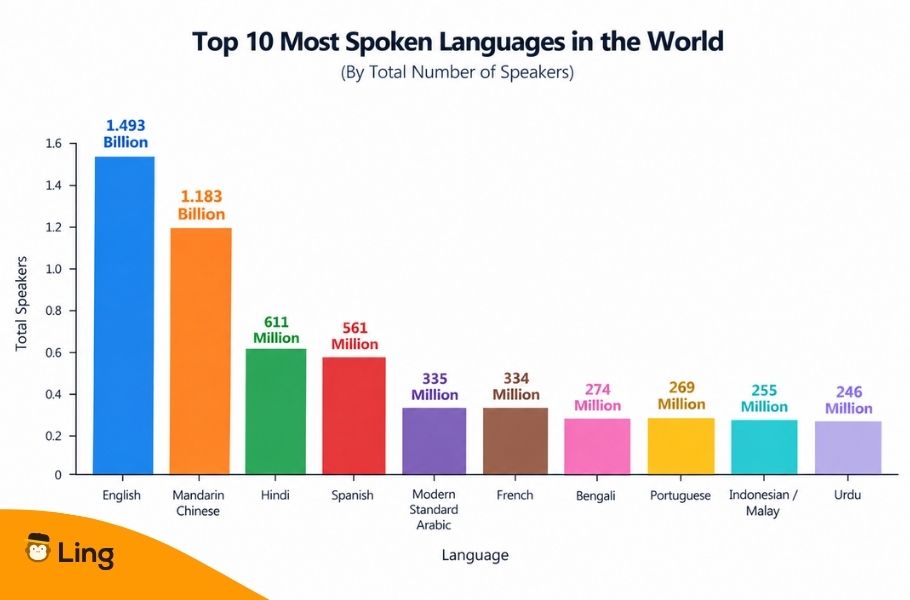
The top 10 most spoken languages in the world are English, Mandarin Chinese, Hindi, Spanish, Modern Standard Arabic, French, Bengali, Portuguese, Malay, and Urdu. Here’s a quick overview:
| Rank | Language | Language Family | Total Speakers | Native speakers | Second-language speakers | Major Countries/Regions |
|---|---|---|---|---|---|---|
| 1 | English | Indo-European | 1.493 Billion | 372 Million | 1.121 Billion | United Kingdom, United States, Canada, Australia, Nigeria, India |
| 2 | Mandarin Chinese | Sino-Tibetan | 1.183 Billion | 988 Million | 194 Million | China, Taiwan, Singapore. |
| 3 | Hindi | Indo-European | 611 Million | 347 Million | 264 Million | India, Nepal, Fiji. |
| 4 | Spanish | Indo-European | 561 Million | 487 Million | 75 Million | Spain, Mexico, Colombia, Argentina, USA. |
| 5 | Modern Standard Arabic | Afro-Asiatic | 335 Million | 0 | 335 Million | Middle East, North Africa. |
| 6 | French | Indo-European | 334 Million | 75 Million | 258 Million | France, Canada, Western & Central Africa. |
| 7 | Bengali | Indo-European | 274 Million | 234 Million | 43 Million | Bangladesh, India (West Bengal). |
| 8 | Portuguese | Indo-European | 269 Million | 252 Million | 18 Million | Brazil, Portugal, Angola, Mozambique. |
| 9 | Indonesian/Malay | Austronesian | 255 Million | 78 Million | 177 Million | Indonesia, Malaysia, Singapore. |
| 10 | Urdu | Indo-European | 246 Million | 78 Million | 168 Million | Pakistan, India |
Note: Modern Standard Arabic is generally not acquired as a native first language in the same way as regional Arabic varieties; it is primarily learned formally as a second language.
Why Are The Most Spoken Languages In The World Widely Spoken?
The world’s most spoken languages are widely used because of factors such as large populations, migration, education, trade, history, and international communication. These factors can help a language spread beyond its original community and gain millions of additional speakers as a second or foreign language.
Here’s a closer look at these factors:
Large Native-Speaking Populations
Population size is one of the most obvious reasons why some languages are among the most spoken languages in the world. Mandarin Chinese, for example, has an exceptionally large native-speaking population, largely concentrated in China. It is, in fact, the largest language in the world, if you count only native speakers.
Hindi also benefits from India’s huge population. It is widely used across the country and throughout parts of South Asia.

Language Usage Across Borders
Some languages have become the most widely spoken because they are used outside the communities where they originated. Spanish is a good example. Major Spanish-speaking populations are spread across Europe and the Americas.
Portuguese also has a similar advantage. There’s an enormous Portuguese-speaking base in Brazil. It’s also used across several other countries.
The Influence Of Education, Business And Technology
A language can gain millions of additional speakers when people learn it for practical reasons. English, which is the most widely spoken language, is the clearest example.
English is widely used in international business, science, education, travel, and digital communication. This encourages people around the world to learn it as a second language. In fact, the number of people who speak English as an additional language is far greater than its native-speaking population.
History And Cultural Influence
History has also played an important role in determining where major languages are spoken today. For example, colonial expansion helped spread languages such as English, French, Spanish, and Portuguese across continents.
Where Are the Most Spoken Languages Used Around The World?
The world’s most spoken languages have different geographic footprints. Some are concentrated in a few countries, while others have spread across continents through migration, trade, education, and historical influence.
English, which is the most spoken language in the world, has one of the widest geographic reaches of any language. It is the main language in countries such as the United States, the United Kingdom, Canada, Australia, and New Zealand. It also serves as an official or widely used second language in many countries across Africa and Asia.
On the other hand, Mandarin is spoken primarily in China and Taiwan. It has an enormous native-speaking population because of China’s size. Hindi and Bengali are also quite similar. Hindi is primarily spoken in India, where it is one of the country’s major languages. Bengali also has its strongest concentration in Bangladesh and the Indian state of West Bengal.
Most Spoken Languages In The World: FAQ
What Is The Most Spoken Language In The World?
English is the most spoken language in the world when native and second-language speakers are counted together, with around 1.5 billion speakers worldwide.
What Language Has The Most Native Speakers?
Mandarin Chinese has the largest native-speaking population in the world. It has close to 1 billion native speakers.
How Many Languages Are Spoken In The World?
There are more than 7,000 living languages spoken around the world, although the exact number varies depending on how languages and dialects are classified.
Which Language Is Spoken In The Most Countries?
English is generally considered the most geographically widespread language, with official or widely used status in countries across multiple continents.
Learn New Languages With Ling
These widely spoken languages show just how powerful language can be in connecting people across countries and cultures. This is why learning another language can be an important tool for connection, as it allows you to understand a new culture, communicate with more people, and connect with people from different backgrounds.
The journey of learning a new language can, however, be somewhat demanding. But it can be easier with a language-learning app like Ling.
Through interactive lessons, practical dialogs, and features like native-speaker audio and mini-games, Ling is designed to help you build your skills at your own pace. In fact, the Ling app has been helping learners around the world for years, with 10M+ downloads and a 4.7/5 rating across the Google Play Store and Apple App Store.
So, ready to begin? Download the Ling app and start learning a new language today.