If you’re looking to learn a new language, the Ling app and LingoDeer are two solid options, but which one is best for your needs?
Ling and LingoDeer have a few similarities, such as gamified lessons, native-speaker audio, and several review features. But they also have key differences, such as the number of languages they teach, how much conversational practice they offer, and more.
In this post, we’ll thoroughly compare Ling vs LingoDeer by going over their main features, their course structure, which learners they’re best suited for, how much they cost, and more. The plan is that by the end, you’ll know everything you need to make a decision between them.
I want to learn even more languages with Ling!
Download now!
Ling Vs LingoDeer: Quick Comparison
Let’s start with a quick comparison table on Ling vs LingoDeer before we delve any deeper.
| Feature | Ling | LingoDeer |
|---|---|---|
| Languages offered | 70+ languages | 19 languages |
| Short, gamified lessons | ✓ | ✓ |
| Ideal for beginner/intermediate learners | ✓ | ✓ |
| Speaking & pronunciation practice | ✓ | Limited |
| Flexible lesson plan | ✓ | ✗ |
| Instant pronunciation feedback | ✓ | ✗ |
| Cultural notes | For some languages | ✗ |
| Grammar explanations | For some languages | ✓ |
| Non-Latin script writing practice | ✓ | ✓ |
| Native-speaker audio | ✓ | ✓ |
| Vocabulary in context | ✓ | ✓ |
| Streaks & progress tracking | ✓ | ✓ |
| Flashcards & vocabulary bank | ✓ | ✓ |
| Short videos | ✗ | ✓ |
| Spaced repetition review | ✗ | ✓ |
| Travel phrasebook | ✗ | ✓ |
| Free version | 7-day free trial | First unit free |
| Pricing | $16.99/month $89.99/year | $14.99/month $95.99/year |
In short, Ling and LingoDeer share many similarities, including short, interactive lessons, native-speaker audio, flashcards, and a vocabulary bank. As for differences, the main ones are that Ling offers instant pronunciation feedback, more conversational practice, cultural notes for some languages, and a flexible lesson plan, while LingoDeer has spaced repetition reviews, short videos, and a free travel phrasebook.
What Is Ling, And Who Is It Best For?
Ling is a language-learning app designed to make the learning process fun and interactive. It has gamified features such as mini-games, streaks, points, and achievements, and several essential features for learning a language, like native-speaker audio, review options, and dialogs to practice conversations.
As such, the Ling app is ideal for several types of users:
- Travelers looking to connect with the locals
- Expats seeking to become part of a community
- Heritage learners who want to (re)connect with their roots
- Those seeking to better connect with their partner and their families
- Curious learners interested in languages that most people skip over
What Are The Main Features Of The Ling App?
The Ling app has several practical features, such as short, gamified lessons, native-speaker audio, several review options, character practice for non-Latin scripts, and more. It also offers 70+ languages, with a special focus on underrated languages that other apps ignore.
The Ling app’s main features include:
- More than 70 languages to learn
- Several uncommon languages that other apps skip over
- A special focus on Southeast Asian and Eastern European languages
- Short, interactive lessons you can complete in 5-10 minutes
- Gamified features like points, leaderboards, streaks, and achievements
- Native-speaker audio
- Finger tracing for several non-Latin scripts
- Dialogs to practice conversations
- Grammar and culture notes for several languages
- Practical vocabulary you can use in real life
- Several review options, such as tests, flashcards, and a personal vocabulary bank
- And much more
What Is LingoDeer, And What Type Of Learners Use It?
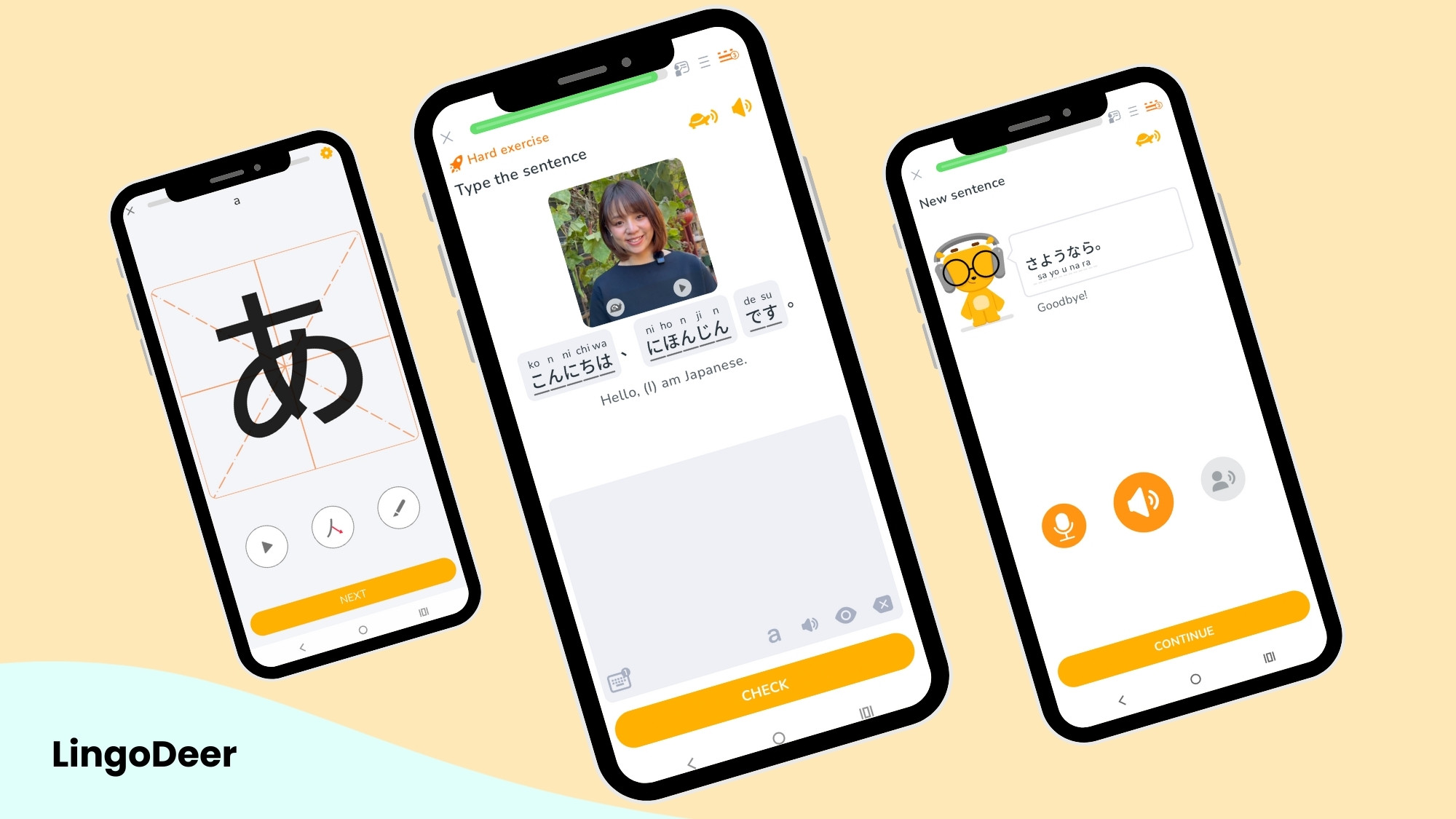
LingoDeer is also a language-learning app that uses gamified features to make learning more fun and interactive. Much like Ling, it has several features that turn learning into a game, such as experience points, streaks, and leaderboards. It also offers native-speaker audio, flashcards to review with the spaced repetition technique, short videos that accompany lessons, and more.
As such, it’s ideal for beginner and intermediate learners, as its more advanced lessons follow the Common European Framework of Reference for Languages (CEFR) and go up to level B1.
What Are The Main Features Of LingoDeer?
LingoDeer’s main features include:
- Short, interactive lessons that take 5-10 minutes
- Gamified features like experience points, gems, achievements, and streaks
- Native-speaker audio
- Character practice for non-Latin scripts
- Short videos that accompany lessons
- Review options like quizzes, targeted practice, and flashcards with spaced repetition
- Grammar explanations
- Travel phrasebooks with practical vocabulary
- A news feed with updates, tips, and extra resources
- A community feature where you can hear other learners’ audio recordings
- Reading and speaking practice
- AI explanations for mistakes made during the lessons
Is Ling Better Than LingoDeer For Speaking And Conversation Practice?
The Ling app is better than LingoDeer when it comes to speaking and conversation practice. That’s because it has instant feedback on pronunciation in the main lessons, plus dialogs for conversational practice. LingoDeer, on the other hand, only has pronunciation feedback on a separate speaking section, and it is a bit slow.
Having the Ling app correct your mistakes in real time can be quite valuable, as research backs the idea that corrective feedback is more effective than just listening. Moreover, the Ling app’s dialogs feature is designed to let you practice scripted, real-life conversations in a safe environment, and the app includes short dialogs at the end of each lesson.
So while LingoDeer does have speaking practice, it’s limited to only speaking, not conversations, and it isn’t as fast and practical as the Ling app’s instant feedback and conversational practice.
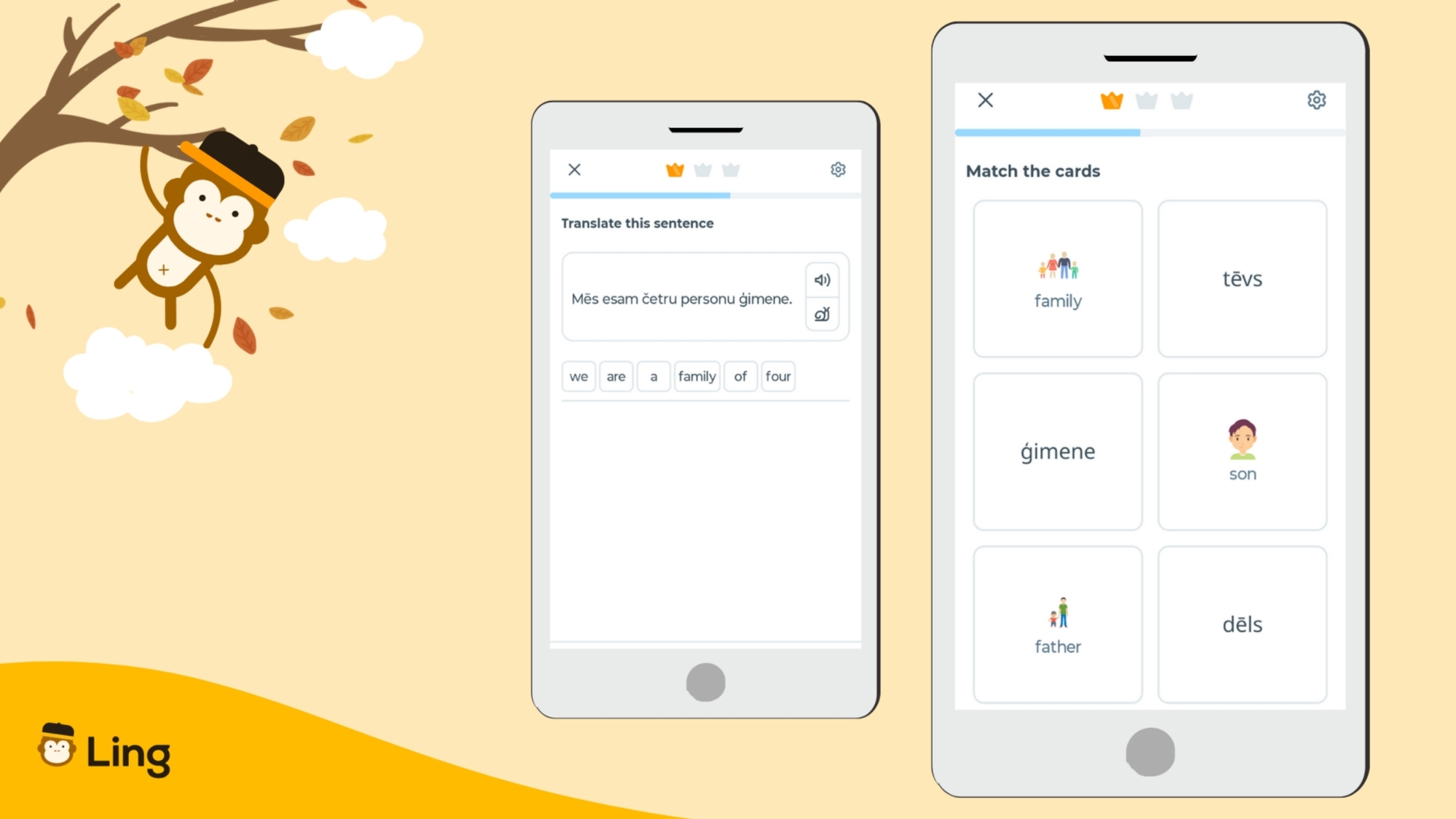
Ling Vs LingoDeer: Course Structure And Lesson Depth
Both the Ling app and LingoDeer are ideal for beginner to intermediate learners, as they aim to get you to a conversational level quickly. As such, they teach practical vocabulary in context, using real-life words and phrases, and the Ling app also provides conversational practice in the form of dialogs.
The Ling App’s Course Structure
The Ling app’s lessons are divided by topics such as ‘Numbers & Family,’ ‘Eating Out,’ Accommodation,’ Weather & Forecast,’ and more. Lessons are also divided into 5 levels, which go from beginner to advanced:
- Beginner: Units 1-10
- Intermediate: Units 11-20
- Upper Intermediate: Units 21-30
- Advanced: Units 31-40
- Expert: Units 41-50
An important thing to note about the Ling app is that it doesn’t force you to follow the learning path; you can jump between lessons whenever you want and focus on topics that align with your goals.
LingoDeer’s Course Structure
LingoDeer also divides its lessons into topics such as ‘Numbers,’ ‘Seasons,’ ‘Modes of Transport,’ and more, and gives you a clear learning path to follow. However, you must do all lessons in order, although you can skip segments by taking a test.
LingoDeer separates its courses by levels, too, but each level is a separate course. Most languages are divided into three courses and cover:
- Language 1 (e.g., Japanese 1)
- Language 2 (e.g., Japanese 2)
- Fluent Language (ex. Fluent Japanese)
- Travel Phrasebook
- Character Drill
Which App Offers More Languages And Better Cultural Context: Ling Or LingoDeer?
The Ling app offers more languages than LingoDeer: Ling has 70+ languages, while LingoDeer offers only 19. Moreover, the Ling app also includes Culture Notes for several of its languages (and more are on the way!), which gives you cultural context for the language you’re learning.
LingoDeer: 19 Languages To Learn
LingoDeer offers courses for 19 languages, which are:
- Arabic
- Chinese
- French
- German
- Greek
- Hindi
- Indonesian
- Italian
- Japanese
- Korean
- Malay
- Polish
- Portuguese
- Russian
- Spanish
- Thai
- Turkish
- Ukrainian
- Vietnamese
The Ling App: 70+ Languages To Learn
On the other hand, the Ling app offers over 70 languages to learn, many of which are uncommon or rare languages, and with a special focus on Southeast Asian and Eastern European languages.
The languages the Ling app offers are:
- Western Europe: Swedish, Spanish, Portuguese, Norwegian, Italian, Irish, Icelandic, German, French, Finnish, English, Dutch, Danish, Catalan
- East Asia: Taiwanese Hokkien, Mongolian, Korean, Japanese, Chinese Traditional, Chinese Simplified, Cantonese
- Southeast Asia: Sundanese, Javanese, Thai, Vietnamese, Tagalog, Malaysian, Lao, Khmer, Indonesian, Cebuano, Burmese
- South Asia: Punjabi, Urdu, Telugu, Tamil, Sinhala, Pashto, Nepali, Marathi, Malayalam, Kannada, Hindi, Gujarati, Bengali
- Caucasus: Georgian, Armenian
- Middle East: Turkish, Persian, Hebrew, Arabic
- Africa: Yoruba, Swahili, Somali, Amharic, Afrikaans
- Central Asia: Kazakh, Uzbek, Azerbaijani
- Oceania: Māori
- Eastern Europe: Ukrainian, Sorbian, Slovenian, Slovak, Serbian, Russian, Romanian, Polish, Lithuanian, Latvian, Hungarian, Greek, Estonian, Czech, Croatian, Bulgarian, Bosnian, Albanian

Cultural Context On The Ling App And LingoDeer
As mentioned, the Ling app includes Culture Notes in several of the languages it offers, including Thai, Tagalog, Albanian, Serbian, Punjabi, Urdu, and more. Since LingoDeer doesn’t offer a similar feature, the Ling app takes the win when it comes to cultural context.
Research shows how important the relationship between language and culture can be, so including it in a language app can have a great impact on learning. As for how the Culture Notes work, they’re short explanations of cultural aspects related to the language you’re learning.
For example, the Culture Note on Unit 3 of the Punjabi course, which is ‘Numbers & Family,’ covers apologies in Punjabi Culture.
It teaches you that “In Punjabi culture, apologies are about humility (nimrata – ਨਿਮਰਤਾ) and empathy (hamdardi – ਹਮਦਰਦੀ). It’s not just about saying “sorry,” but about preserving harmony and respect in the community.” Moreover, the Culture Note includes various ways to apologize in the Punjabi language.
Ling Vs LingoDeer Pricing: Is Ling Worth Paying For?
Considering the vast amount of languages covered by the Ling app, the fact that it offers more conversational and speaking practice, and the extra cultural context for some languages, the scale leans toward Ling as far as which offers more value for almost the same amount of money.
The pricing of the Ling app and LingoDeer doesn’t differ that much. Ling costs $16.99 per month, and LingoDeer costs $14.99 per month. That said, even when Ling does cost a couple of dollars more than LingoDeer for the monthly subscription, it’s the other way around for the yearly plan: Ling costs $89.99, and LingoDeer costs $95.99.
Here are the subscription plans for both Ling and LingoDeer.
| Ling | LingoDeer |
|---|---|
| 1 month: $16.99 | 1 month: $14.99 |
| 3 months: $39.99 | |
| 6 months: $64.99 | |
| 1 year: $89.99 (with 7-day free trial) | 1 year: $95.99 (with 7-day free trial) |
| 3 years: $189.99 | |
| 6 years: $239.99 |
As you can see, Ling and LingoDeer don’t differ too much when it comes to pricing, but they do have different plans. Both offer monthly and yearly plans, but Ling has a 6-month plan while LingoDeer offers plans for 3 and 6 years.
What Do Learners Say About Ling Vs LingoDeer?
Ling and LingoDeer are quite evenly matched on the App Store and Google Play. Ling has 4.8 stars on Google Play and 4.6 on the App Store, while LingoDeer has 4.5 stars on Google Play and 4.8 on the App Store.
So let’s see what users have to say about them with some reviews taken directly from Google Play:
What One User Loved About Ling
“I’ve been looking for an app to sub out for duolingo. Instantly, I knew that I made a good choice. the conversational parts are wonderful. To see and hear how people talk, rather than learning random words with little context.“
★★★★★
Aisling Pedrotti
What One User Loved About LingoDeer
“Probably one of the best language learning apps, especially for grammar. Everything is explained well & the example sentences are realistic. Been using it for 130+ days now and am still super in love with it! I’d absolutely welcome further additional courses for available languages, as well as new languages (such as Scandinavian ones), because this app makes learning super easy & fun for me.”
★★★★★
Giuramento Ira
Ling Vs LingoDeer: Pros And Cons
Still having trouble choosing between Ling vs LingoDeer? Here’s a quick recap of their main pros and cons:
| Ling | LingoDeer | |
|---|---|---|
| Pros | • 70+ languages to learn • More speaking and conversational practice • Culture Notes for some languages • Instant pronunciation feedback • Flexible lesson plan • Ideal for beginner/intermediate learners • Short, gamified lessons | • Grammar explanations • Short videos at the end of lessons • Spaced repetition reviews • AI explanations for mistakes • Travel phrasebook • Ideal for beginner/intermediate learners • Short, gamified lessons |
| Cons | • No videos, only images and audio • Grammar explanations only for some languages • Review features don’t use spaced repetition | • Only 19 languages • Limited speaking practice • Fixed lesson plan • Lacks cultural context • Design can look a bit childish |
As you can see, Ling’s main wins are the vast amount of languages it offers and features like Culture Notes and instant pronunciation feedback, while LingoDeer offers videos and spaced repetition reviews. As for cons, the Ling app doesn’t include videos or spaced repetition, and LingoDeer has limited speaking practice, no cultural explanations, and its design choices can feel a bit childish at times.
Which App Should You Choose Based On Your Learning Goal?
The Ling app is your best choice if you’re looking for more pronunciation practice, cultural context for some languages, and want to learn Eastern European, Southeast Asian, or uncommon languages. LingoDeer might be a good option if you want videos on your lessons, need more grammar explanations, and want to review using the spaced repetition technique.
Choose Ling If You
- Are a traveler or expat looking to connect with the locals
- Want to (re)connect with your heritage via language
- Are curious to learn uncommon or rare languages that many apps don’t offer
- Want to learn an Eastern European or Southeast Asian language
- Need more speaking or conversation practice
- Want instant feedback on your pronunciation
- Want the option to choose which topics to learn
Choose LingoDeer If You
- Are learning popular languages like Spanish, French, or Chinese
- Like to have videos on your lessons
- Want to review what you’ve learned using spaced repetition
- Need more grammar explanations
- Want to follow a predefined learning plan
- Want to listen to other learners’ speaking practice and get ranked
Ling Vs LingoDeer: Frequently Asked Questions
Which Is Better, Ling Or Lingodeer?
That depends on your learning style and goals. The Ling app is better if you’re learning an uncommon language, especially from Southeast Asia and Eastern Europe, if you want conversational and speaking practice, and if you want instant pronunciation feedback.
LingoDeer might be a better choice if you want more grammar explanations, want to see short videos within your lessons, and want to use the spaced repetition technique for reviewing.
Which Offers More Languages, Ling Or LingoDeer?
The Ling app offers more languages than LingoDeer, as Ling offers 70+ languages and LingoDeer only 19. Moreover, the Ling app is especially good for rare and underrepresented languages, as well as those from Eastern Europe and Southeast Asia.
Which Is More Expensive, Ling Or LingoDeer?
That’s tricky. The Ling app is a bit more expensive than LingoDeer for the monthly subscription, as Ling costs $16.99 and LingoDeer costs $14.99. However, it’s the other way around for the yearly plan, because it costs $89.99 at Ling and $95.99 at LingoDeer.
Are There Any Free Trials Available For Ling Or Lingodeer?
Yes, both the Ling app and LingoDeer offer a 7-day free trial that’s linked to the yearly plan. LingoDeer also lets you try its first unit for free.
Final Verdict: Ling Or LingoDeer?
Choosing a language-learning app is never easy. You have to take into account many factors, such as your learning style and goals, the app’s features, its pricing, what learners say about it, and much more. One of the best ways to choose is to try them out for a bit and see how they work.
That said, the Ling app offers many features that LingoDeer doesn’t. For one, it’s better for conversational practice due to its dialogs. It also offers instant pronunciation feedback within the lessons, whereas LingoDeer only offers feedback on the speaking section, and it is a bit slow. What’s more, Ling has many more languages to choose from, with 70+, while LingoDeer only offers 19.
So, while we aren’t going to say that the Ling app is better than LingoDeer (that wouldn’t be very objective of us!), we will say it is better in certain areas.
If conversation practice, multiple language options, cultural context for some languages, and instant feedback appeal to you, give the Ling app a try. Remember, you can use the 7-day free trial to test it out before you commit.
Download the Ling app and start your language journey today!