Learning Bulgarian as a beginner becomes much easier with the right strategy, consistency, and a clear learning plan. This approach can even make Bulgarian’s Cyrillic script feel less confusing and help you reach a conversational level quickly.
But what’s the right strategy to learn Bulgarian for beginners? Let’s find the answer together with this beginner-friendly, step-by-step guide and get clear direction to start learning right away. We’ll also provide a structured one-week Bulgarian learning plan that’s both effective and manageable.
I want to learn even more languages with Ling!
Download now!
Learn Bulgarian For Beginners: 5 Steps To Master Bulgarian Quickly
Here are five easy steps to start learning Bulgarian from zero, with some examples for a quick head start:
1. Start With The Bulgarian Alphabet
As a beginner, start by learning the Bulgarian alphabet and getting familiar with its writing system. Briefly, Bulgarian uses the Cyrillic alphabet, which has 30 letters. Knowing these will help you read and write Bulgarian more easily.
Let’s look at some letters of the Bulgarian alphabet with their pronunciation and an example for a quick idea:
| Bulgarian Alphabet | Pronunciation | Example |
|---|---|---|
| A | ’a’ as in ‘father’ | I – az (аз) |
| Б | ’b’ as in ‘book’ | Bulgaria – Bulgariya (България) |
| B | ’v’ as in ‘van’ | water – voda (вода) |
| Г | ’g’ as in ‘go’ | city – grad (град) |
| Д | ’d’ as in ‘dog’ | yes – da (да) |
| E | ’e’ as in ‘bed’ | day – den (ден) |
| И | ’ee’ as in ‘see’ | name – ime (име) |
| M | ’m’ as in ‘man’ | mom – mama (мама) |
| H | ’n’ as in ‘no’ | no – ne (не) |
| O | ’o’ as in ‘more’ | eye – oko (око) |
Recognizing Bulgarian letters in real words is actually the key to correct pronunciation. Focus more on the unfamiliar letters and practice their pronunciation daily. If you want a complete Bulgarian letters chart, we have a complete guide on the Bulgarian Alphabet to help you learn Bulgarian easily.

2. Master Basic Everyday Bulgarian Greetings
Once you understand the Bulgarian alphabet, the second step is to learn some everyday Bulgarian greetings. With these useful phrases, you can start practicing speaking Bulgarian right away, without needing to master Bulgarian grammar.
Let’s look at some essential Bulgarian greetings that locals commonly use in their everyday lives:
| English | Bulgarian | Transliteration |
|---|---|---|
| Hello (informal) | Здравей | Zdravey |
| Hello (formal) | Здравейте | Zdraveyte |
| Good morning | Добро утро | Dobro utro |
| Good afternoon | Добър ден | Dobǎr den |
| Good evening | Добър вечер | Dobǎr vecher |
| Goodbye | Довиждане | Dovizhdane |
These phrases are a great head start for absolute beginners learning Bulgarian. Once you master these, explore our detailed guide to Bulgarian greetings to expand your vocabulary further.
3. Practice Bulgarian Counting
Next come Bulgarian numbers, another essential part of your first-week plan to learn Bulgarian for beginners. You’ll need to use them when talking about your age, telling time, or asking about prices.
The most effective way to master Bulgarian numbers is to build a foundation by learning numbers one to ten, then moving on to larger numbers. Let’s do this together:
| Number | Bulgarian Script | Transliteration |
|---|---|---|
| 1 | едно | edno |
| 2 | две | dve |
| 3 | три | tri |
| 4 | четири | chetiri |
| 5 | пет | pet |
| 6 | шест | shest |
| 7 | седем | sedem |
| 8 | осем | osem |
| 9 | девет | devet |
| 10 | десет | deset |
How To Form Larger Bulgarian Numbers?
We use the base numbers 1-10 to form the larger Bulgarian numbers. Here’s how we use them:
- To form numbers 11-19, take the base number and add nadeset (надесет-on ten) to it. For example: 11 in Bulgarian is edinadeset (единадесет), 12 is dvanadeset (дванадесет), and so on.
- To form tens (20 to 90), add deset (десет-ten) at the end of the base number. For example, 20 in Bulgarian is dvadeset (двадесет) and 13 is trideset (тридесет).
- To form numbers like 21, 35, and 46, use the word i (и- ‘and’) between the tens and the single digit. For example, 21 in Bulgarian is dvadeset i edin (двадесет и един) and 35 in Bulgarian is trideset i pet (тридесет и пет).
In Bulgarian, the base form of the numbers changes based on gender and quantity. For example, we say ‘one man’ in Bulgarian as ‘edin’ (един) and ‘one woman’ as edna (една). Similarly, when counting a group of people or things collectively, we use suffixes. For example, we say ‘two men entered’ as dvah-mah (двама).
But as a beginner, you don’t need to go into this detail; focusing on basic numbers is enough at this stage.
4. Learn To Introduce Yourself In Bulgarian Language
It’s time to build your Bulgarian vocabulary by mastering more simple phrases, like introducing yourself or asking how someone’s doing. Let’s look at some examples:
| English | Bulgarian | Transliteration |
|---|---|---|
| How are you? | Как си? | Kak si? |
| I am fine | Добре съм | Dobre sǎm |
| What about you? | А ти | A ti |
| What’s your name? | Как се казваш? | Kak se kazvash? |
| My name is Maria | Казвам се Мария | Kazvam se Mariya |
| I am Maria | Аз съм Мария | Az sǎm Mariya |
| Nice to meet you | Приятно ми е | Priyatno mi e |
| Thank you | Благодаря | Blagodarya |
5. Create A Manageable 7-Day Bulgarian Learning Plan
The last step in learning Bulgarian as a beginner is staying consistent, and you can only do that by following a clear, manageable plan. To make it easier, we’ve structured a beginner-friendly one-week plan that takes only 15-20 minutes daily.
| Days | What You Should Learn | How The Ling App Helps |
|---|---|---|
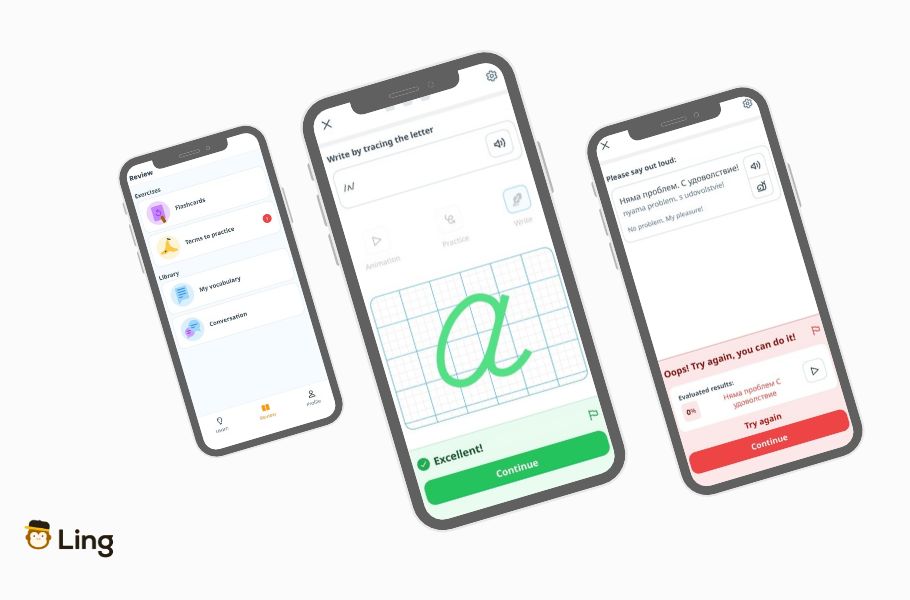
| Day 1 | Practice pronouncing and writing the Bulgarian alphabet | Ling offers finger-tracing writing exercises to help you practice Bulgarian script easily |
| Day 2 | Master basic Bulgarian greetings and everyday-use phrases | The Ling app has separate sections for Bulgarian ‘Greetings’, ‘Introduction’, and ‘Basic Phrases’ |
| Day 3 | Learn Bulgarian numbers | The Ling app has a separate section for Bulgarian ‘Numbers and Counting’ |
| Day 4 | Review what you’ve learned so far through flashcards | The Ling app now offers a flashcard review feature for quick practice |
| Day 5 | Practice recognizing Bulgarian letters in real words | Ling’s Native-speaker audio and speech recognition feature helps you achieve this |
| Day 6 | Solve multiple practice exercises to improve memory | Ling offers game-like practice exercises with every lesson |
| Day 7 | Engage in simple conversation based on your mastered vocabulary | Ling’s Dialog feature lets you practice speaking in real life |
Here comes the best part: Ling offers a 7-day free trial that gives you access to a complete Bulgarian language course. Plus, Ling’s free-trial lessons and gamified learning method can help keep you motivated.
Beginner-Friendly Tips To Learn Bulgarian Efficiently
Below are some quick tips to help you start learning Bulgarian easily and quickly:
- Familiarize yourself with the Bulgarian writing system and alphabet first thing to avoid confusion later.
- Listen to native-speaker audio and practice imitating them to master accurate Bulgarian pronunciation. Reading aloud is an effective technique to improve speaking skills.
- Don’t try to memorize everything at once. Create a manageable learning plan and stick to it.
- Practice what you’ve learned daily to improve retention. Consistency is the key to making faster progress.
Frequently Asked Questions Related To Learning Bulgarian For Beginners
What’s The Easiest Way To Learn Bulgarian For Beginners?
The easiest way to learn Bulgarian for beginners is to start with the alphabet. Once you’re familiar with Bulgarian’s Cyrillic script, move on to Bulgarian numbers, greetings, and everyday phrases to build vocabulary. A clear, manageable study routine is equally important for remembering everything.
Is Learning Bulgarian Difficult For English Speakers?
Learning Bulgarian as an English speaker can be a bit difficult because of its unique Cyrillic script. However, once you get familiar with the Bulgarian alphabet and its pronunciation, reading Bulgarian becomes much easier. However, as an absolute beginner, you’ll need a lot of time and practice to start speaking Bulgarian fluently.
How Long Does It Take To Learn Bulgarian?
Learning Bulgarian can take anywhere from a few months to a year or more, depending on your goals, study routine, and how consistently you practice. While you can learn basic greetings and everyday phrases within a few weeks, developing conversational skills requires regular practice with vocabulary, grammar, listening, and speaking. With Ling, you can progress from beginner to conversation level in just a few months.
Is Bulgarian Similar To Macedonian?
Yes! Bulgarian and Macedonian are very similar, so if you learn one, you’ll have a head start on the other. They share many words, use the Cyrillic alphabet, and have similar grammar. Still, there are some differences in pronunciation and vocabulary, so they’re not exactly the same.
Can I Learn Bulgarian In 30 Days?
Learning Bulgarian in 30 days is possible at a very basic level, but you shouldn’t expect to become conversational or understand the language comfortably in such a short time. How much you learn depends on your starting point, study time, and consistency.
What To Remember When Learning Bulgarian As A Beginner
In this article, we covered the five main steps to learning Bulgarian as a beginner. We’ve also provided a sample one-week learning plan to help you start your language learning journey right away!
Remember to review your previous lessons daily before starting a new topic to reinforce what you’ve learned. This will help you improve your Bulgarian language skills faster! You can also read our guide “How to learn a language in your spare time” for additional guidance.
Learn Bulgarian Online With The Ling App!
Now that you know where to start learning Bulgarian as a beginner, why not start it today? The Ling app is a great choice because of its structured, topic-based lessons and focus on speaking practice. These features make Ling a perfect app for beginners and intermediate learners alike.
Why not try it yourself? Download the Ling app now and join 200,000 monthly active users who have already trusted it to learn their favorite languages online. Take the first step towards fluency today!