Learning numbers is one of the simplest ways to start a new language. You’ll use them to count, ask about prices, talk about quantity, age, and time in everyday situations. The same goes for Kazakh numbers.
Kazakh, a Turkic language widely spoken worldwide, uses a logical, pattern-based numbering system. So, once you master the basic units, learning other numbers becomes way easier. In fact, once you understand the basic numbering pattern, you can form larger numbers on your own without having to memorize each one separately.
So, let’s learn Kazakh numbers in detail together!
I want to learn even more languages with Ling!
Download now!
Introduction To Kazakh Numbers
Although Kazakh uses the Cyrillic alphabet, which can be a bit challenging to decode, learning the Kazakh numbers is actually easy. Just by understanding the logical patterns and combinations, you can begin counting in Kazakh in no time.
Still, before you look at the patterns and the formula, let’s first go over the basic cardinal numbers from 1 to 10, which you’ll use most often when forming combinations
Kazakh Numbers From 0 To 9
So, ignoring the slight difficulty that the Kazakh alphabet might cause, let’s begin with the first 10 numbers, which form the basis of almost every Kazakh number.
| Numbers | Kazakh | Pronunciation |
|---|---|---|
| 0 | нөл | nöl |
| 1 | бір | bir |
| 2 | екі | ye-ki |
| 3 | үш | üsh |
| 4 | төрт | tört |
| 5 | бес | bes |
| 6 | алты | Al-ty |
| 7 | жеті | zhe-ti |
| 8 | сегіз | se-giz |
| 9 | тоғыз | to-ghy |
Before moving to the next heading, memorize at least a few of these numbers for better understanding.
List Of All The Tens: 10 To 90
So now that you can read 0 to 9 in Kazakh, it’s time to move to the next major part of the Kazakh numbers: the tens (10 to 90). Memorizing them is essential to form other compound numbers:
| Numbers | Kazakh | Pronunciation |
|---|---|---|
| 10 | он | on |
| 20 | жиырма | zhy-yr-ma |
| 30 | отыз | ot-uz |
| 40 | қырық | qy-ryq |
| 50 | елу | ye-lu |
| 60 | алпыс | al-pys |
| 70 | жетпіс | zhet-pis |
| 80 | сексен | sek-sen |
| 90 | тоқсан | toq-san |
Counting Compound Numbers: 11 And Beyond
Here comes the section that actually requires the logic. From 11 onwards, a fixed pattern is followed to form large numbers. To make it easier, let’s understand this by dividing the numbers into categories:
Use ‘On’ To Make 11 – 19
In Kazakh, we read ‘10’ as on (он). So, to build the other teen numbers (11 to 19), add the word on before the number. Let’s do it together!
Use the formula: tens + the number (unit) and follow:
| Numbers | Kazakh | Pronunciation |
|---|---|---|
| 11 | он бір | on bir |
| 12 | он екі | on ye-ki |
| 13 | он үш | on üsh |
| 14 | он төрт | on tört |
| 15 | он бес | on bes |
| 16 | он алты | on al-ty |
| 17 | он жеті | on zeh-ti |
| 18 | он сегіз | on se-giz |
| 19 | он тоғыз | on to-ghyz |
The Rest Follow The Same Pattern
Now, as you have formed the compound numbers with on (он), the same pattern (tens + units) is followed for the rest of the tens. Let’s look at some examples:
| Numbers | Kazakh | Pronunciation |
|---|---|---|
| 21 | жиырма бір | zhy-yr-ma bir |
| 31 | отыз бір | ot-uz-bir |
| 43 | қырық үш | qy-ryq üsh (deep ‘q’ sound, like ق in Arabic) |
| 54 | елу төрт | ye-lu tört |
| 66 | алпыс алты | al-pys al-ty |
| 78 | жетпіс сегіз | zhet-pis se-giz |
| 89 | сексен тоғыз | sek-sen to-ghyz |
| 95 | тоқсан бес | toq-san bes |
Have you understood the pattern here? It’s simple.
- The number 21 has twenty and one, so we read it in Kazakh as zhyyr-mabir (жиырма біp)
- Similarly, 66 has sixty and six, so we read it as alpys alty (алпыс алты)
This numbering pattern is followed throughout. See, that’s why we began learning the Kazakh numbers with basic units and the tens. They make learning numbers easier.
Counting Bigger Numbers: Hundreds, Thousands, Millions, And Billions
Like all the tens, hundreds, thousands, millions, and billions also have specific words that differentiate them.
| Numbers | Kazakh | Pronunciation |
|---|---|---|
| 100 | жүз | jüz |
| 200 | екі жүз | eki jüz |
| 300 | үш жүз | üş jüz |
| 400 | төрт жүз | Tört jüz |
| 500 | бес жүз | bes jüz |
| 600 | алты жүз | altı jüz |
| 700 | жеті жүз | jeti jüz |
| 800 | сегіз жүз | segiz jüz |
| 900 | тоғыз жүз | toğız jüz |
| 1000 | мың | myng |
| 1,000,000 | миллион | mil-lion |
| 1,000,000,000 | миллиард | mil-li-yard |
These are the basic units that we use to create their compound number forms.
However, what if you have a more complex number, for instance, 4,567, how will you read it then?
It’s also straightforward. Just follow the rule: bigger, smaller, smaller. Let me simplify it with an example.
Read 5,467 (five thousand four hundred sixty seven) in Kazakh as bes myng tört jüz al-pys zhe-ti (төрт мың бес жүз алпыс жеті). And we already know that here:
- Bes (бес) means five
- Myng (мың) means thousand
- Tört (төрт) means four
- Jüz (жүз) means hundred
- Al-pys (алпыс) means six
- Zhe-ti (жеті) means seven
Practice building more Kazakh numbers by following the same rule.
How To Read Ordinal Kazakh Numbers
The case with ordinal Kazakh numbers is a little different from that of cardinal units. To form ordinal numbers, we add a special suffix, shi (інші) or shy (нші), to every number. This choice of whether to add інші or нші suffix depends on the ending sound of the number. Let’s see how it works:
| English | Kazakh | Pronunciation |
|---|---|---|
| First | бірінші | bi-rin-shi |
| Second | екінші | ye-kin-shi |
| Third | үшінші | ü-shin-shi |
| Fourth | төртінші | tört-in-shi |
| Fifth | бесінші | bes-in-shi |
| Sixth | алтыншы | al-tyn-shy |
| Seventh | жетінші | zhe-tin-shi |
| Eight | сегізінші | se-giz-in-shi |
| Ninth | тоғызыншы | to-ghyz-yn-shy |
| Tenth | оныншы | on-yn-shy |
| Eleventh | он бірінші | on bi-rin-shi |
| Twenty First | жиырма бірінші | zhy-yr-ma bi-rin-shi |
| Forty-Third | қырық үшінші | qy-ryq ü-shin-shi |
You see, we have taken the number and added a suffix to make an ordinal number. However, don’t forget that we only add suffixes to the last part of the number by matching it with the word’s sound.
How Do You Say ‘Number’ In The Kazakh Language?
In Kazakh, we say ‘number’ as sahn (сан). And, if you want to say ‘numbers’ in plural, say sahndar (сандар).
Essential Everyday Vocabulary Related To Kazakh Numbers
Here are some other Kazakh words that you might need when visiting Kazakhstan:
| English | Kazakh | Pronunciation |
|---|---|---|
| How much? | неше? | ne-sheh |
| How many? | қанша? | qan-sha (deep Q sound) |
| Price/Cost | баға | ba-gha |
| Age | жас | zhas (zh sounds like ‘s’ in measure) |
| Hour | сағат | sa-ghat |
Let’s look at some exemple Kazakh phrases using these words:
- I am 19 years old – Me-ning ya-sym on to-ghyz-da (Менің жасым он тоғызда).
- How much does this cost? – Bul qan-sha too-ra-dy? (Бұл қанша тұрады?)
- It’s 3 o’clock – Sa-ghat üsh (Сағат үш)
Quick Tips To Help You Learn Kazakh Numbers Faster
Here are some pro tips to help you master Kazakh numbers quickly and avoid making common mistakes that most learners make!
- Begin with learning the first 10 numbers and all the tens (10-90). Once you know how to say these in Kazakh, the rest follows the fixed pattern.
- Use the formula: tens + units to form bigger numbers. For instance, in Kazakh, we say ‘1’ as bir and ‘10’ as on, so ‘11’ becomes on bir.
- Count your steps, objects, or time in Kazakh instead of English for improved memory.
- Listen to native Kazakh speakers to hear how they pronounce certain numbers, as the Kazakh alphabet has distinct vowel harmony. So, listening will really enhance your pronunciation skills.
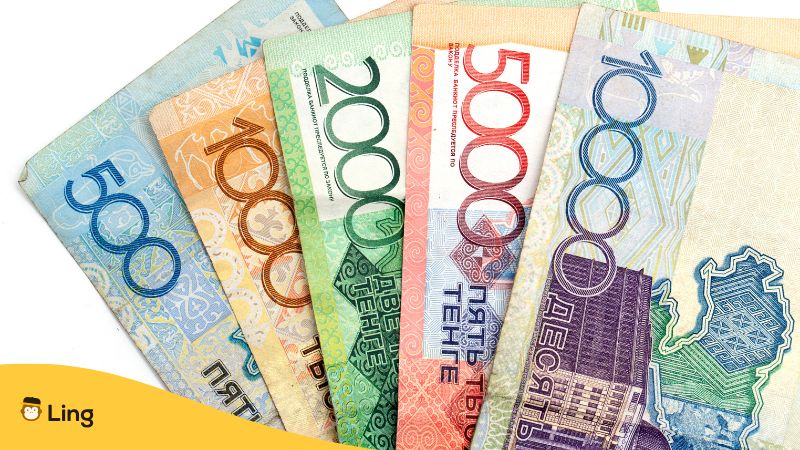
- You can also practice Kazakh numbers with prices. Find Kazakh shops or menus online and read prices aloud. It will prepare you for asking prices. Just remember Kazakhstan uses ‘Tenge’. Moreover, you can use Ling’s dialog feature to practice using numbers in real-life situations.
- To master the pattern-based structure, practice combining 2 to 3-digit numbers daily. In this way, you can understand how the combination works.
- Watch YouTube channels or listen to children’s Kazakh number songs to recall them with fun.

Frequently Asked Questions Related To Kazakh Numbers
How Many Digits Are There In Kazakhstan’s Number?
Kazakhstan’s national phone number has 11 digits. It typically looks like: +7 347-589-9315. Here, ‘+7’ is the country code, ‘347’ is the mobile operator code, and ‘589-9315’ is the user’s contact number.
Are Kazakh Numbers Similar To The Turkish Language?
Yes. Both Kazakh and Turkish belong to the Turkic language family, so there are several similar numbers. For instance, Kazakhs and Turks both read ‘1’ as bir, ‘2’ as iki, and ‘10’ as on, etc. So, learning Kazakh numbers becomes easier if you know any Turkic language.
How Do Kazakhs Read Phone Numbers?
Kazakhs read each digit in the phone number separately. For example: if your number is , +7 347-589-9315, you can read it in Kazakh as plyus jeti-üsh tört jeti-bes segiz toğız- toğız üsh bir bes (плюс жеті – үш төрт жеті – бес сегіз тоғыз – тоғыз үш бір бес).
Kazakh Numbers: Wrapping Up
So, what have we learned about the Kazakh numbers? We discovered that they follow a logical pattern to form numbers. There’s a simple formula that we can use to create bigger numbers easily, which is ‘tens + units’. So, once you learn the basic units (1-10), the tens (20-90), and the words representing hundreds, thousands, and millions, you can form any number in Kazakh yourself. Additionally, we’ve explored that by adding the suffix інші/нші to a number, we can form ordinal numbers in Kazakh.
And that’s all for the Kazakh numbers. Don’t worry if you still find them overwhelming. By just strictly following the tips mentioned above, I am sure you will soon be confidently using Kazakh numbers in your daily conversations.
Discover The Kazakh Language With Ling!
Now that you know how to read numbers in the official language of Kazakhstan, why not take your Kazakh language skills to the next level and start speaking it fluently? For this, the Ling app is your best bet.
In it, you’ll find fun, interactive lessons, points, and streaks to keep you motivated, audio from native speakers, and much more. You’ll also get a bunch of review features, friendly reminders, and a dialog feature to practice real-life conversations. Everything you need to learn a language and more!
So pick up your device, download the Ling app, and start learning Kazakh today. You surely won’t regret it!
Happy learning!