“Is Albanian a Slavic language?” is the most common question beginner Albanian learners like you ask when you see it surrounded by Slavic-speaking countries on the map. But the short and definitive answer to this is a resounding no.
If your inner linguistic detective has been piqued, this article will explain why the Albanian language is completely different from Slavic languages and what causes the confusion.
Is Albanian A Slavic Language? The Clear Answer
The short answer to “Is Albanian a Slavic language?” is no. Despite its geographical location, Albanian is not related to any Slavic languages like Bulgarian, Russian, Serbian, or Croatian.
I want to learn even more languages with Ling!
Download now!
This is because Albanian is a linguistic island. Though it is a part of the Indo-European language group, it’s the only surviving member of its branch called Albanoid, or simply Albanian.
Where Does Albanian Sit In The Indo-European Language Family?
To fully understand why the answer to “Is Albanian a Slavic language?” is no, you need to look at the bigger picture, which is the Indo-European language family. This is a mega-family that includes most European languages and many South Asian languages.
Indo-European languages descended from the reconstructed Proto-Indo-European (PIE) language, which was spoken thousands of years ago. To make it simpler, think of it as a family tree:
- Proto-Indo-European is the great-great-grandparent.
- It branched out into eight language families, all of which are great-grandkids and cousins.
- Some language families (like Romance languages) have more members, while some have fewer or almost none.
Albanian is the only living language in its branch, while the Slavic languages sit on a completely different branch. So they’re like distant cousins sharing the same ancestry but not a close “parent.” But why is Albanian still getting confused with Slavic? The answer lies in history.

Why Do People Think Albanian Is A Slavic Language?
It’s normal for newbie Albanian learners to wonder, “Is Albanian a Slavic language?” And this confusion isn’t unfounded. If you’re familiar with Balkan history, you’ll know it is one of the most historically layered regions worldwide, which led to the eventual mix-up.
Here are some events that led to Albanian being confused with Slavic languages:
- Slavic migrations during the 6th and 7th centuries AD turned them into the main population in most of the region, but not all of it. In modern Albania, parts of North Macedonia, and Kosovo, Albanian-speaking communities have retained their own language and identity.
- Five centuries of Ottoman rule (1385-1912) led to a dramatic change in the region’s culture, religion, and language. This resulted in Albanian identity growing both in resistance to and alongside this empire.
- During the Yugoslav Era (20th century), Albanian speakers coming from North Macedonia and Kosovo lived in the Slavic-majority Yugoslav states. This led to their politics and culture getting more tangled.
- In present times, large Albanian communities have formed in the Balkans, particularly in Serbia, Macedonia, Greece, and Montenegro. This eventually led outsiders to think and feel like everyone living in this region is Slavic, even if Albanians are not.
Where Does The Albanian Language Come From?
Many linguists think that Albanian came from the Illyrian language, since the locals lived in the same areas where the ancient Illyrians lived in the western Balkan region. This is a natural guess based on geography and history, and is the most widely accepted view despite the lack of written evidence.
Another theory about the origin of the Albanian language is the Thracian Thesis, which proposes that Albanian might have Thracian-like language roots from the eastern Balkans. Neither theory links Albanian to the Slavic languages.
Despite these theories, the “when” and “where” of Albanian is unclear. Still, linguists believe that the older pre-Indo-European languages that were present in the Balkans before Indo-European speakers arrived have shaped the language.
Albanian Vs Slavic Languages: What Are The Core Differences?
To further solidify our answer to “Is Albanian a Slavic language?”, here’s a comparison table that shows some differences between Albanian and Slavic languages:
| Feature | Albanian | Slavic languages |
|---|---|---|
| Language family | Indo-European: its own independent branch. | Indo-European: Balto-Slavic branch. |
| Script | Latin alphabet. | Latin or Cyrillic. |
| Noun cases | 5 cases. Expressed via articles, not endings alone. | 6-7 cases typical. Endings change directly on nouns. |
| Definite article | Suffixed to noun. Ex.: mal “mountain,” mali “the mountain.” | No definite article in most Slavic languages. |
| Grammatical gender | Masculine, feminine, neuter. Neuter has largely merged with masculine. | Masculine, feminine, and neuter in most languages. |
| Verb aspect | No grammatical aspect system. | Aspect (perfective vs. imperfective) is the central verbal category. |
| Tense system | Rich tense system. | Simpler tense distinctions. |
| Infinitive | No infinitive. | Most Slavic languages retain the infinitive. |
| Mutual intelligibility | Not intelligible with any Slavic language. | High within each branch (East/West/South Slavic). Lower across branches. |
| Geographic spread | Albania, Kosovo, North Macedonia, parts of Serbia, Montenegro, Greece, and Italy. | Eastern Europe, the Balkans, and Central Asia. |

How Do You Say “Slavic Language” In Albanian?
The Albanian way of saying “Slavic language” is gjuhë slavishte (joo-heh slah-vee-shteh).
Use this phrase when explaining whether Albanian is a Slavic language to beginner learners.
What Are Some Essential Albanian Words For Beginners?
Thinking of learning the Albanian language? Here’s a table showing some daily Albanian vocabulary that’s useful for beginners:
| English | Albanian | Pronunciation | Sound |
|---|---|---|---|
| Hello | Përshëndetje | per-shen-DET-ye | |
| Thank you | Faleminderit | fah-le-min-DE-reet | |
| Good morning | Mirëmëngjes | mee-reh-MENG-yes | |
| Yes | Po | PO | |
| No | Jo | YO | |
| I love you | Të dua | teh DOO-ah | |
| Friend | Mik | MEEK | |
| Water | Ujë | OO-yeh | |
| Bread | Bukë | BOO-keh | |
| Fire | Zjarr | ZYAR | |
| Mountain | Mal | MAL | |
| Sky/heaven | Qiell | CHYEL | |
| Eagle | Shqiponjë | sh-chi-PON-yeh |
What Are Some Fun Ways To Explore The Albanian Language?
As we said, Albanian is considered a linguistic island. That is, the language doesn’t have any living linguistic relatives.
Most may be peeved by having to learn a unique language with no reference, but to get past this, here are the best ways to explore Albanian like a true language buff:
- Start with the digraphs: Albanian has 36 letters in its alphabet, including the gj, nj, and xh letter combinations. Pronouncing these letters is a good introduction to Albanian.
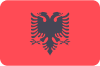
- Learn the eagle connection: “Eagle” – Shqiponjë is a good first word to learn in the Albanian language. With the eagle being Albania’s national symbol, you can explore why the people call themselves Shqiptarë or “Sons of the Eagle” and why there is a two-headed eagle on their flag.
- Compare the Gheg dialect vs. the Tosk dialect: The northern Gheg and southern Tosk dialects have noticeable differences. Exploring both dialects will get you a richer picture of Albanian as a whole.
- Give the 100-word challenge a try: Challenge yourself to learn 100 new Albanian words. Since Albanian has no close relatives, each word you learn is like unlocking a code. Save these new words in the Ling app‘s My Vocabulary feature.
- Listen to the iso-polyphony of the Albanian language: Albanian iso-polyphony (a form of traditional multi-part singing) is recognized by UNESCO as an Intangible Cultural Heritage, showing how unique Albanian culture is.
- Don’t forget to explore the Balkan Language League: Despite Albanian also being unrelated to the Balkan languages (Greek, Bulgarian, Romanian), they share grammatical features in a phenomenon called the Balkan Sprachbund.
Is Albanian A Slavic Language? Frequently Asked Questions
Is Albania A Slavic Country?
No. Albanians kept their own language and identity through the Slavic migrations of the 6th and 7th centuries AD, so the country is not Slavic, even though several of its Balkan neighbors are Slavic-speaking.
Is Albanian Slavic Or Balkan?
Albanian is not Slavic as it is an independent branch of the Indo-European family. But Albanian is more Balkan as it is spoken in the western Balkans (Albania, Kosovo, and some parts of former Yugoslavia).
It shares some features of the Balkan languages, like replacing infinitives with the “to-go-to-verb” structure and the addition of the word “the” after nouns.
What Languages Is Albanian Related To?
Since Albanian is the only language in its branch of the Indo-European languages, it doesn’t have close “siblings.” However, most linguists think Greek and some ancient Balkan languages (Paleo-Balkan group) are related to the Albanian language. This similarity, though, is more about the shared ancient roots rather than the sounds.
Why Is The Albanian Language So Different?
The Albanian language is different because it is the only living member of its branch of the Indo-European family. Greek, Latin, Turkish, and Slavic have shaped how Albanian sounds and its vocabulary, but Albanian still keeps its core structure intact and unique from Germanic, Romance, or Slavic languages.
Is It Hard To Learn Albanian?
Albanian is a Category III language in the FSI difficulty rankings, which estimate about 44 weeks (1,100 class hours) of study for English speakers, due to its differences from English. Here is more on how long it takes to learn Albanian.
Is Albanian A Slavic Language? Recap: What To Remember
As we mentioned, beginner Albanian learners often ask this question: “Is Albanian a Slavic language?”
Confusion is understandable since Slavic-speaking countries surround Albania and have centuries of cultural overlap with it. But you’ve learned in this post that Albanian constitutes its own branch on the Indo-European language family tree, so Albanian is, in fact, not a Slavic language at all.
Fall In Love With Albanian With Ling!
Congratulations, you now know the real answer to “Is Albanian a Slavic language?” and you’ve scratched the surface of one of Europe’s most unique languages. Why not keep going?
With bite-sized lessons, native speaker audio, flashcards and Dialog for real conversation practice, Ling keeps learning simple and fun. Start learning Albanian today and enjoy every new word you unlock!