How many people speak Serbian worldwide? Around 8.2 million people speak Serbian as a native language, according to Ethnologue’s 2025 edition as cited on Wikipedia, and about 12 million if second-language speakers are counted (worlddata.info). Censuses in six countries add up to about 7.07 million Serbian mother-tongue speakers.
The gap comes from how speakers are counted. Ethnologue groups Serbian with Croatian, Bosnian and Montenegrin under Serbo-Croatian; censuses ask different questions; and Serbian is written in two scripts. This guide sets the figures side by side, shows where Serbian speakers live, and uses Ling’s learner data to show who is learning the language now.
Key Takeaways
- 8.2 million native speakers (Ethnologue 2025 edition, cited on Wikipedia, 2022 to 2023) and about 12 million including second-language speakers (worlddata.info).
- About 7.07 million mother-tongue speakers in the latest censuses of Serbia (5,607,558), Bosnia and Herzegovina (1,086,027), Montenegro (269,307), Croatia (45,004), Kosovo (55,168) and North Macedonia (11,252).
- Two scripts: Serbian is written in Cyrillic and Latin, and Serbia’s constitution makes Cyrillic the official script (Wikipedia).
- 80,360 people in the United States speak Serbian at home, plus 19,040 who report Serbo-Croatian (U.S. Census Bureau, 2017-2021).
- 35,233 people with Serbian as their target language started a lesson on Ling in the 12 weeks to Nov. 15, 2026, the most of the seven Eastern European languages Ling tracks.
I want to learn even more languages with Ling!
Download now!
How Many People Speak Serbian Worldwide?
Estimates of Serbian speakers range from 8.2 million native speakers (Wikipedia, citing Ethnologue’s 2025 edition) to about 12 million total speakers (worlddata.info). Censuses in six countries count about 7.07 million mother-tongue speakers. The range depends on whether second-language speakers are counted, how the census question is worded, and how Serbian is separated from its close relatives.
What The Data Shows About Serbian Speakers
| Source | What it counts | Figure | Year |
|---|---|---|---|
| Wikipedia language infobox, citing Ethnologue (28th edition) | Native speakers worldwide | 8.2 million | 2022 to 2023 |
| worlddata.info | Total speakers, including second-language speakers | About 12 million | Not stated |
| National censuses in six countries (sum of the table below) | Mother tongue | About 7.07 million | 2013 to 2024 |
Note: The census total is a floor, not a worldwide count: it covers six countries and leaves out the diaspora elsewhere.
Why The Numbers Differ
Five things move the count up or down:
- Serbian or Serbo-Croatian. Ethnologue lists Serbian, Croatian, Bosnian and Montenegrin as separate languages under a Serbo-Croatian macrolanguage (Ethnologue). Some census forms keep a combined option: 12,999 people in Montenegro (2023) and 8,182 in Croatia (2021) gave Serbo-Croatian as their mother tongue. They are not counted as Serbian here.
- Different questions. Montenegro asked two: 269,307 people named Serbian as their mother tongue, and 271,422 said they usually speak it (MONSTAT, 2024).
- Missing answers. In Serbia, 303,179 people (4.6%) fall in the unknown category and 88,122 did not declare a mother tongue, 5.9% of residents combined (Statistical Office of the Republic of Serbia, 2023).
- Language is not ethnicity. In Montenegro, 43.18% of residents named Serbian as their mother tongue, while 32.93% declared Serbian ethnicity (MONSTAT, 2024).
- Naming is contested. Britannica says whether these forms of speech count as one language or several depends on the definition used (Britannica).
Where Do Serbian Speakers Live?
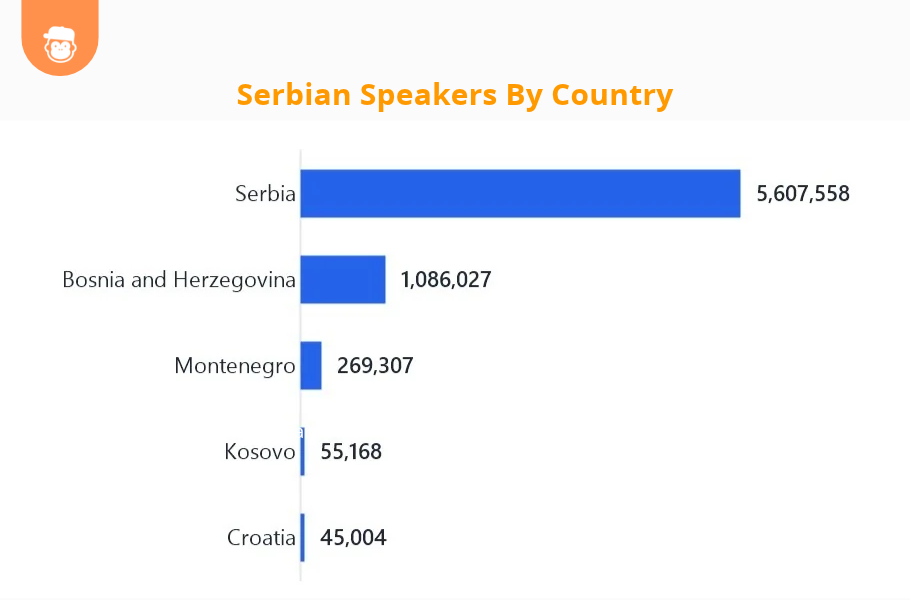
About 5.6 million people in Serbia, 84.4% of its 6.65 million residents, name Serbian as their mother tongue (Statistical Office of the Republic of Serbia, 2022 census). Bosnia and Herzegovina adds 1,086,027 (2013) and Montenegro 269,307 (2023), so three countries hold about 98% of the speakers these censuses count.
Serbian Speakers By Country
| Country | Serbian speakers | What is counted | Census year | Source |
|---|---|---|---|---|
| Serbia | 5,607,558 (84.4% of 6,647,003) | Mother tongue | 2022 | Statistical Office of the Republic of Serbia |
| Bosnia and Herzegovina | 1,086,027 (30.8% of 3,531,159) | Mother tongue | 2013 | Agency for Statistics of Bosnia and Herzegovina |
| Montenegro | 269,307 (43.2% of 623,633) | Mother tongue | 2023 | MONSTAT |
| Kosovo | 55,168 | Mother tongue | 2024 | Kosovo Agency of Statistics, via citypopulation.de |
| Croatia | 45,004 (1.2% of 3,871,833) | Mother tongue | 2021 | Croatian Bureau of Statistics |
| North Macedonia | 11,252 | Mother tongue | 2021 | State Statistical Office, via citypopulation.de |
Serbia, Bosnia And Herzegovina, Montenegro, Croatia, Kosovo And North Macedonia
Bosnia and Herzegovina’s 2013 census lists Bosnian (1,866,585), Serbian (1,086,027) and Croatian (515,481) as separate mother tongues (Agency for Statistics of Bosnia and Herzegovina, 2016). In Montenegro, Serbian is the mother tongue of 43.18% of residents and Montenegrin of 34.52%, or 215,299 people (MONSTAT, 2024). Croatia’s 2021 census counted 45,004 Serbian mother-tongue speakers (Croatian Bureau of Statistics). Kosovo and North Macedonia figures come from citypopulation.de, citing their statistics offices.
Serbian Speakers Abroad
About 80,360 people aged 5 and over in the United States speak Serbian at home, with a margin of error of 3,825. Another 19,040 report Serbo-Croatian (U.S. Census Bureau, 2017-2021 American Community Survey, Nation). The survey lists Serbian, Serbo-Croatian, Croatian and Bosnian as separate categories, so how people label their language changes the count.
What Scripts Does Serbian Use?
Serbian is written in two scripts, Cyrillic and Latin, and Serbia’s constitution makes Cyrillic the official script, according to Wikipedia. Britannica adds that Serbia encourages Cyrillic over Latin, and that Vuk Karadžić’s Serbian Cyrillic alphabet has 30 letters, one for each of the language’s five vowels and 25 consonants (Britannica).
Cyrillic And Latin
Outside legal and government contexts, the law leaves the choice of script to personal preference, and Latin predominates in public signage and packaging, according to Wikipedia. Britannica’s alphabet table pairs each Serbian Cyrillic letter with a Latin letter or two-letter combination. Ling’s Serbian alphabet guide walks through both.
Ekavian And Ijekavian Pronunciation
The word for milk is mleko in Serbia and mlijeko in Croatia, Bosnia and Herzegovina, and Montenegro (Britannica). That is the Ekavian and Ijekavian split. Ekavian dominates in Serbia, Kosovo and North Macedonia, and Ijekavian in Bosnia and Herzegovina, Montenegro and Croatia, according to Wikipedia.
Is Serbian The Same Language As Croatian And Bosnian?
Educated speakers of Serbian, Croatian, Bosnian and Montenegrin can understand each other, with only some everyday words and technical terms getting in the way, according to Britannica. Ethnologue lists the four as separate languages within a Serbo-Croatian macrolanguage (Ethnologue).
Britannica says neither calling them one language nor several is completely right or wrong, because the answer depends on how “language” is defined. In writing, however, you cannot follow the Serbian and Croatian standards at the same time. Croatian prefers its own coinages, for example sveučilište where Serbian uses univerzitet for “university” (Britannica).
For a side-by-side look, read Ling’s Croatian vs Serbian vs Bosnian guide.
Why Are People Learning Serbian?
Ling’s data points to everyday social reasons and a gap in other apps: the most-seen Serbian search is “happy birthday in Serbian” (3,090 search impressions), followed by questions about whether Duolingo has Serbian (1,323) between Aug. 20 and Nov. 17, 2026 (Google Search Console, ling-app.com). Ling has no survey data on motives, so this is an inference from behavior, not a stated reason.
What Learners Look For First
No Serbian on Duolingo drew 17,113 impressions and 941 clicks in that period, the most of Ling’s Serbian pages. Happy birthday in Serbian drew 10,517 and Serbian sayings and proverbs 7,119. Three Duolingo-related queries (“duolingo serbian”, “does duolingo have serbian” and “serbian duolingo”) drew 2,358 impressions together.
Who May Be Learning It
The size of the Serbian-speaking diaspora suggests that some learners are heritage speakers: about 80,360 people in the United States speak Serbian at home, plus 19,040 who report Serbo-Croatian (U.S. Census Bureau, 2017-2021). Ling cannot tell how many of its learners are heritage speakers or have Serbian-speaking family.
How Many People Are Learning Serbian With Ling?
21,996 people chose Serbian as the language they want to learn on Ling in the 12 weeks to Nov. 15, 2026, 4% more than the 21,175 in the 12 weeks before and the second most of the seven Eastern European languages Ling tracks, after Albanian (Ling learner data, Amplitude).
Another 35,233 people with Serbian as their target language started a lesson in the same 12 weeks; the most of the seven. That count includes people who signed up earlier, which is why it is higher than the number who chose Serbian in the period. Weekly selections rose from 1,642 in the week of Jun. 1 to a peak of 2,365 in the week of Aug. 24, then stayed between 1,713 and 2,016 a week from mid-September.
Is Serbian Hard To Learn?
The U.S. Foreign Service Institute lists Serbo-Croatian in Category III, the “hard languages” group, at about 44 weeks or 1,012 class hours for English speakers (U.S. Department of State). The category covers languages with significant linguistic or cultural differences from English.
The grammar has three genders, seven cases and two numbers (Wikipedia). The spelling is more regular than the script suggests: each of the 30 letters of the Serbian Cyrillic alphabet matches one sound, and no letter stands for a consonant plus a vowel (Britannica). Starting with everyday phrases gives you usable words before the grammar. Ling’s How to Learn Serbian guide lays out a beginner roadmap.
Which Apps Teach Serbian?
As of Nov. 24, 2026, Ling is the only app that offers a complete Serbian learning course. Duolingo’s own course list for English speakers does not include Serbian, and neither do Babbel’s language list or Mondly’s App Store listing. Pimsleur offers Croatian but has no Serbian course page, and Memrise has only user-made word lists.
| App | Serbian? | What we checked | Checked |
|---|---|---|---|
| Duolingo | No | Duolingo’s course page, “I speak English” | Nov 24, 2026 |
| Babbel | No | Babbel’s “Foreign languages” page | Nov 23, 2026 |
| Mondly | Not in its App Store language list | Mondly’s App Store listing | Nov 23, 2026 |
| Pimsleur | No Serbian course page; Croatian is offered | Pimsleur’s Serbian and Croatian pages | Nov 24, 2026 |
| Memrise | Only user-made word lists | Memrise’s “Learn Serbian” page | Nov 24, 2026 |
| Ling | Yes | Ling’s App Store/Google Play Listing | Nov 24, 2026 |
Note: To get a more detailed analysis, you can read No Serbian on Duolingo?, No Serbian on Mondly? and No Serbian on Pimsleur?
Common Myths About Serbian Speakers
Myth 1: Serbian Is Only Spoken In Serbia
Not true. Bosnia and Herzegovina has 1,086,027 Serbian mother-tongue speakers (2013 census), Montenegro 269,307 (2023), Kosovo 55,168 (2024) and Croatia 45,004 (2021), against 5,607,558 in Serbia (2022). Serbia holds about 79% of the six-country total.
Myth 2: Serbian Is Only Written In Cyrillic
Serbian uses both Cyrillic and Latin. Cyrillic is the official script, but the law leaves the choice to personal preference outside legal and government contexts, and Latin predominates in public signage and packaging, according to Wikipedia.
Myth 3: Only Ethnic Serbs Speak Serbian
Language and ethnicity count different people. In Montenegro’s 2023 census, 269,307 people named Serbian as their mother tongue while 205,370 declared themselves Serbs (MONSTAT, 2024).
What Do These Numbers Mean?
Serbian has about 7.07 million census-counted mother-tongue speakers in six countries, so the right figure depends on your question and on whether you treat Serbian as part of a wider Serbo-Croatian group. For learners, the practical points are the two scripts and the Ekavian and Ijekavian pronunciation split (Britannica).
FAQs About How Many People Speak Serbian
How Many People Speak Serbian In The World?
About 8.2 million people speak Serbian as a native language (Ethnologue’s 2025 edition, cited on Wikipedia), and about 12 million including second-language speakers (worlddata.info). The latest censuses in six countries count about 7.07 million mother-tongue speakers, most of them in Serbia, Bosnia and Herzegovina, and Montenegro.
How Many People Speak Serbian In Serbia?
Serbia’s 2022 census recorded 5,607,558 people with Serbian as their mother tongue, 84.4% of 6,647,003 residents (Statistical Office of the Republic of Serbia). Another 303,179 residents are in the unknown category and 88,122 did not declare a mother tongue, so among residents who gave a stated mother tongue, the share is about 89.6%.
Is Serbian The Same Language As Croatian And Bosnian?
They are closely related, and educated speakers can understand each other, according to Britannica. Ethnologue lists Serbian, Croatian, Bosnian and Montenegrin as separate languages within a Serbo-Croatian macrolanguage. In writing, the Serbian and Croatian standards differ in some words, scripts and spelling, so no joint standard exists.
Is Serbian Written In Cyrillic Or Latin?
Both. Serbia’s constitution makes Cyrillic the official script, but the law leaves the choice to personal preference outside legal and government contexts, and Latin predominates in public signage and packaging, according to Wikipedia. Britannica says Serbia encourages Cyrillic, whose 30 letters each match one sound.
Is Serbian Hard To Learn For English Speakers?
The U.S. Foreign Service Institute lists Serbo-Croatian in Category III, hard languages, at about 44 weeks or 1,012 class hours for English speakers (U.S. Department of State). The grammar has three genders, seven cases and two numbers (Wikipedia), but each Cyrillic letter matches one sound (Britannica).
Is Serbian On Duolingo?
No. Duolingo’s own course list for English speakers does not include Serbian as of Nov. 24, 2026, and neither do Babbel’s language list or Mondly’s App Store listing. Pimsleur offers Croatian but has no Serbian course page, and Memrise has only user-made word lists.
Why Are People Learning Serbian?
Ling’s data points to everyday social use and a gap in other apps: happy birthday in Serbian is the most-seen Serbian search reaching Ling, followed by questions about Duolingo. 21,996 people chose Serbian on Ling in the 12 weeks to Nov. 15, 2026. We do not have survey data on motives, so we cannot say why people start.
Start Learning Serbian
Serbian has about 7.07 million census-counted speakers in six countries, and about 22,000 people chose it on Ling in the last 12 weeks. If you want to join them, start with what most learners look for first: birthday wishes, the alphabet and everyday sayings. If you are new to Serbian, you can read the complete beginner’s roadmap to learning Serbian first.
Ling has a Serbian course for beginners, complete with native-speaker audio and short daily lessons. The in-app Serbian course is offered in Latin script.
Sources
- Wikipedia, Serbian language. Infobox: about 8.2 million native speakers (2022 to 2023), citing Ethnologue’s 28th edition (2025). Also used for scripts, Ekavian and Ijekavian. Read Nov 24, 2026, with the infobox checked in the page’s wikitext.
- Ethnologue, Serbian (srp), Serbo-Croatian (hbs) and the Serbia country page. Free pages; accessed Nov 24, 2026.
- worlddata.info, Serbian. About 12 million total speakers; no data year or source stated. Accessed Nov 24, 2026.
- Statistical Office of the Republic of Serbia, Mother tongue, religion and ethnic affiliation, 2022 census release, 16 June 2023.
- Agency for Statistics of Bosnia and Herzegovina, Census of Population, Households and Dwellings in Bosnia and Herzegovina, 2013, Final Results (June 2016), Table 5.1, PDF hosted by the UN Statistics Division.
- MONSTAT (Montenegro), 2023 census, second release, No. 135/2024, 15 October 2024.
- Croatian Bureau of Statistics, 2021 census, population by mother tongue, detailed classification, results page.
- Kosovo Agency of Statistics, 2024 census, mother tongue, as reported by citypopulation.de. Accessed Nov 23, 2026.
- State Statistical Office of North Macedonia, 2021 census, mother tongue, as reported by citypopulation.de. Accessed Nov 23, 2026.
- U.S. Census Bureau, 2017-2021 American Community Survey 5-year estimates, Table 1, detailed languages spoken at home.
- Wayles Browne, Bosnian-Croatian-Montenegrin-Serbian language, Encyclopaedia Britannica. Accessed Nov 24, 2026.
- Wikipedia, Serbo-Croatian grammar. Accessed Nov 24, 2026.
- U.S. Department of State, Foreign Language Training, language learning timelines. Accessed Nov 23, 2026.
- Duolingo, Courses, list for English speakers. Checked Nov 24, 2026.
- Babbel, Foreign languages. Checked Nov 23, 2026.
- Apple App Store, Mondly: Learn Languages, language list. Checked Nov 23, 2026.
- Pimsleur, Learn Croatian. Its Serbian page address redirects to the Pimsleur homepage. Checked Nov 24, 2026.
- Memrise, Learn Serbian. Accessed Nov 24, 2026.
- Ling learner data (Amplitude, Ling Production): 12 weeks Aug 24 to Nov 15, 2026 compared with Jun 1 to Aug 23, 2026.
- Google Search Console, ling-app.com: Aug 20 to Nov 17, 2026 compared with the previous 90 days.