How many people speak Bulgarian worldwide? Around 6.8 million people speak Bulgarian as a native language, according to Ethnologue’s 2025 edition as cited on Wikipedia, and about 7.9 million speak it in total. Bulgaria’s own 2021 census counted 5,037,607 people with Bulgarian as their mother tongue, 85.3% of those who answered the question.
The gap comes from what each source counts. A census counts residents in one country and asks one question, while Ethnologue estimates speakers worldwide, including people who live abroad. This guide sets the figures side by side, shows where Bulgarian speakers live, and uses Ling’s learner data to show who is learning the language now.
Key Takeaways
- 6.8 million native speakers and 7.9 million in total (Ethnologue 28th edition, 2025, cited on Wikipedia, 2019 to 2023).
- 5,037,607 people named Bulgarian as their mother tongue in Bulgaria’s 2021 census, 85.3% of those who answered (National Statistical Institute of Bulgaria, 2022). Turkish (514,386) and Romani (227,974) were the next most common.
- Bulgarian is an official language of the European Union and has been since 2007 (Wikipedia).
- Ling’s learner interest in Bulgarian grew 29%: 5,429 people chose Bulgarian in the 12 weeks to Nov. 15, 2026, up from 4,206 in the 12 weeks before, the fastest rise of the seven Eastern European languages Ling tracks.
- Bulgarian is not on Duolingo. Duolingo’s own course list for English speakers does not include it (checked Nov 24, 2026), while Mondly’s App Store listing does.
I want to learn even more languages with Ling!
Download now!
How Many People Speak Bulgarian Worldwide?
Estimates of Bulgarian speakers run from 5.04 million mother-tongue speakers in Bulgaria’s 2021 census to 6.8 million native speakers worldwide in Ethnologue’s 2025 edition, as cited on Wikipedia. The range depends on what is counted: residents of one country, native speakers worldwide, or everyone who can use the language.
What The Data Shows
| Source | What it counts | Figure | Year |
|---|---|---|---|
| Wikipedia language infobox, citing Ethnologue (28th edition) and the 2021 census | Native speakers (L1) worldwide | 6.8 million | 2019 to 2023 |
| Same infobox | Second-language speakers (L2) | 1.2 million | 2021 |
| Same infobox | Total speakers | 7.9 million | 2019 to 2023 |
| worlddata.info | First-language speakers worldwide, with 4.9 million of them in Bulgaria | 5.5 million | Not stated |
| National Statistical Institute of Bulgaria | Mother tongue, answers in the census of Bulgaria | 5,037,607 | 2021 |
Note: The infobox shows 7.9 million in total, while its rounded native and second-language figures add up to 8.0 million. The census total covers residents of Bulgaria only, so it leaves out Bulgarian speakers who live elsewhere.
Why The Numbers Differ
Five things move the count up or down.
- Residents or the world. The census counts people living in Bulgaria. Ethnologue estimates speakers worldwide, so the 6.8 million is about 1.8 million higher than the census count. None of the sources say how much of that gap is people living abroad.
- Language is not ethnicity. In 2021, 5,118,494 people declared Bulgarian ethnicity while 5,037,607 named Bulgarian as their mother tongue. For Turkish, the order flips: 508,378 declared Turkish ethnicity and 514,386 named Turkish as their mother tongue (National Statistical Institute of Bulgaria, 2022).
- Who answered. The shares in the census release are percentages of people who answered the mother-tongue question. Another 10,633 could not determine their mother tongue and 49,602 chose not to answer.
- Native or total. Ethnologue’s total of 7.9 million includes 1.2 million second-language speakers, so it is not comparable with a mother-tongue count.
- Sources are dated and disagree. worlddata.info gives 4,941,000 speakers in Bulgaria with no year, while the 2021 census counted 5,037,607.
Where Do Bulgarian Speakers Live?
About 5.04 million people in Bulgaria name Bulgarian as their mother tongue, 99% of the 5.08 million that the latest mother-tongue counts in Bulgaria, Moldova, Serbia and Romania add up to. Ukraine’s 2001 census and speaker counts in England and Wales and the United States add more people, but each measures something different.
Bulgarian Speakers By Country
| Country | Bulgarian speakers | What is counted | Census year | Source |
|---|---|---|---|---|
| Bulgaria | 5,037,607 (85.3% of those who answered) | Mother tongue | 2021 | National Statistical Institute of Bulgaria |
| Ukraine | 204,600 ethnic Bulgarians, of whom 64.2% named Bulgarian as their native language | Ethnicity and native language | 2001 | State Statistics Committee of Ukraine |
| Moldova | 28,800 (1.2%) | Mother tongue | 2024 | National Bureau of Statistics of Moldova |
| Serbia | 7,939 | Mother tongue | 2022 | Statistical Office of the Republic of Serbia |
| Romania | 4,478 | Mother tongue | 2021 | National Institute of Statistics, Romania |
Note: The table does not add the Ukraine row to the others because it counts ethnic Bulgarians, not speakers. Ukraine’s census is also 25 years old.
Bulgaria
Bulgaria’s 2021 census counted 5,037,607 people with Bulgarian as their mother tongue, 85.3% of those who answered. Turkish was the mother tongue of 514,386 people (8.7%), Romani of 227,974 (3.9%) and another language of 62,906 (1.1%) (National Statistical Institute of Bulgaria, 2022). Bulgarian is the official language of Bulgaria and has been an official language of the European Union since 2007 (Wikipedia). Britannica also lists parts of Greece, Romania, Moldova and Ukraine as places where it is spoken.
Bulgarian Speakers Abroad
About 111,431 residents of England and Wales aged 3 and over gave Bulgarian as their main language in the 2021 census, 0.2% of 57,704,270 residents (Office for National Statistics, via Nomis). About 71,460 people aged 5 and over in the United States speak Bulgarian at home, with a margin of error of 3,491, and 19,040 of them speak English less than very well (U.S. Census Bureau, 2017-2021 American Community Survey).
In Germany, 421,895 Bulgarian citizens were counted in the latest Destatis table, but citizenship does not show which language people speak.
The two diaspora counts that measure language add up to about 183,000 speakers. That is far less than the roughly 1.7 million gap between the census total and Ethnologue’s native-speaker figure, so these sources do not explain it.
What Makes Bulgarian Different From Other Slavic Languages?
Bulgarian is a South Slavic language written in the Cyrillic alphabet that has almost entirely lost case endings on nouns, which sets it apart from most other Slavic languages, according to Britannica. It is most closely related to Macedonian, and the two share features found in other Balkan languages, such as a definite article placed after the noun.
Grammar Without Cases
Britannica gives the example masa (“table”) and masata (“table the”): the article attaches to the end of the noun or adjective, as in Albanian and Romanian. The verb infinitive is also replaced by a clause, as in modern Greek, Albanian and Romanian (Britannica). Wikipedia adds that Bulgarian has evidential verb forms that show whether the speaker witnessed, inferred or only heard about an event.
The Cyrillic Alphabet
Bulgarian is written in Cyrillic, and Wikipedia dates the Bulgarian alphabet to 893. Britannica notes that the vocabulary contains a sizable number of Russian and Church Slavonic loanwords. Ling’s Bulgarian alphabet guide shows how to read the letters, and Ling’s comparison of Bulgarian and Russian covers how the two languages differ.
Why Are People Learning Bulgarian?
Ling’s data points to curiosity about names: Ling’s guide to Bulgarian names earned 79,143 search impressions between Aug. 20 and Nov. 17, 2026, 97% of the impressions on the two Bulgarian pages in Ling’s top 500 pages, and those impressions nearly doubled from the 40,849 in the 90 days before (Google Search Console, ling-app.com). Ling has no survey data on motives, so this is an inference from behavior, not a stated reason.
What Ling’s Bulgarian Learners Look For First
Bulgarian names drew 430 clicks from 79,143 impressions, and Ling’s page on flirting phrases in Bulgarian drew 80 clicks from 2,674. The most-seen Bulgarian search was “bulgarian names,” with 3,783 impressions, and “how to say happy birthday in bulgarian” drew 509. Together, the two pages earned 81,817 impressions, up 85% on the previous 90 days.
Who May Be Learning It?
The Bulgarian-speaking diaspora suggests that some learners are heritage speakers: about 111,431 people in England and Wales and 71,460 in the United States use Bulgarian as a main or home language (Office for National Statistics, 2021; U.S. Census Bureau, 2017-2021). Ling cannot tell how many of its learners are heritage speakers or have Bulgarian-speaking family.
How Many People Are Learning Bulgarian?
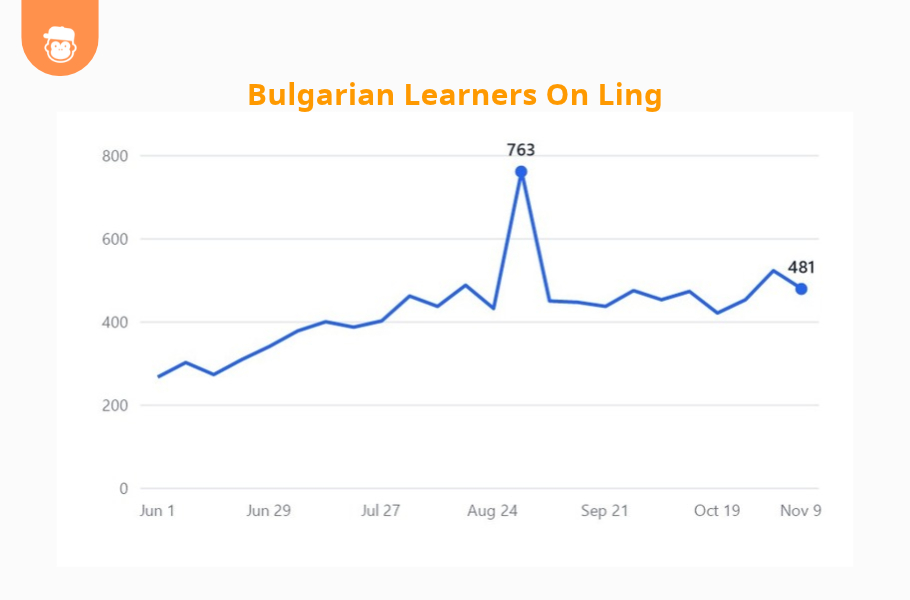
5,429 people chose Bulgarian as the language they want to learn on Ling in the 12 weeks to Nov. 15, 2026, 29% more than the 4,206 in the 12 weeks before. That is the sixth most of the seven Eastern European languages Ling tracks and the fastest growth among them (Ling learner data, Amplitude). Another 5,915 people with Bulgarian as their target language started a lesson in the same 12 weeks.
Weekly selections rose from 268 in the week of Jun. 1 to between 422 and 524 a week since Sep. 7, with one jump to 763 in the week of Aug. 31.
Is Bulgarian Hard To Learn?
The U.S. Foreign Service Institute puts Bulgarian in Category III, its “hard languages” group, at about 44 weeks or 1,012 class hours for English speakers (U.S. Department of State). The category covers languages with significant linguistic or cultural differences from English. Albanian, Lithuanian, Serbo-Croatian and Slovenian sit in the same category.
Nouns have almost no case endings, unlike most other Slavic languages (Britannica). Learners still need the Cyrillic alphabet, and Wikipedia notes evidential verb forms that English lacks. Starting with the alphabet and everyday phrases gives you usable words before the grammar. Ling’s guide on whether Bulgarian is hard to learn goes into detail, and its how to learn Bulgarian guide lays out a beginner roadmap.
Which Apps Teach Bulgarian?
As of Nov. 24, 2026, Mondly’s App Store listing includes Bulgarian, while Duolingo’s own course list for English speakers does not. Babbel’s language list has no Bulgarian, Pimsleur has no Bulgarian course page, and Memrise offers only user-made word lists.
| App | Bulgarian? | What we checked | Checked |
|---|---|---|---|
| Duolingo | No | Duolingo’s course page, “I speak English” | Nov 24, 2026 |
| Babbel | No | Babbel’s “Foreign languages” page | Nov 24, 2026 |
| Mondly | Yes | Mondly’s App Store listing, which names Bulgarian among its 41 languages | Nov 24, 2026 |
| Pimsleur | No Bulgarian course page | Pimsleur’s Bulgarian page | Nov 24, 2026 |
| Memrise | Only user-made word lists | Memrise’s “Learn Bulgarian” page | Nov 24, 2026 |
| Ling | Yes | Ling’s App Store & Google Play Store listings | Nov 24, 2026 |
Quick tip: For the details on Duolingo, read No Bulgarian On Duolingo?
Common Myths About Bulgarian Speakers
Myth 1: Bulgarian Is Only Spoken In Bulgaria
Mostly, but not only. Bulgaria holds 99% of the 5.08 million mother-tongue speakers in the latest counts for Bulgaria, Moldova, Serbia and Romania. The rest live in Moldova (28,800), Serbia (7,939) and Romania (4,478). Ukraine’s 2001 census counted 204,600 ethnic Bulgarians, and 111,431 people in England and Wales gave Bulgarian as their main language in 2021.
Myth 2: Everyone In Bulgaria Speaks Bulgarian As A Mother Tongue
Not quite. In the 2021 census, 85.3% of those who answered named Bulgarian as their mother tongue, 8.7% named Turkish and 3.9% named Romani (National Statistical Institute of Bulgaria, 2022).
Myth 3: Bulgarian Is A Dialect Of Russian
No. Britannica places Bulgarian in the South Slavic branch, in a subgroup with Macedonian, and Russian in the East Slavic branch. Bulgarian has almost lost noun case endings, unlike most other Slavic languages, and its vocabulary includes a sizable number of Russian and Church Slavonic loanwords (Britannica). Ling’s Bulgarian vs Russian guide compares them.
What Do These Numbers Mean?
Bulgarian has about 5.04 million census-counted mother-tongue speakers in Bulgaria and an Ethnologue estimate of 6.8 million native speakers worldwide, so the right figure depends on whether you count residents or speakers anywhere. Counts of speakers abroad that we found cover only about 183,000 people, so they do not close the gap.
For anyone quoting a speaker count, say which measure and year it uses: native speakers, mother tongue or main language.
FAQs: How Many People Speak Bulgarian?
How Many People Speak Bulgarian In The World?
About 6.8 million people speak Bulgarian as a native language and about 7.9 million speak it in total, according to Ethnologue’s 2025 edition as cited on Wikipedia. Bulgaria’s 2021 census counted 5,037,607 people with Bulgarian as their mother tongue, so the right figure depends on whether you count residents or speakers worldwide.
How Many People Speak Bulgarian In Bulgaria?
The 2021 census counted 5,037,607 people in Bulgaria with Bulgarian as their mother tongue, 85.3% of those who answered (National Statistical Institute of Bulgaria). Turkish was the mother tongue of 514,386 people and Romani of 227,974. The count is from 2021, so it may no longer match today’s population.
Is Bulgarian Hard To Learn For English Speakers?
The U.S. Foreign Service Institute places Bulgarian in Category III, hard languages, at about 44 weeks or 1,012 class hours for English speakers (U.S. Department of State). Nouns have almost no case endings (Britannica), but learners need the Cyrillic alphabet and evidential verb forms (Wikipedia).
Is Bulgarian Written In Cyrillic Or Latin?
Standard Bulgarian is written in the Cyrillic alphabet, and Wikipedia dates the Bulgarian alphabet to 893. Wikipedia also lists a separate Latin alphabet for the Banat Bulgarian dialect. Most learners start with Cyrillic, and Ling’s Bulgarian alphabet guide shows how to read the letters.
Is Bulgarian On Duolingo?
No. Duolingo’s own course list for English speakers does not include Bulgarian as of Nov. 24, 2026, and neither do Babbel’s language list or Pimsleur’s course pages. Mondly’s App Store listing does name Bulgarian, and Memrise has only user-made word lists.
Is Bulgarian An Official Language Of The European Union?
Yes. Bulgarian has been among the official languages of the European Union since 2007, according to Wikipedia. It is also the official language of Bulgaria, where 5,037,607 people named it as their mother tongue in the 2021 census (National Statistical Institute of Bulgaria).
Why Are People Learning Bulgarian?
Ling’s data points to curiosity about names: Bulgarian names earned 79,143 search impressions, 97% of the impressions on Ling’s two Bulgarian pages in its top 500. 5,429 people chose Bulgarian on Ling in the 12 weeks to Nov. 15, 2026, 29% more than before. We have no survey data on motives, so we cannot say why people start.
Start Learning Bulgarian With Ling
Bulgarian has about 5.04 million census-counted speakers in Bulgaria, and 5,429 people chose it on Ling in the last 12 weeks, 29% more than before. If you want to join them, start with what most learners look for first: names, flirting phrases and the alphabet.
Ling has a Bulgarian course for beginners. New to Bulgarian? Read the complete beginner’s roadmap to learning Bulgarian first.
Sources
- Wikipedia, Bulgarian language. Infobox: 6.8 million native speakers (2019 to 2023), 1.2 million second-language speakers (2021) and 7.9 million total, citing the 2021 census and Ethnologue’s 28th edition (2025). Also used for the alphabet, evidential verbs and EU status. Read Nov 24, 2026.
- Ethnologue, Bulgarian (bul). Free page, which shows only a population band of 1M to 1B and no counts. Accessed Nov 24, 2026.
- worlddata.info, Bulgarian. 5.5 million first-language speakers worldwide and 4,941,000 in Bulgaria; no data year or source stated. Accessed Nov 24, 2026.
- National Statistical Institute of Bulgaria, Ethno-cultural characteristics of the population as of September 7, 2021, press release of Dec 21, 2022.
- Statistical Office of the Republic of Serbia, Mother tongue, religion and ethnic affiliation, 2022 census release.
- National Bureau of Statistics of Moldova, 2024 census final results, mother tongue and ethnicity.
- National Institute of Statistics, Romania, 2021 census final results, table of resident population by mother tongue.
- State Statistics Committee of Ukraine, 2001 census, nationality and language.
- Office for National Statistics, Census 2021, TS024 Main language (detailed), read through Nomis.
- U.S. Census Bureau, 2017-2021 American Community Survey, Table 1, languages spoken at home.
- Destatis, foreign population by sex. Citizenship only.
- Britannica, Bulgarian language and Slavic languages. Accessed Nov 24, 2026.
- U.S. Department of State, Foreign Language Training. Accessed Nov 23, 2026.
- Duolingo, Courses, list for English speakers. Checked Nov 24, 2026.
- Babbel, Foreign languages. Checked Nov 24, 2026.
- Apple App Store, Mondly: Learn 41 Languages, language list. Checked Nov 24, 2026.
- Pimsleur, Learn Bulgarian. The address redirects to the Pimsleur homepage. Checked Nov 24, 2026.
- Memrise, Learn Bulgarian. Checked Nov 24, 2026.
- Ling learner data (Amplitude, Ling Production): 12 weeks Aug 24 to Nov. 15, 2026, compared with Jun. 1 to Aug. 23, 2026.
- Google Search Console, ling-app.com: Aug. 20 to Nov. 17, 2026, compared with the previous 90 days.