



Do you know how many languages are there in India? Some say 22, while others say there are more than 100, but the truth is that there’s no fixed number. That’s mainly because of India’s regional diversity, which makes learning about its languages interesting.
With that in mind, let’s find out how many languages there are in India and look at three interesting facts about India’s language diversity.
Key Takeaway
- India has 22 Scheduled languages according to the Eighth Schedule of India’s Constitution.
- Hundreds of other dialects and languages are also spoken across India apart from the 22 Scheduled languages.
- Not all languages spoken in India belong to a single language family. Most of them have distinct historical roots. For example, Hindi and Bengali are Indo-Aryan languages, while Tamil and Telugu are Dravidian languages.
- Multilingualism is very common in many Indian communities because of the hundreds of languages spoken in India.
- India has a diverse linguistic identity, which means learning even a few local phrases can make everyday conversations easier.
I want to learn even more languages with Ling!
Download now!
How Many Languages Are There In India: 3 Interesting Facts
Here are the three interesting facts that make India’s linguistic diversity worth exploring:
1. India’s 22 Scheduled Languages Are Only The Officially Recognized Languages Of India
When asked how many languages there are in India, most people say 22, since this number is mentioned in the Eighth Schedule of the Indian Constitution.
But what’s more intriguing is that the Scheduled languages aren’t the only languages spoken in India. They are simply the ones that have received constitutional recognition.
These 22 Scheduled languages include: Hindi, Sindhi, Bengali, Telugu, Nepali, Dogri, Kannada, Manipuri, Urdu, Assamese, Odia, Sanskrit, Tamil, Malayalam, Santali, Marathi, Punjabi, Maithili, Kashmiri, Gujarati, Bodo, and Konkani.
So, while these 22 languages are mentioned in the Indian Constitution, they represent only part of the country’s rich linguistic landscape. That said, think of the 22 Scheduled languages as a list of constitutionally recognized languages, not the total number of languages spoken across India.
2. Hundred Other Dialects And Languages Actually Add Color To India’s Linguistic Identity
Beyond India’s 22 Scheduled languages, hundreds of distinct dialects and language varieties make India linguistically diverse. India’s 2011 Census report identified 121 major languages after grouping around 19,569 reported mother tongues. This language grouping was based on linguistic similarities between different languages. For example, two language variations, ‘Kodu’ and ‘Konda ’, are grouped under the mother tongue name ‘Konda’ because this variation has more speakers, unlike the similar dialect ‘Kodu’.
Think of it as two Indian people who live in the same state but don’t speak the same language. It’s pretty common in India. For example:
- Tulu and Kannada are widely spoken in coastal Karnataka.
- Khasi and Garu are the most spoken languages in Meghalaya.
- In Bengaluru, you’ll commonly hear Kannada, Tamil, Telugu, Hindi, and English.
- Marathi is particularly common in northern Karnataka.
- Several Dravidian communities across Central India speak Gondi.
- Urdu and English are more common in urban areas, like Aligarh.
See, people living in the same Indian state may have distinct mother tongues, as in Karnataka: one may speak Tulu, another Marathi, and another Kannada, etc. However, most of these languages are very similar, sharing the same vocabulary and grammar in most cases.
So, while the 22 Scheduled Indian languages are officially recognized, hundreds of other regional dialects also add variety with their unique sounds and vocabulary. So, next time you hear different pronunciations of the same word, or a different word with the same meaning, remember that daily conversations in India reveal many more commonly spoken languages and language varieties.
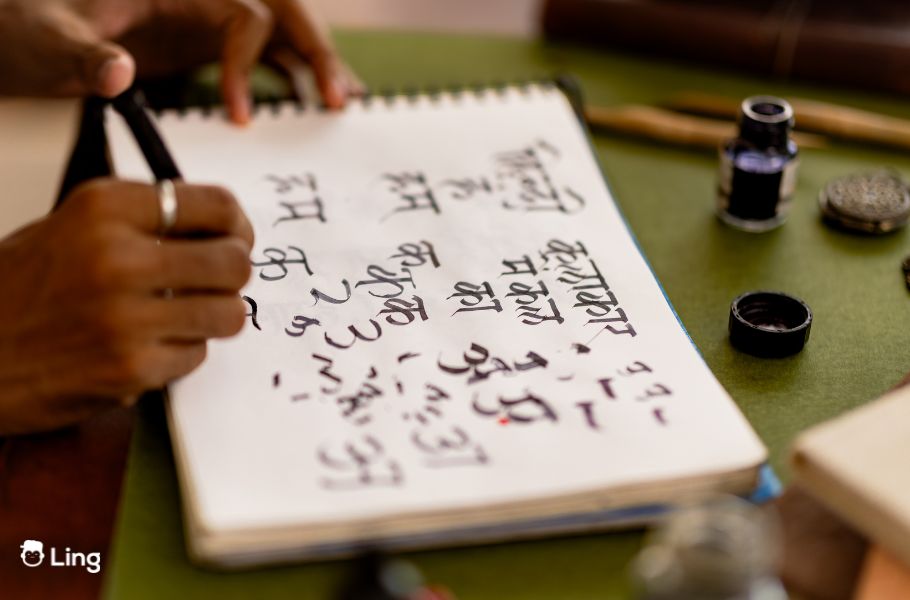
3. Different Indian Languages Have Distinct Historical Roots
Knowing India is home to hundreds of languages is interesting, but do you know that not all Indian languages share the same origin? Yes, they belong to different language families with distinct historical roots and linguistic features.
Let’s look at the four major language families and discover which Indian languages are more connected:
- Indo-Aryan language family mainly includes Northern Indian languages like Hindi, Bengali, Marathi, Gujarati, Punjabi, and Assamese. These languages are spoken by about 70% of India’s population.
- Dravidian language family mainly includes Southern Indian languages and nearby regions like Tamil, Telugu, Kannada, and Malayalam. These are spoken by 20% of Indians.
- Austroasiatic language family includes regional languages like Santhali and Mundari. Adivasi communities and people in central, eastern, and northeastern India speak most of these languages, making up roughly 1.2% of the population.
- Sino-Tibetan language family is mostly concentrated in the Northeastern states and includes regional languages like Manipuri and Bodo. These are spoken by about 2% of the total population.
Other than these four major language families, there are also minor families and language isolates that are limited to much smaller groups of speakers, such as the Andamanese language families, whose languages are spoken by very few people in the Andaman Islands.
To explore more about language history and culture, you can also read our detailed guide on how many language families there are in the world or check out our interesting facts about languages.
FAQs: How Many Languages Are There In India
How Many Languages Are There In India?
There’s no fixed answer because several other dialects and language varieties are also widely spoken across India. Although India has 22 Scheduled languages according to the Eighth Schedule of India’s Constitution, hundreds of other dialects and languages make it a linguistically diverse country. For example, India’s 2011 Census recorded 121 major languages. So, the number varies.
What Is The Most Spoken Language In India?
Hindi is the most spoken language in India, according to the 2011 Census report. Around 43.63% of the Indian population speaks Hindi. In fact, Hindi has been an official language of India since 1950, as recognized by the Eighth Schedule of the Indian Constitution.
Is English One Of India’s 22 Scheduled Languages?
No, English is not included in the list of India’s 22 Scheduled languages. However, the Official Languages Act of 1963 allowed English to be used as an official language of India’s Union government alongside Hindi.
Learn Your Favorite Indian Language With The Ling App!
Now that we know how many languages are there in India, why not explore these languages for yourself? Download the Ling app now, search for your favorite Indian language, and start exploring it right away!
The best part is that the Ling app now offers comprehensive courses in 70+ languages, and you can try it with a 7-day free trial. So, what are you waiting for? Start learning a new language with Ling today!

















































































