

What happens inside your brain when you start learning another language? Your brain has to remember new words, recognize unfamiliar sounds, and choose between different ways of expressing the same idea.
Over time, all that practice can affect how certain brain regions work and develop, but how does that work? In this article, we’ll look at how learning a new language changes your brain, including what happens to gray matter, memory, and executive function.
Key Takeaways
- Learning a new language strengthens your attention, memory, and mental flexibility.
- Language learning can be linked to changes in gray matter, especially in areas involved in language and memory.
- Remembering new vocabulary and using it repeatedly can strengthen the brain’s ability to store and retrieve information.
- Switching between languages exercises executive function, which helps you focus, manage competing information, and shift between tasks.
I want to learn even more languages with Ling!
Download now!
How Learning A New Language Changes Your Brain
Your brain gets busy when you learn a second language. It adapts to new information, strengthens memory, and manages two or more languages at once. Here’s a closer look at what happens inside your brain as your new language skills develop alongside your native language.
1. Learning A Language Can Change Your Brain Structure
Your brain adapts to what you practice. Think of your brain as something that responds to how you use it. When you spend months learning vocabulary, listening to new sounds, and putting sentences together, the brain adapts to those demands.
Research on bilingualism has found differences in gray matter in regions involved in language processing and memory, including areas such as the hippocampus. Gray matter contains many of the brain’s nerve cells and plays an important role in processing information.
The exact structural changes aren’t the same for everyone, though, and can depend on factors such as brain health, how much you practice, how proficient you become, and when you started learning.
2. New Vocabulary Gives Your Memory A Workout
You know that moment when a new word is on the tip of your tongue? That little struggle is part of how learning a new language changes your brain. Every time you learn a word, your brain has to encode it, connect it with meaning, and retrieve it when you need it later.
This makes memory a central part of learning another language. As you encounter and use words repeatedly, recalling them can become easier. You’re also building connections between a word, its sound, its meaning, and the situation where you might use it.
Research has linked language learning with changes in memory-related brain regions, including the hippocampus, although that doesn’t mean learning a foreign language automatically improves your long-term memory in every situation.
3. Speaking Two Or More Languages Exercises Executive Function
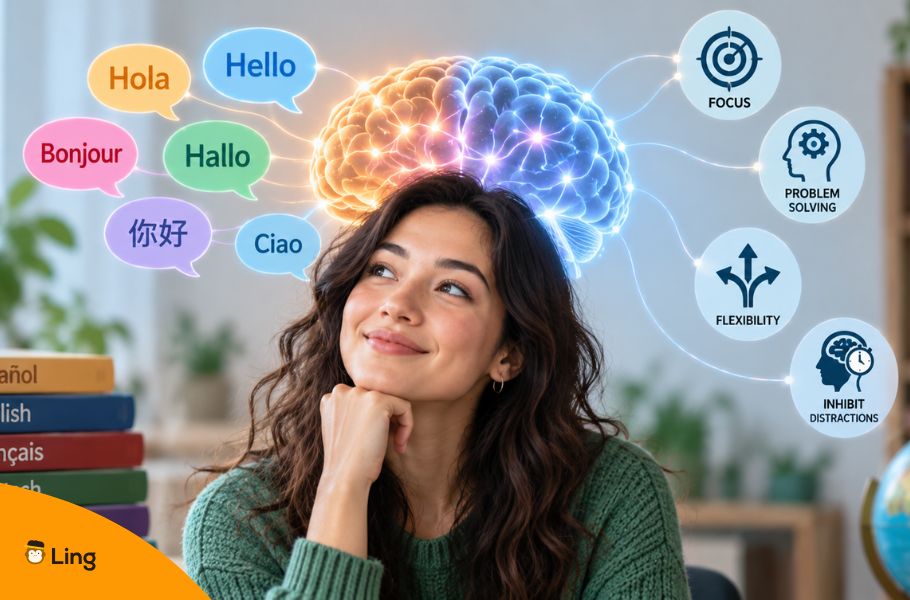
Speaking a new language has many benefits. Findings suggest that when you know more than one language, your brain can have several words available for the same idea. Speaking requires you to select the language you want and keep the other one from getting in the way. That process involves executive function, which includes co-skills such as attention, inhibition, and switching between tasks.
Language learners practice these skills when they move between languages, adjust to a conversation, or focus on the language they’re trying to use.
Studies on whether bilingualism leads to broader improvements in executive function have produced mixed findings. Some report benefits in specific tasks, while others find little or no overall advantage. What’s clear is that speaking multiple languages requires the brain to manage competing information and make choices.
4. Regular Language Practice Keeps Neuroplasticity At Work
Learning a language takes time because your brain needs repeated exposure to build and reinforce what you’re learning. This ability to adapt in response to experience is called neuroplasticity or neural plasticity, and it’s the brain’s ability to reorganize itself by forming new neural pathways and changing existing ones.
Every conversation, listening exercise, reading session, or attempt to remember a new phrase gives your brain another opportunity to work with the language. With practice, tasks that once required intense concentration can become more automatic.
Age can play a role in how easily the brain adapts, but adults or older learners can still learn languages and experience changes linked to learning. The amount and type of exposure matter too, so you don’t need perfect fluency for your brain to engage with the demands of a new language.
FAQs: How Learning A New Language Changes Your Brain
Does Learning A New Language Change Your Brain?
Learning a new language can change the brain by strengthening the networks used for language, memory, attention, and cognitive control.
Do People With High IQs Learn Languages Faster?
Not necessarily. General intelligence is only one factor that may relate to language-learning performance. Motivation, previous language experience, learning strategies, exposure, and practice can all affect how quickly someone progresses.
Can Learning A Language Improve Your Memory?
Learning a language gives your brain ongoing opportunities to store, recall, and connect new information. Over time, this can strengthen the skills involved in remembering vocabulary and retrieving words when you need them.
Learn A New Language And Change Your Brain With Ling!
Learning a new language keeps your brain active as you remember words, focus on conversations, and switch between languages. Your brain keeps adapting as you learn and use the language, which is part of how learning a new language changes your brain for the better.
And choosing a resource that fits the way you learn can make your routine easier to stick with. That’s why Ling’s 70+ language courses are developed by language specialists who take into account how people learn best.
Download the Ling app and start with a 7-day free trial. Choose a language that interests you, give it a try, and see how much you can learn in just seven days.