

The Hong Kongers ‘ land can transform from a beautiful to a scary place when you’re lost. So, let’s learn asking and giving directions in Cantonese 方向 Fong1 Hoeng3.
Hong Kong is truly one of the Asian countries with many tourists every year because of its beautiful places and culture. But, we also know that Hong Kong is also one of the busiest streets in the world. One example of that busy place is the City Center of Hong Kong, which is the Tsim Sha Tsui. The number of people you will see walking the streets, and the tallest skyscraper will make you feel overwhelmed. Although most Hongkongers know how to speak English, learning Cantonese directions is really essential.
So, save your future travel in this blog and learn about asking and giving directions in Cantonese. Don’t worry because the Jyutping romanization (pronunciation) and English translation will make it easy for you to learn these Cantonese words and phrases.
I want to learn even more languages with Ling!
Download now!
Mandarin VS Cantonese
Before we start learning some words and phrases in asking and giving directions in Cantonese, we should learn that Mandarin and Cantonese are different. Although Hong Kong is under the principle “One country, two systems ” of the People’s Republic of China, Hongkongers speak Cantonese and English more than Mandarin.
So, for the phrase “Turn left,” for example, if you encounter “左转 (Zuǒ zhuǎn) ” it is Mandarin. The Cantonese word for “Turn left” is “轉 左 (Zyun3 Zo2) “.
As you can see, the two words are very different from each other. Each character is different, and also the tones in spoken language are also different.
Asking/Giving Directions In Cantonese Language
Did you know that Hong Kong is one of the safest cities to travel to using public Hong Kong transportation? Whether you’re taking the MTR, taxi, bus, or tram, you can jump in for a long ride while enjoying the outside view with nice music from your audio player. But, what if you got lost? Have you missed your station? It is pretty daunting, especially if you don’t know how to speak Cantonese.
So, in this part of the lesson, I will introduce to you some essential Cantonese words and phrases used in asking and giving directions in Cantonese.
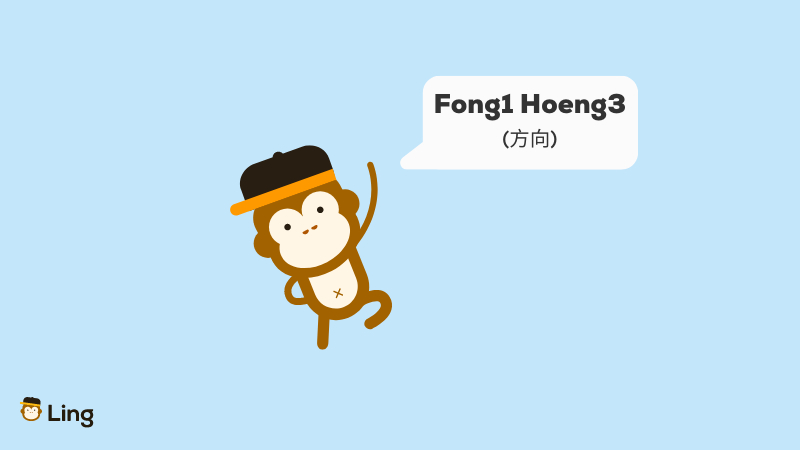
方向 (Fong1 Hoeng3) – Direction
The first word we need to learn is 方向 (Fong1 Hoeng3), which means “direction” in English. The Cantonese characters that are used are easy to remember, and you can easily use them in a sentence.
1. Turn Left – 轉左 (Zyun3 Zo2 / Jyun3 Jo2) / Turn Right – 轉右 (Zyun3 Jau6/Jyun3 Yau6)
If you are walking down the streets or even driving and you suddenly get lost, you will usually ask for directions from the locals standing there at the moment. This is mostly used for short-distance directions only. You might not remember it when you use it for long-distance directions.
2. Go Straight – 一直行 (Jat1 Zik6 Haang4/ Jik6 Haang4)
In Cantonese, another common phrase for giving directions is “Go Straight” (一直行 Jat1 Zik6 Haang4/ Jik6 Haang4). It is essential to know that Hong Kong people will use their body parts to point to something. Usually, locals will just point it out or use hand signals to indicate that you should go straight or straight ahead.
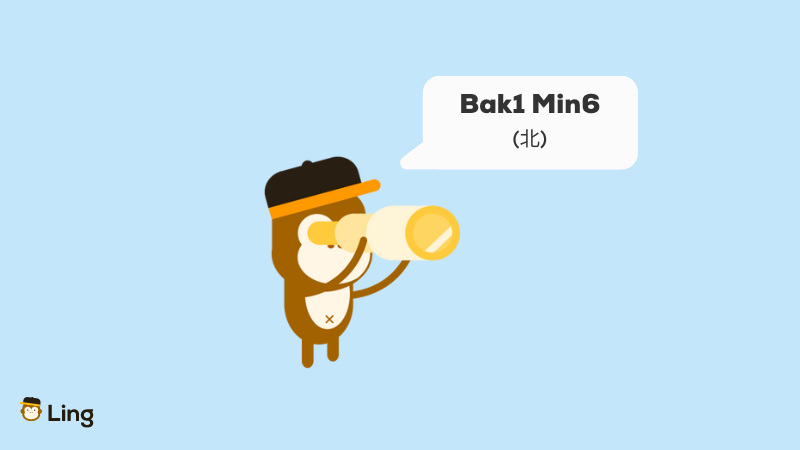
3. North – 北 (Bak1 Min6) , South – 南 (Naam4 Min6) , East – 東 (Dung1 Min6) , West – 西 (Sai1 Min6)
Of course, we should also learn how to say the basic directions in the Cantonese language. This can be so very helpful if you refer to places that are far away from each other. Are you going to Hong Kong for holidays? It’s best to plan your schedule to avoid super crowded days.
For example, the Tsim Sha Tsui, an entertainment and shopping hub, is located at the southern point of Kowloon. You can also have fun in the Eastern District of Hong Kong, where the Monster Building, Cityplaza, and Hong Kong Museum of Coastal Defence are located.
4. In Front Of – 前面 (Chin4 Min6) And Behind 後面 (Hau6 Min6)
It’s easy to get lost while traveling in Hong Kong. The next words about asking and giving directions in Cantonese that you need to know is the word “In front of” or “Behind.” It is also one of the best ways to locate places with the use of landmarks. For example, if you have gone to Hong Kong Disneyland on Lantau Island, you will see the Mickey Mouse flower bed in front of Disneyland’s Main Street Train.
5. Near – 附近 (Fu6 Gan6) , Far – 遠 (Yun5)
The word for near and far is also important when you’re learning in asking and giving directions in Cantonese. This is one of your bases if you will take a ride or you just walk. It is also helpful to know the exact location of the place based on the places near it. For example, you ask a local where to see the beautiful Hong Kong skyline. In that case,e they will say, “In Victoria Peak or the Kowloon waterfront (near the clock tower along the Tsim Sha Tsui Promenade), not far from the Star Ferry pier, where benches surround the shoreline with views of Hong Kong.”
6. Where Is The Hospital? – 邊度有醫院? (Bin1 Dou6 Jau5 Ji1 Jyun2)
As mentioned above, you can go around the cities of Hong Kong by trains, buses, trams, and taxis. You just have to bring with you your Octopus Card. But, aside from this, you should also learn how to ask for the location of bus stops because you cannot ride buses anywhere in the streets. The bus stops on the bus routes, which you can check online too.
8. Where Is The Bathroom? – 廁所喺邊 (Ci3 So2 Hai2 Bin1?)
Going to the bathroom is one of the most common emergencies we can experience while we enjoy traveling. If you’re in a shopping mall or restaurant, you can simply ask the guards. But, if you are in a public place, you may ask the locals for the nearest public toilet. You may also want to check the website of the Food and Environmental Hygiene Department to check the nearest public toilet in your location.
9. How To Get There? – 如何前往?(Jyu4 Ho4 Cin4 Wong5)
This is a very basic phrase for asking directions in Cantonese that you can use in most situations. You can start by naming the place you want to go to and then follow up with this question.
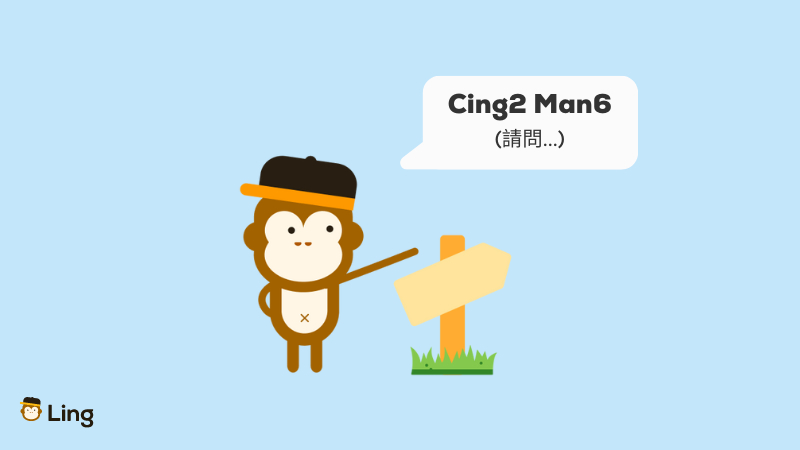
10. Excuse Me… – 請問… (Cing2 Man6)
The last word related to asking and giving directions in Cantonese is 請問 (Cing2 Man6). If you are asking for help, you should be extra polite. Being polite is a sign of respect and humility, and it is one of the most important lessons that you should learn.
If you’re the one asking for directions from the locals, make sure not to sound rude by using 請問… (Cing2 Man6), which means “Excuse Me.” This will help you politely ask for someone’s attention to help you. You can also use the combination of 請問… (Cing2 Man6) and 唔該 (m4 goi1). The Cantonese expression 唔該 (m4 goi1) has a lot of meaning. It can be used for “Thank you in Cantonese,” “Please,” and “Excuse me.”
Additional Direction Words And Phrases In Cantonese
| English Translation | Cantonese | Jyutping | Sound |
|---|---|---|---|
| map | 地圖 | dei6 tou4 | |
| traffic light | 紅綠燈 | hung4 luk6 dang1 | |
| to go | 去 | heui3 | |
| to be (somewhere); to be located at | 喺 | hai2 | |
| to walk | 行 | haang4 | |
| to cross | 過 | gwo3 | |
| to get on the bus | 上巴士 | seung5 ba1 si2 | |
| to go abroad (v.) | 出國 | ceot1 gwok3 | |
| to stop | 停 | ting4 | |
| between | 中間 | jung1 gaan1 | |
| behind | 後面 | hau6 min6 | |
| left | 左 | zo2 / jo2 | |
| right | 右 | jau6/ yau6 | |
| on the left | 左邊 | jo2 bin6 | |
| on the right | 右邊 | yau6 bin6 | |
| under | 下面 | ha6 min6 | |
| on | 上 | seung6 min6 | |
| outside | 出面 | cheut1 min6 | |
| inside | 裏面 | leui5 min6 | |
| at | 喺 | hai2 | |
| to | 到 | dou3 | |
| here | 呢度 | ni1 dou6 | |
| there | 嗰度 | go2 dou6 | |
| from | 由 | yau4 | |
| center | 中心 | zung1 sam1 | |
| corner | 角落 | gok3 lok6 | |
| distance | 距離 | keoi5 lei4 | |
| road | 馬路 | ma5 lou6 | |
| street | 街 | gaai1 | |
| intersection | 十字路口 | sap6 ji6 lou6 hau2 | |
| straight ahead | 直前方 | zik6 cin4 fong1 | |
| next | 下 | ha6 | |
| slow | 慢 | maan6 | |
| bus route | 巴士路線 | baa1 si2 lou6 sin3 | |
| at the corner | 喺街角 | hai2 gaai1 gok3 | |
| away from | 距離 | keui5 lei4 | |
| opposite to | 對面 | deui3 min6 | |
| Turn left at a traffic light. | 紅綠燈轉左 | hung4 luk6 dang1 zyun3 zo2 | |
| Please go straight to the corner. | 請直行向街角 | ching2 jik6 haang4 heung3 gaai1 gok3。 | |
| You walk from here | 你由呢度開始行 | nei5 yau4 ni1 dou6 hoi1 chi2 haang4。 | |
| The bus stop is on the main road. | 個巴士站喺大馬路 | go3 ba1 si2 jaam6 hai2 daai6 ma5 lou6。 | |
| Where are the ticket machines? | 售票機喺邊? | sau6 piu3 gei1 hai2 bin1? | |
| Where can I buy a ticket? | 喺邊度買飛? | hai2 bin1 dou6 maai5 fei1? | |
| Where does this trail lead? | 呢條路去邊? | Ni1 Tiu4 Lou6 Heoi3 Bin1? | |
| What is the shortest route to this hotel? | 點樣去呢間酒店最快? | dim2 joeng2 heoi3 ni1 gaan1 zau2 dim3 zeoi3 faai3 | |
| Could I get a map? | 我可唔可以要張地圖? | ngo5 ho2 m4 ho2 ji3 jiu3 zoeng1 dei6 tou4? | |
| Can I have your address? | 可以講你個地址我知嗎? | ho2 ji5 gong2 nei5 go3 dei6 zi2 ngo5 zi1 maa1 ? | |
| Excuse me, where is the nearest town? | 請問最近嘅城市喺邊? | cing2 man6 zeoi3 kan5 ge3 sing4 si5 hai2 bin1? | |
| Does this bus go to…..? | 呢架巴士去唔去…? | ni1 gaa3 baa1 si2 heoi3 m4 heoi3 …? | |
| Where shall we meet? | 我哋喺邊度等? | Ngo5 Dei6 Hai2 Bin1 Dou6 Dang2? | |
| You get on the bus. | 你上巴士 | nei5 seung5 ba1 si2 | |
| I walk to school. | 我行路返學 | ngo5 hang4 lou6 faan2 hok6 | |
| You walk to the bus stop. | 你行去巴士站 | nei5 haang4 heui3 ba1 si2 jaam6 | |
| Please stop here. | 請喺呢度停低 | ching2 hai2 ni1 dou6 ting4 dai1 |
Improve Your Cantonese Language Skills
Now that you already know which words to say when asking and giving directions in Cantonese, can you now identify what direction you are heading in your language learning journey? Don’t be lost, and start mapping your way to success using the Ling app. With a variety of topics to learn and an interactive learning experience, you can learn Cantonese in no time.
It uses smart flashcards that contain examples of words, phrases, and sentences, audio recordings from native speakers that you can hear, images, and activities. This will develop your language skills to achieve mastery and fluency and also create a meaningful learning environment.