

Funny Cantonese phrases are a fantastic way to inject some humor into your daily life and break the ice in social situations. People in Hong Kong and South China can be a little tight, and these phrases can surely help you break that tough front and get to the smoochy warmth inside!
Table of Contents
How To Say Funny Cantonese Phrases?
Oh boy, Cantonese is so fun! There are many phrases that make you laugh if you look at their translation and literal meaning. Here is a list of the funny Cantonese phrases we will be talking about today!
| Meaning | Cantonese | Pronunciation |
|---|---|---|
| Crazy | 痴線 | ch1 sin3 |
| Chinese people that were raised overseas | 竹升 | zuk1 sing1 |
| perverts or creepy men | 金魚佬 | gam1 jyu4 lou2 |
| someone who is wrapped up well on the top half of their body but underdressed for the bottom half | 上面蒸鬆糕 下面賣涼粉 | soeng6 min6 zing1 sung1 gou1 haa6 min6 maai6 loeng4 fan2 |
| someone got romantically rejected | 食檸檬 | sik6 ning4 mung4 |
| Talking to the phone for hours | 煲電話粥 | bou1 din6 waa6 zuk1 |
| Bollocks! | 哎呀 | aai1 aa1 |
| A conversation that people don’t understand each other | 雞同鴨講 | Gai1 tung4 aap3 gong2 |

痴線 (ch1 sin3)
The literal translation is “glued wires,” and chi sin means “crazy” or “insane”. That makes sense, right? If you think that the mind is like a circuit, crazy people may have some wires that are a little… short-circuited. This phrase is also used to express surprise or incredulity, so that is why when I shot a very low price to the store lady, she literally called me crazy. In a cute and respectful way let’s say.
I want to learn even more languages with Ling!
Download now!

竹升 (zuk1 sing1)
This phrase was originally expressed as 竹竿 (zuk1 gon1—bamboo pole) and was used to represent Chinese people who were raised overseas. Like the bamboo, it was hollow inside, signifying the lack of Chinese culture in their knowledge. Many Cantonese phrases involve nature, like plants.
The English equivalent to 竹升 (bamboo rise) is to call someone a banana in Cantonese – yellow on the outside and white on the inside. A very witty and smart way to call someone an outsider.

金魚佬 (gam1 jyu4 lou2)
A “goldfish man” is used to mean a middle-aged or older man with supposed paedophilic tendencies. On a deeper note comes this Cantonese phrase with a very dark back story. This was inspired by a series of crimes that occurred in the 60s where creepy men would lure young women into kidnapping them by promising to show them goldfish. It is also commonly used to represent perverts or creepy men.

上面蒸鬆糕,下面賣涼粉 (soeng6 min6 zing1 sung1 gou1 haa6 min6 maai6 loeng4 fan2)
This is a phrase used to describe someone who is wrapped up well on the top half of their body but underdressed for the bottom half! Imagine a girl with a very heavy and fluffy jacket but wearing a mini skirt in plain winter in Hong Kong. The literal meaning is a bit more complex and compares two different types of food. It means Selling steamed cake above and grass jelly below.

食檸檬 (sik6 ning4 mung4)
It literally means “Eating lemons,” like rubbing lemons into an open wound. It is hurtful and used to say that someone was rejected, most likely romantically. For example, saying “I love you” in Cantonese, but the person doesn’t feel the same. Ouch!

煲電話粥 (bou1 din6 waa6 zuk1)
If, literally, you’re imagining a pan boiling a telephone in a congee soup, and figuratively, you should be imagining someone talking to the phone for hours on end. Congee is a rice porridge (a sample of traditional Cantonese food) that needs to be cooked for a very long time. Hence Cantonese finds this very amusing way to tell that someone spends too much time talking to their friends on the phone.

哎呀 (aai1 aa1)
Do you want to learn an expression you can use in Cantonese vocabulary when you forget your keys in the office or when you stub your foot pinky into the furniture? Bollocks! You’ve probably already heard this expression somewhere. It is recognized all across China and Sri Lanka; you’ll get some sympathy if you say it!

雞同鴨講(Gai1 tung4 aap3 gong2)
When “Chicken talks to a duck,” what will it happen?
Can you imagine a conversation between a chicken and a duck? Pointless, right? This phrase is used when Cantonese speakers witness a conversation that doesn’t seem to have an ending and that goes round and round.
Why Learn Funny Cantonese Phrases For Your Travels?
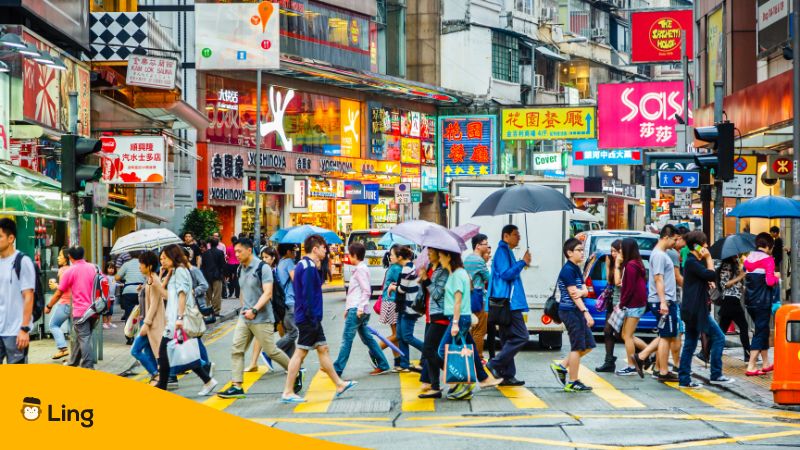
As a traveler to Hong Kong, I discovered the power of funny Cantonese phrases on my first visit when I found myself in the bustling streets of Causeway Bay, bargaining with local shopkeepers. During my several bargaining interactions, I kept hearing the phrase “chi sin” along with a somewhat desperate face when I asked to buy something half the price of what they were asking me (I know it is a little hardcore, but you have to start low to meet them in the middle!). Intrigued, I decided to learn what this phrase was, and consequently, I discovered the world of funny Cantonese phrases.
The next day, I decided to put my knowledge into practice, so I confidently asked the store lady for the price, and as soon as she told me, I dropped a “chi siiiiin” with a cheeky and playful tone and a very funny cartoon-like facepalm. To my delight, it had the desired effect, and the store lady was in tears of laughter. Any language barriers that might have existed were instantly destroyed! She loved it so much that she almost wanted to offer me the T-shirt I wanted to buy, but I felt bad and agreed on a fair price!
This experience showed me the importance of knowing these phrases in everyday life. They not only make for a more enjoyable experience but can also be an effective way to break down social barriers and especially get a lower price while bargaining! They are always useful!
More Funny Cantonese Phrases
Whether you are looking to make new friends, haggle for a better price, or simply add some humor to your interactions, funny Cantonese phrases are a must-know for anyone traveling to Hong Kong or Southern China, where Cantonese is widely spoken.
From playful banter to witty comebacks and some Cantonese slang, these funny Cantonese phrases will not only bring a smile to your face but also help you connect with the area’s deep and rich culture. Here are some more funny Cantonese phrases.
| Meaning | Cantonese | Pronunciation |
|---|---|---|
| So average | 麻麻哋 | maa4 maa4 dei2 |
| Someone acting naive or weak to trick others, then surprising them with unexpected strength or intelligence. | 扮豬食老虎 | baan6 zyu1 sik6 lou5 fu2 |
| Someone older to humorously imply they’re more experienced | 食鹽多過你食米 | sik6 jim4 do1 gwo3 nei5 sik6 mai5 |
| Are you kidding me? | 有冇搞錯呀? | jau5 mou5 gaau2 co3 aa3? |
Frequently Asked Questions About Funny Cantonese Phrases
What Does Ma Ma Dei Mean?
“Ma Ma Dei” (maa4 maa4 dei2) in Cantonese refers to something that is not impressive or just average.
What Are Common Cantonese Terms for describing someone silly or foolish?
In Cantonese, if you want to describe someone silly, you may say 痴線 (ch1 sin3) or 傻豬 (so4 zyu1).
Are There Cantonese Phrases similar to “LOL”?
笑死我 (siu3 sei2 ngo5) literally means “laugh me to death,” and 哈哈哈 (haa1 haa1 haa1) are both similar to the usage of lol.
Learn More Funny Cantonese Phrases? Use Ling!
That’s it for today! Hopefully, I have sparked your curiosity about this incredible language and made you want to learn more about it! If this is the case, don’t forget to check our Cantonese blog weekly and read our updated and interesting content about this language.
Language learning can be so much fun with the Ling app, so grab your phone and download Ling now!