



Duolingo, Babbel, and Ling are popular language-learning apps that you will probably come across early on in your learning journey, and each takes a very different approach to teaching languages.
To make sure you choose the right one, this in-depth Duolingo vs Babbel vs Ling comparison will break down everything you need to know, from pricing and features to speaking practice and long-term effectiveness.
Keep on reading to find out which is the right language learning app for you in 2026!
I want to learn even more languages with Ling!
Download now!
Duolingo vs Babbel vs Ling: A Quick Comparison
Before delving a bit deeper into each app, its features, and what it promises, here’s a side-by-side overview to help you get an overall idea about them:
| Feature | Duolingo | Babbel | Ling |
|---|---|---|---|
| Best for | Casual learners | Structured learning | Real-life communication |
| Languages offered | 40+ | 10+ | 70+ |
| Languages offered in users’ native languages | 20+ | 9 | ✅ 70+ native languages |
| Pricing model | Freemium model + Premium plans | Free 1st lesson of every course + Premium plans | Free trial + Premium plans |
| Lesson style | Gamified and highly interactive | Structured & curriculum based | Gamified and conversation-focused with cultural context |
| Script writing practice with finger-tracing tech | ⚠️ (Limited) | ❌ | ✅ (For languages with non-Latin alphabets) |
| Ideal for beginners & intermediate learners | ✅ | ✅ | ✅ |
| Short, interactive lessons | ✅ | ✅ | ✅ |
| Native-speaker audio clips | ❌ | ✅ | ✅ |
| Speaking & pronunciation exercises | ⚠️ (Limited) | ✅ | ✅ |
| Streaks & progress tracking | ✅ | ✅ | ✅ |
| Flashcards & vocabulary bank | ✅ | ✅ | ✅ |
| Grammar notes (for some languages) | ✅ | ✅ | ✅ |
Quick takeaway: Duolingo is a gamified app that’s the easiest to start with, while Babbel is more structured. Both can be used to learn popular languages such as Spanish, French, Japanese, or Korean. However, Ling is the most practical app for real-life language use and offers courses in both popular and less commonly taught languages.
What Is Duolingo And Who Is It Best For?
Duolingo is arguably the most popular language app in the world, and for good reasons. Its colorful interface, addictive streak system, and quick lessons interspersed with funny characters and interactions have made it a favorite among millions of users.
How Does Duolingo Work?
Duolingo uses a fully gamified learning model with short lessons and an interactive interface. The app is designed to help you learn through repetition and pattern recognition, and to keep you motivated.
Duolingo Course Structure
Duolingo offers several language courses that feature:
- 40+ languages, including popular ones like Spanish and French, and fictional ones like High Valyrian
- Short lessons with interactive exercises and activities
- AI conversations (limited to some languages)
- A gamified method that includes streaks, XP points, and leagues
- Stories for reading and listening practice (available with the premium plan)
Who Should Use Duolingo?
Duolingo is your go-to app if you:
- Only want to dabble in a language and learn basic vocabulary
- Want to build effective daily learning habits
- Prefer a fun language learning experience with no stress
Hence, if your goal is to confidently speak a language in real-life situations, Duolingo alone is unlikely to get you there.
Duolingo Pricing
- Freemium version
- Super Plan: $7.26/ month
- Super Family Plan: $10.76/ month
What Is Babbel And Who Is It Best For?
Babbel is another app that takes a more traditional and structured approach to language learning. Unlike Duolingo, Babbel offers well-structured lessons with clear, practical explanations.
How Does Babbel Work?
Babbel’s courses are organized into progressive lessons that build on each other. Each lesson introduces you to new vocabulary and grammar explanations (that are only available for some languages). Then, you reinforce your learning through various exercises.
Babbel Course Structure
Babbel has a course structure that includes:
- 14 language courses (mainly popular languages)
- Short lessons and quick exercises
- Grammar rules, explanations, and guides (for some languages)
- Speaking and conversation exercises
- In-app podcast feature (available for some languages)
To sum up, if you’re looking for an app with a Duolingo-type vibe, then you might find Babbel is a more serious tool for learning. However, the language selection is a bit too narrow, focusing almost exclusively on European languages.
Who Should Use Babbel?
Babbel is best for:
- Serious language learners who want structure and clarity, not just fun
- Professionals or students
- Learners who seek to reach fluency
If you like understanding how a language works, you’ll find Babbel a strong fit for your goals and learning style!
What Is Ling And Who Is It Best For?
Ling is a pioneering language app designed around one core idea: helping learners navigate hard languages easily and communicate in real life.
While it shares some features with apps like Duolingo and Babbel, Ling really stands out for its strong focus on practical conversations, pronunciation, and cultural context. It also focuses on languages left behind by these same popular apps, offering 70+ languages such as Albanian, Azerbaijani, and Maori.
How Does Ling Work?
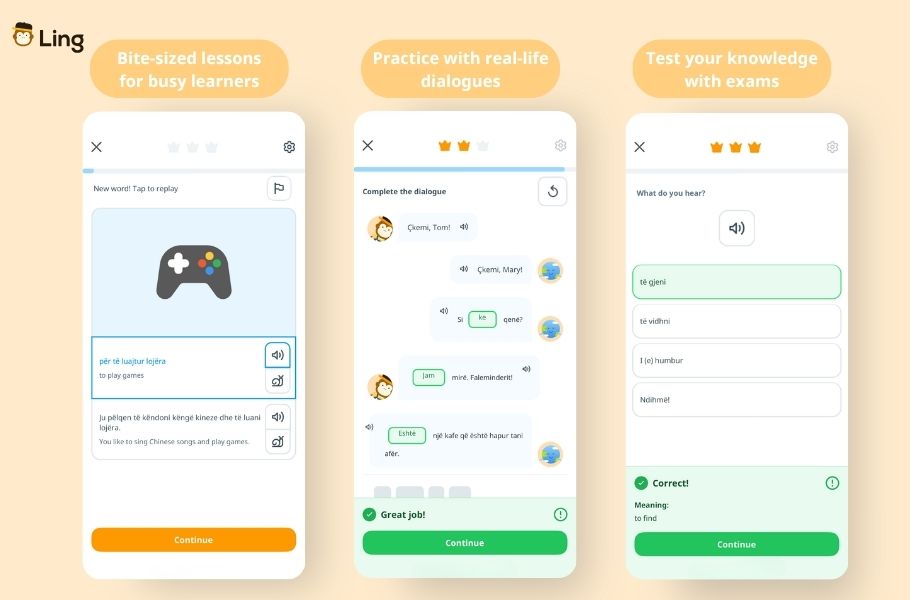
Ling helps you learn languages through scenario-based lessons. Each unit covers a specific theme, such as ordering food or asking for directions, through various exercises and native-speaker audio.
Ling Course Structure
The Ling app’s language courses are structured in a way that gives you access to:
- 70+ languages, including Southeast Asian and Eastern European languages
- 70+ interface languages to learn from your mother tongue
- Interactive and gamified lessons to learn practical words and phrases for daily life
- Native-speaker audio to learn the right accent
- Real-life dialogs and a chatbot powered with speech recognition technology
- Mini-exams to test your knowledge after each lesson
- Flashcards and review features
- Culture and grammar notes for better immersion in the language (available for some languages)
- A whiteboard to learn how to write complex characters
- Motivating learning pathways with streaks and rewards
- A competitive leaderboard to monitor your progress
- An offline mode to learn whenever and wherever you want
To sum up, Ling is a highly practical language-learning app that offers everything you need to actually speak the language of your choice, even if it’s a minor one!
Who Should Use Ling?
Ling is ideal for:
- Travelers and expats looking to visit or settle in a new country
- Heritage hunters reconnecting with the language of their family or ancestors
- Amateur linguists who like to discover new languages
- Learners who want to connect with their spouses and their families
So, compared to Duolingo and Babbel, Ling has two main advantages: more languages and the right balance between fun and learning.
What Do Duolingo, Babbel, And Ling Have In Common?
The biggest feature Duolingo, Babbel, and Ling have in common is gamification. Here is how they compare:
| App | Gamification style |
|---|---|
| Duolingo | – Fuels learners’ competitiveness – Makes learners addicted to keeping streaks alive |
| Babbel | – Gamified exercises but not as much as Duolingo’s – Motivational streaks to keep learners going |
| Ling | – Balanced gamified elements – Various types of interactive exercises – Gamification doesn’t overpower the learning goal |
Quick takeaway: Ling offers a well-balanced and gently gamified learning method that helps learners actually speak the language they’re learning.
What Are The Main Differences Between Duolingo, Babbel, And Ling?
Number Of Languages Offered
Duolingo, Babbel, and Ling primarily differ in the number of languages they offer:
- Duolingo offers more than 40 languages, including fictional ones (mostly available from English)
- Babbel offers only 14 languages (mostly European languages)
- Ling offers 70+ languages, ranging from Asian and Eastern European languages to African and Pacific languages.
Use Of AI
Another difference between Duolingo and both Ling and Babbel is the use of AI:
- Duolingo shifted towards an AI-first strategy for course creation and personalization in 2025
- Babbel uses AI to support speaking practice and feedback
- Ling primarily offers courses vetted by native speakers and uses AI for its AI tutor
Which Of Duolingo, Babbel, And Ling Is Better For Speaking Skills And Real-Life Conversation?
If your goal is to speak the language you chose to learn in 2026, this is where the differences between all three apps become very clear. Here is how they compare:
- Duolingo offers a few speaking exercises but focuses more on helping you build good learning habits.
- Babbel includes speaking exercises with pronunciation training.
- Ling offers regular practice with dialogue or speech exercises for each lesson to help you practice speaking every day.
Which App Provides Better Cultural Context: Duolingo, Babbel, Or Ling?
All three apps help you learn how languages are connected to their cultures.
Duolingo provides cultural context with stories and AI roleplay, but only for some popular languages like Spanish. Babbel has a “Countries and Traditions” section where you can learn more about the customs that are linked to the language you learn.
On the other hand, Ling helps you learn languages within their cultures by giving you access to interesting, bite-sized culture notes that are available for several languages.
For example, the Thai language culture notes will teach you all about Thai cuisine, the real name of Bangkok, or Thai honorifics.
Ling’s culture notes are available for the following niche languages :
- Thai
- Khmer
- Vietnamese
- Tagalog
- Punjabi
- Urdu
- Serbian
- Albanian
- Croatian
- Bosnian
- Lithuanian
- Japanese
- Korean
- Cantonese
And the list keeps expanding!
Pricing Comparison: Duolingo vs Babbel vs Ling
Want to know more about the type of subscriptions available in each app? Check this pricing comparison table:
| Duolingo | Babbel | Ling |
|---|---|---|
| Freemium version (limited by energy recharging) | 1 month: $9.60 | 7-day free trial (for annual subscribers) |
| Super Plan: $7.26/ month | 3 months: $24.45 | 1 month: $16.99 |
| Super Family Plan: $10.76/ month | 6 months: $43.20 | 6 months: $64.99 |
| 12 months: $57.60 | 12 months: $89.99 | |
| Lifetime: $159.50 |
Quick takeaway: In terms of value for money, you’ll find Ling subscriptions to be unbeatable because they give you access to all 70+ language courses!
What Do Learners Say About Duolingo, Babbel, And Ling?
The best way to know whether a language app is worth it is to check user reviews. Here is what they say about Duolingo, Babbel, and Ling:
What Learners Say About Duolingo
“I would rate 4.5, but I can’t so I rounded it up to five stars! Now, I love Duolingo. It has been helpful to my language learning, and I like the variety of languages it has. I love the simple characters and their designs, especially Zaris! My only criticisms is the fact some less, but not unknown languages (such as nepali) aren’t on there, some ads are completely unskippable, and I find the excessive use of AI a bit unnecessary. Overall, one of the best free apps for language learning though!”
⭐⭐⭐⭐⭐
Fen W.
“Overall good way to learn a bit of a language, regularly. There have been some road bumps with AI generated lessons, but most of that has been corrected. The conversation mode in Max is a bit of a game changer, if it could correct your pronunciation like a human it would be there. Still one of the best ways to learn with an app.”
⭐⭐⭐⭐⭐
Christopher S.
What Learners Say About Babbel
“I moved away from Duolingo as it was annoying me. I feel like I’m learning more and not having my dopamine rinsed as much.”
⭐⭐⭐⭐⭐
Ben G.
“I’ve tried several apps and methods and Babbel works best for me. I’m studying Spanish quite seriously, and it goes into more detail than other apps, and tells you the rules. I also use to learn a few basics of other languages when I’m going to visit any country, and it does that well too.”
⭐⭐⭐⭐⭐
Stewart
What Learners Say About Ling
Did you know? The Ling app has 10M+ downloads and has a 4.7/5-star rating on the app stores! Here are some of the reviews of satisfied learners:
“I’ve tried a lot of language apps, Duolingo, Drops, Jumpspeak, and more. Tagalog options are limited in most apps on the market. This is the first app that I’ve found with Tagalog that gives real, applicable conversational inputs. I love the real-life examples of sentences and conversations. I just tried the conversation simulator and am stoked!”
⭐⭐⭐⭐⭐
Patrick H.
“I have scoured the internet for a good app for Georgian. It seems like resources are very few and far between for that language, but this app delivers. It’s fairly priced and structured very well with a lot more languages than Duolingo, Busuu, and Babbel. I’m plainly impressed and will recommend this app to others who want to learn less common languages. It’s a good supplement for language learning (nothing replaces cultural immersion and speaking to native speakers), and I highly recommend it!”
⭐⭐⭐⭐⭐
Jason F.
Duolingo vs Babbel vs Ling: Pros And Cons
| Pros/Cons | Duolingo | Babbel | Ling |
|---|---|---|---|
| Pros | – Beginner-friendly – Highly engaging and ideal for daily habit building – Free version with a lot of accessible content – Great for building vocabulary basics | – Clear grammar explanations – Real-life dialogs – Structured progression for long-term learning – Strong focus on practical use of the language | – 70+ languages, including minor and lesser-known languages – Structured learning path – Native-speaker audio – Writing exercises for non-Latin languages – Real-life vocabulary – Culture & grammar notes for several languages – A balanced gamified method |
| Cons | – Lesser-known languages are underrepresented – Grammar explanations are only available for some languages – Sentences can feel unnatural or unrealistic – An overgamified method – A free version that’s becoming more restrictive | – No fully free version – Focus on European languages mostly – Less gamified than competitors | – Grammar and culture notes only available for some languages – No personalized materials |
Quick takeaway: As you can see, all three apps have pros and cons. But if you want to choose the app that combines the best advantages to learn a language effectively in 2026, then you may want to try Ling!
Which App Should You Choose Based On Your Goals?
Depending on your goals, the level of fluency you want to reach, and the type of language you want to learn, here is how you can choose between Duolingo, Babbel, and Ling:
- Duolingo is best for beginners and casual learners to build good learning habits
- Babbel is best for well-structured courses and learning European languages
- Ling is best for traveling, reconnecting with family, or building a solid basis for real-life communication in 70+ languages
FAQs: Duolingo vs Babbel vs Ling
Is Duolingo Enough To Become Fluent In A Language?
No. Duolingo is certainly not enough to become fluent in a language. Although it’s great for beginners, it lacks depth for advanced fluency. So it’s best to use other apps or additional resources with it.
Is Babbel Better Than Duolingo For Grammar?
Yes, Babbel is way better than Duolingo for learning grammar. The app provides clear and in-depth explanations. Duolingo does have grammar courses, but only in a few languages.
Is Ling Better For Speaking Practice?
Yes. Ling is better than Duolingo and Babbel for speaking practice, as it includes many interactive speaking exercises in all its lessons.
Is Ling Worth Paying For?
If your goal is to learn how to speak a niche language and chat easily with locals or with your family, Ling is definitely worth paying for. Plus, purchasing a subscription means that you’ll always have access to exclusive content and to new languages.
Can I Use Ling, Duolingo, And Babbel For Free?
It is indeed possible to try all three apps for free. Duolingo offers a freemium version, Babbel offers a free lesson for each unit, and Ling offers a 7-day free trial to test the app. But to access more features and more languages, you’ll need to purchase the premium version.
Can I Use Duolingo, Babbel, And Ling Together?
Absolutely! Combining different learning tools can help you achieve your goals more quickly. You can use Ling for step-by-step progression, Duolingo for gamification, and Babbel for more in-depth learning. However, note that Duolingo and Babbel do not offer as many language courses as Ling.
How Do Duolingo, Babbel, And Ling Compare For Language Learning?
Duolingo is good for beginners and casual learners to build learning habits.
Babbel is great for well-structured courses and learning European languages. Ling is best for traveling, reconnecting with family, and building a solid basis for real-life communication in 70+ languages.
Final Verdict: Which App Is The Best To Learn A Language? Duolingo, Babbel, or Ling?
In 2026, Ling is definitely the best app to learn a language.
Why?
Because Ling is the app that:
- Focuses on languages that are often put aside by most language learning apps like Duolingo and Babbel
- Helps you speak the language you learn from day one
- Has the right balance between gamification and structure
So in 2026, Ling definitely needs to become your language companion!
Ready To Take Your First Steps In A Language With Ling?
Now, you’ve reached the end of this guide! Congrats!
Have you made up your mind about the app you’ll choose to learn a language in 2026? If you haven’t yet, let us help you!
If you want to learn a lesser-known language, you don’t need to rack your brains anymore! Ling is your ready-made solution. With one subscription, you have access to 70+ language courses and amazing features designed to help you speak a language from day one.
So what are you waiting for? Quickly grab your 7-day free trial by downloading the Ling app and start learning a language with us today!

















































































