


Some of you may have noticed that the Chinese and western dragons are distinct in ways beyond just their image. Aside from the obvious visual differences, this blog has a wealth of other information about the Chinese dragon to glean from.
There are as many aspects of the Chinese language and culture to master as there are of dragons. Dragons have been a staple of Chinese art from the dawn of Chinese civilization. Depictions of this creature can be seen in nearly every medium, from sculpture to paintings.
For example, there are several occasions in Chinese culture where a dragon dance is performed, including Chinese New Year, when it is believed that the year would be prosperous for businesses. The dance is performed to honor the dragon gods and to pray for their blessing for the coming business year.
I want to learn even more languages with Ling!
Download now!
We’re here to let you know that a wide variety of Chinese dragons are out there. But before we rush onto that list, let’s get a handle on what distinguishes Chinese dragons from their Western counterparts.
Chinese Dragon VS Western Dragon
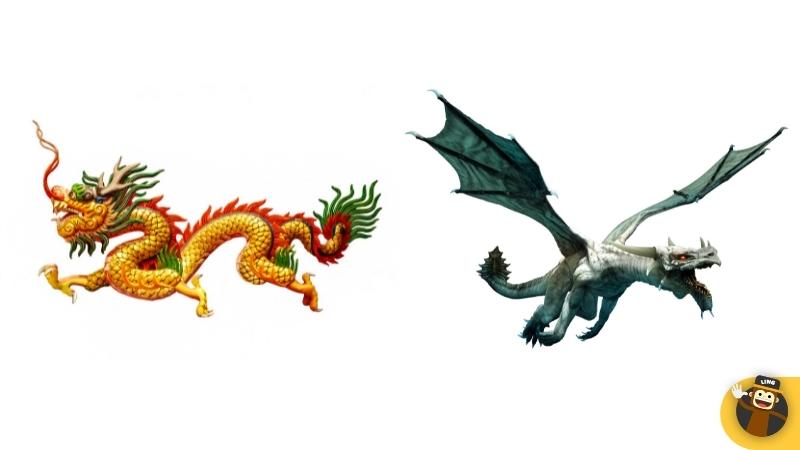
The Western or European dragon is often shown as a gigantic, fire-breathing scaly, horned lizard-like monster with leathery, bat-like wings, four legs, and a long, muscular, prehensile tail, especially in and after the early Middle Ages. Dragon’s blood is said to have remarkable capabilities in several folktales, such as extending a dragon’s life or making its drinker very toxic or poisonous.
In Christian mythology, the dragon guards a treasure palace or a cavern. Generally speaking, nice dragons are thought to offer encouragement or good advice, whereas evil ones are linked to heroic figures who try to destroy them.
In Chinese mythology, folklore, and popular culture, the dragon (龙, Lóng, sometimes pronounced as loong, or lung – ) plays a significant role. Some depictions of Chinese dragons are of turtles or fish, but the four-legged snake kind is by far the most common.
Experts have settled on four competing explanations for the Chinese dragon’s creation: snakes, Chinese alligators, thunder, and respect for nature. Furthermore, as we shall see below, the dragon in Chinese culture typically denotes good fortune, which may differ from Western cultures.
What Do Chinese Dragons Symbolize?
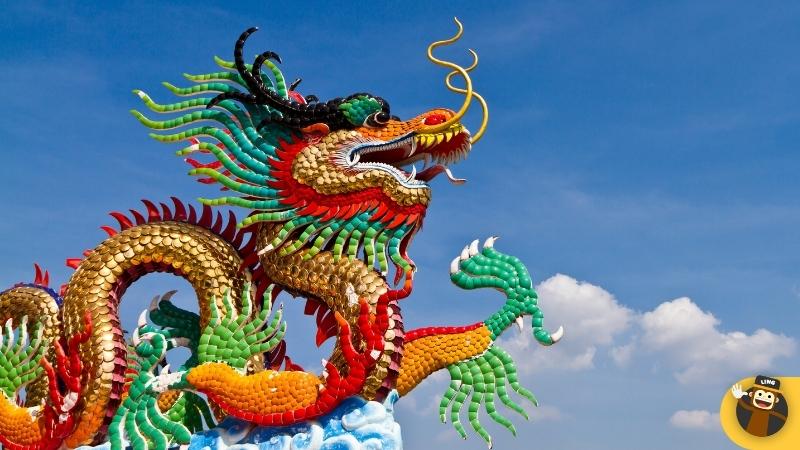
As a traditional Chinese sign of strength and good fortune, they are often associated with the ability to control the elements of nature, such as the weather and water flow. Imperial China’s emperors frequently employed dragon imagery to demonstrate their authority and power.
In the modern day, the Chinese dragon symbolizes good fortune, power, and health. It also represents Yang, the masculine principle. Furthermore, there are more births in the Chinese zodiac year of the dragon than any other animal since the dragon is the sole legendary creature in the calendar.
Therefore, it’s hardly surprising that many Chinese sayings and idioms include references to dragons, such as “Hoping one’s child would become a dragon,” or 望子成龙, wàng zǐ chéng lóng .
There Are Five Distinct Dragon Colors, Did You Know That?
Chinese dragons have been categorized in several ways by Chinese academics. For example, Song dynasty Emperor Huizong recognized five different colored dragons as “kings.” So, let’s see how to call those dragons in the Chinese language.
| Chinese Word | Pinyin | English Definition | |
| 青龍 | qīnglóng | The Azure Dragon reigns as the finest of all dragons. | |
| 朱龍 | zhūlóng | The Vermilion Dragon represents kings who bestow their good fortune on lakes. | |
| 黃龍 | huánglóng | The Yellow Dragon represents kings who respond positively to requests. | |
| 白龍 | báilóng | Honest and pure monarchs characterize the White Dragon. | |
| 黑龍 | hēilóng | The Black Dragon is a monarch of the deep, mystical seas. | |
The Many Types Of Chinese Dragons
There are several different habitats for Chinese dragons. For instance, there is the heavenly dragon, who resides in the heavens, and the seagoing, coiled dragon, who calls the depths of the ocean home. According to Chinese mythology, some dragons inhabit the ocean, while others fly through the clouds.
Check out the table below for some instances of Chinese dragons so you can learn to identify them accurately.
| Chinese Word | Pinyin | English Definition | |
| 天龍 | tiānlóng | Tianlong is the celestial dragon that protects the heavenly kingdom. | |
| 神龍 | shénlóng | Shenlong, the God dragon, is the god of thunder and has human features on his head, dragon scales for his body, and a drum for his stomach. | |
| 伏藏龍 | fúcánglóng | Fuzanglong is a hidden treasure dragon; he protects the valuable stones, metals, and metal products of volcanoes in the underworld. | |
| 地龍 | dìlóng | Dilong is an earth dragon who rules over the oceans and rivers. | |
| 應龍 | yìnglóng | Yinglong is a winged dragon who responds to rain and flooding. | |
| 蛟龍 | jiāolóng | Leader of all aquatic creatures, Jiaolong is a crocodile dragon who can be either hornless or scaled. | |
| 蟠龍 | pánlóng | Panlong is a lake dragon who hasn’t made it to the clouds; he’s a coiled dragon. | |
| 黃龍 | huánglóng | Huanglong, or the yellow dragon, is a hornless dragon that represents the Emperor. | |
| 飛龍 | fēilóng | It is said that Feilong is a winged dragon that flies across the sky and floats on clouds. | |
| 虯龍 | qíulóng | Qiulong, the curling dragon, has two seemingly contradictory names: “horned dragon” and “hornless dragon.” | |
| 燭龍 | zhúlóng | In Chinese mythology, Zhulong is a gigantic red draconic solar god known as a torch dragon. It opened and closed its eyes to make day and night, and its breath produced seasonal breezes. It had a human head and a snake’s body. | |
| 魑龍 | chīlóng | Chilong is a demon dragon, a hornless dragon, or a mountain demon. | |
| 龍王 | lóngwáng | Longwang means dragon king and refers to the almighty monarchs of the oceans. | |
| 龍馬 | lóngmǎ | From the depths of the Luo River sprang the dragon horse known as Longma. | |
| 虹 | hóng | When you see Hong, think of a rainbow snake with two heads. | |
| 蜃 | shèn | According to legend, Shen, a giant clam dragon, can transform into a dragon or sea monster. | |
| 巴蛇 | bāshé | This massive python-like dragon called Bashe feasted on elephants. | |
| 螣 | téng | Teng is a flying snake dragon with no legs. | |
In Summary
Dragons are a fascinating part of Chinese culture and have existed since ancient times. We’ve discovered together that dragons heavily influence Chinese Chinese culture. Therefore, familiarity with the Chinese dragon is similar to familiarity with the local culture. We hope this blog will inspire you to study the Chinese language so that you may one day discuss Chinese dragons with the locals.
Learn Chinese With Ling Now!

Instead of stopping at a basic understanding of Chinese dragons, continue your study by acquiring the Chinese language‘s more advanced terms. Installing the Ling app on your smartphone or tablet gives you access to a wealth of resources for improving your command of Chinese characters. Mini-games, puzzles, and an intelligent chatbot are just some entertaining extras we throw in for good measure!
Most Chinese learners chose Ling to help them succeed, so why not join them? Download the Ling App from Google Play Store and Apple App Store now, and prepare to be fluent in Chinese soon!