



Which Are The Hardest Asian Languages?
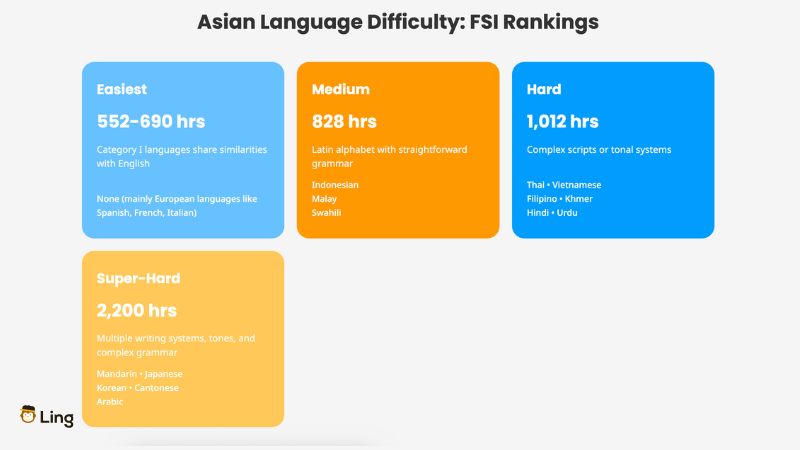
Super-Hard (88 weeks, 2,200 hours): Mandarin, Cantonese, Japanese, Korean
Hard (44 weeks, 1,012 hours): Thai, Vietnamese, Khmer, Hindi
Medium (36 weeks, 828 hours): Indonesian, Malay
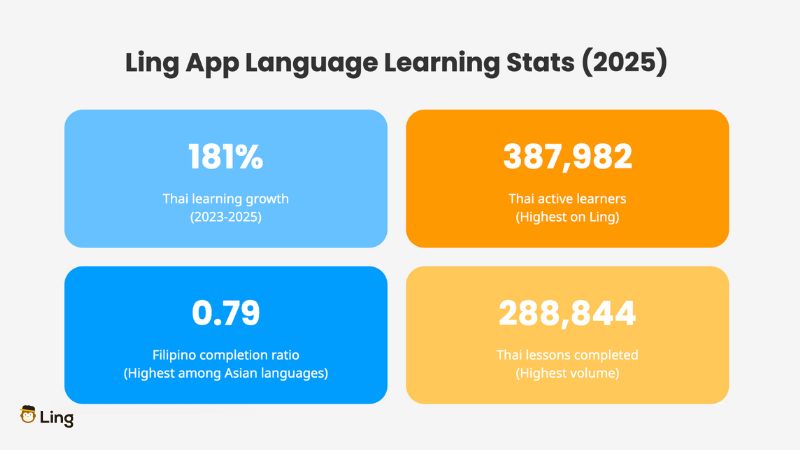
Thai learning surged 181% on Ling from 2023-2025, reaching 387,982 active learners who completed 288,844 lessons in 2025—the highest lesson count of any Asian language on the platform.
The hardest Asian languages to learn present multiple severe challenges for English speakers. Some, like Chinese and Thai, use non-alphabetic writing systems requiring you to memorize thousands of characters or complex scripts.
I want to learn even more languages with Ling!
Download now!
Others, like Mandarin, Thai, and Vietnamese, are tonal, meaning your vocal pitch determines word meaning entirely.
And all of them use grammar that works on completely different logic than English. Mandarin Chinese, Japanese, Korean, and Thai top every difficulty ranking because they each combine multiple obstacles that force your brain to rebuild how it processes language from scratch.
Research on linguistic distance and second language acquisition demonstrates that greater linguistic distance—differences in vocabulary, grammar, syntax, and writing systems—directly predicts longer learning times and significantly more cognitive effort required (Cambridge Core, 2023).
Ask any English speaker who’s tried learning an Asian language, and you’ll hear the same story: “I thought Spanish was hard until I tried Mandarin.” Or Japanese. Or Korean. Or Thai.
Research on language learning and neuroplasticity shows that language practice builds and strengthens neural pathways, with studies demonstrating measurable changes in brain structure that support more efficient language processing.
Learning Spanish from English is like moving to a neighboring city. Learning Thai? That’s relocating to a different planet! Your brain has to build entirely new mental frameworks.
But here’s what Ling’s data shows: learner engagement doesn’t always correlate with difficulty. Some Category III languages see massive growth, while Category IV languages maintain dedicated learner communities. The right resources make even the hardest languages achievable.
Wth quality lessons, native speaker audio, and bite-sized learning modules, even challenging languages become achievable.
Understanding Asian Language Difficulty Ranking
What Makes Asian Language Difficulty So High?
The challenge isn’t one factor, it’s how multiple barriers compound:
Writing Systems That Abandon Alphabets
Learning Chinese means memorizing thousands of characters, each representing meaning rather than sound. Japanese requires mastery of three writing systems simultaneously (hiragana, katakana, and kanji). Thai script contains 44 consonants and 15 vowel symbols that combine in complex ways.
Compare this to Spanish or French, where you learn 26 letters and you’re done with the writing system. In Mandarin, after learning 3,000 characters, you’re functionally literate—but still encountering new ones regularly.
Tonal Systems Where Pitch Determines Meaning
In Mandarin, the syllable “ma” has four different meanings depending on tone: mother (mā), hemp (má), horse (mǎ), or scold (mà). Your vocal pitch becomes as important as the consonants and vowels you pronounce.
Imagine calling someone’s mother a horse because you used the wrong tone. It happens. A lot. And it’s both embarrassing and hilarious.
Multiple studies on tone acquisition consistently show tone perception and production are among the hardest skills for non-tonal language speakers to master, with research indicating that acquiring lexical tones remains challenging even after extended study.
But here’s what researchers don’t always mention: hearing native speakers repeatedly makes a massive difference. That’s why apps like Ling emphasize interactive audio from real native speakers from day one, your ears need training as much as your mouth does.
Grammar That Works on Different Logic
English follows Subject-Verb-Object order: “I eat rice.”
Japanese reverses this to Subject-Object-Verb: “I rice eat.”
Korean adds layers of formality that change verb endings based on your relationship with the listener. Thai places adjectives after nouns and uses classifiers (counter words) that vary depending on what you’re counting.
These aren’t minor adjustments, they require rewiring how you construct thoughts into sentences.
How Are Asian Languages Ranked By Difficulty?
FSI Language Difficulty Classifications
The Foreign Service Institute (FSI) has trained U.S. diplomats in dozens of languages since 1946. Based on thousands of students reaching professional proficiency, they’ve quantified exactly how long different languages take to learn.
The FSI classification system divides languages into categories based on classroom hours needed to reach professional proficiency:
| Category | Study Hours Required | Difficulty Level | Example Asian Languages |
| Category I | 24-30 weeks (552-690 hours) | Easy | None (mainly European) |
| Category II | 36 weeks (828 hours) | Medium | Indonesian, Malay, Swahili |
| Category III | 44 weeks (1,012 hours) | Hard | Thai, Vietnamese, Khmer, Lao, Hindi, Nepali, Urdu, Bengali, Burmese |
| Category IV | 88 weeks (2,200 hours) | Super-Hard | Mandarin, Cantonese, Japanese, Korean, Arabic |
The writing system creates the primary obstacle.
Category IV languages take approximately four times longer than Category I languages like Spanish, with the Defense Language Institute’s classifications confirming these rankings across government training programs.
What Are the Hardest Asian Languages For English Speakers?
Mandarin Chinese: The Character Challenge
Mandarin Chinese consistently ranks as one of the world’s most difficult languages for English speakers. The FSI classifies it as Category IV, requiring 2,200 hours to reach professional proficiency.
Chinese uses logographic characters where each symbol represents a word or concept rather than a sound. You need to recognize approximately 3,000 characters to read a newspaper comfortably, and educated native speakers know 8,000 or more.
Each character must be memorized individually — there’s no way to “sound out” an unfamiliar word like you can with alphabetic scripts. It’s like learning 3,000 tiny pictures that all mean different things.
Mandarin’s four tones add another layer of difficulty.
The same syllable can have completely different meanings depending on whether you use a flat tone, rising tone, dipping tone, or falling tone. Research on Chinese language acquisition shows that even learners who master tone recognition often struggle with tone production, and neuroscience studies confirm this remains challenging even after years of study, as non-tonal language speakers must develop entirely new pitch processing abilities.
But here’s the encouraging part: every fluent Mandarin speaker was once exactly where you are now, staring at characters that looked like modern art. They figured it out. So can you.
Grammar offers some relief.
Mandarin has no verb conjugations, no plural forms, and a relatively straightforward sentence structure. But this simplicity can be deceptive — the language relies heavily on context, and specific particles have subtle meanings that take years to use naturally.
Japanese: Three Scripts And Social Complexity
Japanese shares Mandarin’s Category IV classification but presents unique challenges. The language uses three different writing systems in the same sentence: hiragana for grammatical elements, katakana for foreign words, and kanji (Chinese characters adapted for Japanese) for core vocabulary.
Learning kanji is just the beginning.
Unlike Chinese, where each character has one reading, Japanese kanji often have multiple readings depending on context. The character 生 can be read as sei, shou, nama, i, u, or ki depending on the word it appears in.
If that sounds confusing, it’s because it absolutely is. Even native Japanese speakers sometimes struggle with obscure kanji readings.
Japanese grammar follows subject-object-verb order, the opposite of English’s subject-verb-object pattern.
Particles mark grammatical relationships, and the system of honorific speech (keigo) requires adjusting your entire vocabulary and verb forms based on social relationships. Speaking appropriately to a boss versus a friend involves completely different language registers.
The spoken language itself is relatively simple phonetically. Japanese has only five vowel sounds and straightforward pronunciation rules. This makes listening easier than tonal languages, but the complex writing system and grammar still place it among the hardest Asian languages overall.
Korean: Logical Script, Complex Grammar
Korean occupies an interesting position among hard Asian languages. Its writing system, Hangeul, is one of the world’s most logical and scientifically designed alphabets.
Created in the 15th century, it can be learned in a few days. You could literally learn to read Korean this weekend.
So why the Category IV classification? The difficulty lies in Korean’s agglutinative grammar.
Verb endings stack together to express tense, politeness, mood, and connection to other clauses. A single verb stem might have dozens of possible forms. The sentence structure places verbs at the end, meaning you must listen to an entire sentence before understanding the main action.
Korean has seven levels of formality built into its grammar.
Speaking to elders, strangers, friends, or subordinates requires different verb endings and vocabulary. This isn’t just about being polite; using the wrong level sounds unnatural or even offensive to native speakers.
Despite these challenges, Korean maintains strong popularity among language learners. Cultural influences like K-pop and Korean dramas motivate many to push through the difficulty.
When you’re motivated by wanting to understand your favorite group’s variety show without waiting for subtitles, grammar complexity becomes just another obstacle to overcome.
Thai: Tones And Script Together
Thai combines two major difficulty factors: a tonal system and a non-alphabetic script.
Thai has five tones: mid, low, falling, high, and rising.
Unlike Mandarin’s four tones, Thai’s five-tone system includes a mid tone that many learners initially struggle to distinguish from the low tone. Getting tones wrong doesn’t just sound foreign — it changes your meaning entirely.
The word maa can mean “come,” “dog,” or “horse,” depending on tone. You can see why getting this right matters when you’re trying to tell someone to come here versus calling them a dog.
The Thai script presents another challenge.
Based on ancient Indian scripts, it has 44 consonants and 15 vowel symbols that combine in complex ways. Vowels can appear before, after, above, or below consonants. There are no spaces between words, and tone marks are often omitted in everyday writing, forcing readers to know vocabulary to read correctly.
It looks intimidating at first. Most Thai learners stare at their first sentence and think, “How does anyone read this?”
Grammar offers some relief.
Thai has no verb conjugation, no tenses, no plurals, and no articles. Word order is relatively straightforward. Context and time words indicate when something happened rather than verb changes. This simplicity helps balance the difficulty of tones and script.
Vietnamese: Six Tones In A Latin Alphabet
Vietnamese occupies a unique position among difficult Asian languages. It uses a Latin alphabet thanks to 17th-century Portuguese missionaries, making it visually familiar to English speakers.
Vietnamese has six tones, more than any other widely studied Asian language.
These tones use diacritical marks above and below letters, so the written form shows tone clearly. But producing six distinct tones consistently while speaking requires significant practice.
At least you can see the tones when reading, which is more than Thai or Mandarin learners can say.
The grammar is relatively straightforward.
Like Thai, Vietnamese has no verb conjugations or plural forms. Vietnamese word order is similar to English in many cases. But the language has borrowed extensively from Chinese, and formal vocabulary often uses Sino-Vietnamese words with pronunciations quite different from their Chinese origins.
Pronunciation presents subtle challenges beyond tones.
Vietnamese has several vowel and consonant sounds that don’t exist in English, and regional accents vary significantly. The northern Hanoi accent differs substantially from southern Ho Chi Minh City speech, sometimes affecting mutual intelligibility.
Which Asian Languages Are Easier To Learn?
Not all Asian languages demand 2,200 hours of study. Several languages in Southeast Asia rank as significantly more accessible for English speakers.
And here’s something interesting: these “easier” languages often get overlooked by major language learning apps. They focus on the big names, Mandarin, Japanese, and Korean, while languages like Filipino, Indonesian, or Khmer get ignored or poorly taught.
Indonesian And Malaysian: Simplified Grammar
Indonesian (Bahasa Indonesia) and Malay (Bahasa Melayu) are nearly identical languages classified as Category II by the FSI.
These languages use the Latin alphabet with virtually no additional characters.
Pronunciation is straightforward, and the languages lack tones entirely. Grammar is remarkably simple: no verb conjugations, no noun genders, no articles, and no plurals (repetition indicates plural: buku-buku means “books” from buku meaning “book”).
Indonesian and Malay represent a rare example of accessible Asian languages that don’t sacrifice expressive power for simplicity.
They’re widely spoken across Southeast Asia and serve as lingua francas in their regions, making them practical choices for travelers and business professionals.
Yet these languages often get minimal attention from big language apps. The focus stays on Mandarin, Japanese, and Korean while Indonesian speakers, the 4th most populous country in the world, get overlooked.
This is where specialized apps make a difference. Ling treats Indonesian and Malay with the same care and native speaker quality as any other language, because every language deserves proper teaching.
Filipino (Tagalog): A More Accessible Language
Filipino presents moderate difficulty for English speakers. Unlike Thai or Vietnamese, it’s not tonal and uses the Latin alphabet, making it more accessible in some ways. But, altough there is no official FSI ranking for this language, other linguistic research shows English speakers still face challenges with Filipino’s verb-focused grammar and vocabulary.
What makes Filipino more accessible than other difficult Asian languages?
While English follows Subject-Verb-Object pattern, Tagalog uses a verb-focused structure where verbs change depending on “focus” (actor, object, location, or instrument). This initially confuses learners but becomes intuitive with practice.
The Latin alphabet advantage: Unlike Chinese characters or Thai script, Filipino uses familiar Roman letters, making reading and writing significantly easier from day one.
Spanish influence: The language borrowed extensively from Spanish during 300 years of colonization. If you know Spanish or have studied it, you’ll recognize thousands of words like “kotse” (car, from Spanish “coche”), “kumusta” (how are you, from “cómo está”), and “silya” (chair, from “silla”). For English speakers without Spanish knowledge, this advantage might be less, but the phonetic spelling and lack of tones still make Filipino easier than many mainland Asian languages.
Data from Ling supports Filipino’s relative accessibility. In 2025, Filipino maintained 148,713 active learners with 117,432 completed lessons, showing strong engagement.
This is exactly the kind of language where having quality lessons matters. Filipino might be Category III, but it’s still often taught poorly or not at all by mainstream apps. Ling focuses on these underserved languages precisely because millions of people have real reasons to learn them—family connections, heritage, work opportunities, but lack quality resources.
Why Do Learners Still Choose Difficult Asian Languages?
If Asian languages are so hard, why do hundreds of thousands of people dedicate years to learning them?
The answer reveals something important: Asian language difficulty matters far less than motivation. When you have a compelling reason to learn, the challenge becomes achievable.
Career Opportunities Drive Many Learners To Asian Languages
China’s economic influence makes Mandarin valuable for business professionals. Japanese proficiency opens doors in technology, manufacturing, and entertainment industries. Korean skills are increasingly sought in tech companies and Korean cultural exports. Thailand’s growing expat community and business sector make Thai useful for those relocating to Southeast Asia.
But careers alone don’t explain the passion we see in our learners.
Cultural Connections Provide Even Stronger Motivation
Learners often study their heritage language to reconnect with family roots. They develop a passion for a culture through music, film, literature, or travel. Korean drama fans dive into Korean to watch without subtitles. Anime enthusiasts tackle Japanese to access content that never gets translated. Thai food lovers learn Thai to understand recipes and communicate with vendors in Thailand.
One Ling user told us they started learning Thai because they fell in love with someone from Bangkok. Two years later, they’re conversing with their partner’s grandmother in Thai, understanding jokes at family dinners, and feeling like they belong. That’s what makes 1,100 hours worth it.
Personal Relationships Motivate Countless Learners
In fact, our 2025 survey of 1.75 million.
Ling users revealed that romance and relationships are the top motivation for language learning, with 23.7% of learners studying a language to connect with their spouse or partner.
Speaking your partner’s language transforms relationships with their family. Raising bilingual children requires parents to learn alongside them. Even friendship can drive serious language study.
The data proves motivation overcomes difficulty. Despite Thai’s Category IV classification with its five tones and complex script, Thai learning on Ling grew in the Ling app. Korean maintains the second-highest number of active learners on the app at 148,749 users. Japanese, Mandarin, and Vietnamese all show strong, sustained engagement despite their difficulty rankings.
Modern Learning Tools Also Make Hard Languages Accessible
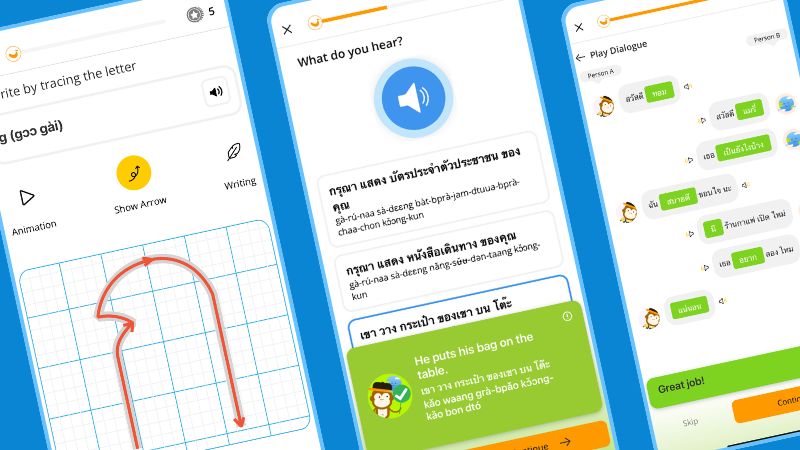
This is where the right approach makes a real difference. Ling specializes in underserved Asian and Eastern European languages, the ones major apps often ignore or teach poorly. Every lesson uses native-speaker audio for authentic pronunciation, which matters enormously for tonal languages.
The app’s approach breaks study into 10-15 minute sessions, making even challenging languages manageable in daily life. No one has time for 2-hour study sessions every day. But 15 minutes? That fits between meetings, during your commute, or before bed.
Here’s what makes a difference with difficult languages: quality matters more than quantity. You’d rather have 15 minutes with proper native speaker audio, clear explanations, and engaging practice than an hour with robotic pronunciation and confusing grammar explanations.
Ling’s team includes native speakers and language experts who regularly update lessons based on user feedback. When learners say “this grammar point is confusing” or “we need more tone practice,” the lessons get improved. That responsiveness matters when you’re investing hundreds of hours into a language.
Technology addresses specific difficulty points. Interactive audio lets learners hear tonal distinctions clearly. Spaced repetition systems help with character memorization. Writing practice tools provide immediate feedback.
These innovations don’t make languages “easy,” but they make difficult languages genuinely learnable for motivated students.
How Can You Learn Hard Asian Languages Effectively?
Successfully learning a difficult Asian language requires strategy, not just effort. Learners who reach proficiency typically follow several key principles.
Start With Spoken Language Before Diving Into Writing Systems
This advice especially applies to character-based languages like Chinese or Japanese. Building a foundation of spoken vocabulary and grammar makes character learning more meaningful; you’re learning to write words you already know rather than memorizing abstract symbols.
Ling emphasizes audio-first learning with interactive native-speaker recordings, ensuring you hear authentic pronunciation from the beginning. Hearing how words actually sound, not just reading them, builds the right mental patterns from day one.
Focus On Tones From Day One If You’re Learning A Tonal Language
Many beginners ignore tones initially, thinking they’ll “add them later.” This approach backfires badly. Your brain forms habits around the sounds you practice, and learning tones later means unlearning incorrect pronunciation patterns.
Practice tones with every new word, even if it slows your vocabulary acquisition initially. The investment pays enormously in comprehension and communication.
Use The Language Actively, Not Just Passively
Watching shows or listening to music helps, but active practice like speaking, writing, and forming sentences builds the neural pathways language requires, according to research on language learning and neuroplasticity, with studies demonstrating changes in white matter pathways and gray matter volume that support more efficient language processing.
Find language exchange partners, join online communities, or use speaking features in learning apps.
Making mistakes in real communication teaches you far more than perfect passive listening. You’ll mess up tones. You’ll use the wrong particle. You’ll accidentally call someone’s mother a horse. It happens to everyone. That embarrassing moment teaches you more than a hundred perfect practice sentences.
Build Vocabulary Strategically Rather Than Randomly
Learn high-frequency words first — the 1,000 most common words in any language cover roughly 80% of everyday conversation. Language apps typically structure vocabulary by frequency and usefulness, so following their curriculum gives you practical communication ability faster than memorizing specialized vocabulary you rarely need.
Accept That Progress Isn’t Linear
Language learning includes plateaus where you feel stuck, breakthroughs where everything clicks, and setbacks where you forget material you thought you’d mastered. This is completely normal.
The FSI’s 2,200-hour estimate for Category V languages assumes consistent study over nearly two years. Trust the process and maintain consistency even when progress feels slow.
Connect Learning To Your Personal Interests And Goals
If you love cooking, learn food vocabulary early. If business is your motivation, focus on professional language. If you’re learning for family, prioritize conversational skills over formal writing.
Personalized learning isn’t just more enjoyable, it’s more effective because it gives you immediate opportunities to use what you learn.
Consider Formal Instruction Alongside Self-Study
While apps provide excellent foundational learning, difficult languages benefit from structured feedback. Teachers can correct pronunciation errors you don’t hear yourself, explain subtle grammar points, and provide cultural context that makes language use more natural.
Many learners combine app-based daily practice with weekly conversation classes for optimal progress. The app builds your foundation; the teacher helps you use it naturally.
Key Takeaways: Asian Language Difficulty
✓ FSI Classification: FSI Classification: Asian languages range from 828 hours (Indonesian) to 2,200 hours (Mandarin/Japanese/Korean)
✓ Fastest Growing: Thai learning increased 181% on Ling from 2023-2025, reaching 387,982 active users
✓ Most Engaged: Filipino learners show 0.79 completion ratio (highest among major Asian languages)
✓ Linguistic Distance: The further a language is structurally from English, the more study time required
✓ Tonal Challenge: Tone perception remains difficult even after years for non-tonal speakers
Frequently Asked Questions About Asian Language Difficulty
What Is The Hardest Asian Language To Learn For English speakers?
Mandarin Chinese and Japanese are generally considered the hardest Asian languages for English speakers, both requiring approximately 2,200 hours of study according to FSI data. Mandarin’s character system and tones combine with Japanese’s three scripts and complex honorifics to create exceptional difficulty. Arabic, if counted as Asian, ranks similarly.
Is Korean Harder Than Japanese?
Korean and Japanese have similar overall difficulty (both Category IV), but their challenges are different. Japanese requires learning three writing systems and complex honorifics, while Korean’s Hangeul alphabet is easier but its agglutinative grammar is more complex. Korean typically takes 2,200 hours to reach proficiency, the same as Japanese. Your personal learning strengths determine which feels harder.
Which Is Harder To Learn, Thai Or Chinese?
Chinese (Mandarin) is significantly harder than Thai for most English speakers. Chinese requires 2,200 hours (Category IV) compared to Thai’s 1,012 hours (Category III). While Thai has five tones versus Chinese’s four, Chinese’s character system requires memorizing thousands of logograms, making reading and writing far more challenging than Thai’s phonetic (though complex) script.
What’s The Easiest Asian Language To Learn For English Speakers?
Filipino (Tagalog) is tone of the easiest Asian language for English speakers. It uses the Latin alphabet, has phonetic spelling, and includes thousands of Spanish and English loanwords. Indonesian and Malay are similarly accessible at 828 hours to learn, featuring simple grammar with no verb conjugations or tones.
Can I Become Fluent In An Asian Language Without Living In Asia?
Yes, but it requires dedication. Modern apps, native speaker audio, online tutors, and media consumption can replicate many immersion benefits. But, reaching true fluency (natural speech, cultural nuance, effortless comprehension) is significantly easier with time in-country.
How Long Does It Take To Learn Korean?
Korean requires approximately 2,200 hours of study for English speakers to reach professional proficiency, according to FSI classifications. With intensive study (25 hours per week), this translates to 88 weeks or about 22 months. Casual learners studying 5-10 hours weekly should expect 4-5 years to reach advanced proficiency. You can achieve conversational basics in 3-6 months with consistent daily practice.
Are Asian Languages Worth Learning Despite Their Difficulty?
Absolutely. Career opportunities in Asia are growing. Cultural access, understanding anime, K-dramas, Thai cuisine, Chinese literature without translation, enriches life immeasurably. Personal relationships with native speakers deepen exponentially. And cognitive benefits of bilingualism (improved memory, problem-solving, multitasking) apply regardless of difficulty. The question isn’t whether it’s worth it, but whether your specific motivation justifies the time investment.
What Makes Tonal Languages Like Thai And Vietnamese So Hard?
Tonal languages use pitch patterns to distinguish word meanings, which doesn’t exist in English. In Thai, the syllable maa means “come,” “dog,” or “horse,” depending entirely on tone. Your brain must simultaneously process consonants, vowels, and pitch contours, effectively learning a new dimension of sound. Research shows tone perception and production remain challenging even after years of study for non-tonal native speakers, though studies indicate that consistent practice and native-speaker audio models significantly improve outcomes.
Hard Languages, Achievable Goals!
Asian language difficulty is real — most languages require 2-3 times more study hours than European languages. Character-based writing systems, tonal phonology, and unfamiliar grammatical structures create measurable difficulty.
But difficulty shouldn’t discourage you. Hundreds of thousands of learners successfully study hard Asian languages every year, motivated by career goals, cultural passion, or personal connections.
Modern learning technology makes these languages more accessible than ever before. Interactive native speaker audio ensures learners hear authentic pronunciation from real speakers. Gamified lessons take just 10-15 minutes per session, fitting even the hardest languages into busy daily schedules. Regular updates based on user feedback mean lessons keep improving.
The key is choosing a language that genuinely interests you. When motivation runs deep, difficulty becomes irrelevant.
Whether you’re drawn to Korean’s artistic Hangeul script, Thai’s melodic tones, Japanese’s rich literary tradition, or Mandarin’s economic power, your personal “why” will carry you through the challenging moments.
Start small, stay consistent, and celebrate progress measured in conversations held, texts read, and connections made rather than hours studied.
The hardest Asian languages become learnable when approached with realistic expectations, effective strategies, and genuine enthusiasm. You don’t need perfect conditions. You just need to start.
About This Research
This analysis combines:
- Foreign Service Institute (FSI) official language difficulty classifications
- Ling app user data from 1.75 million learners (2023-2025)
- Peer-reviewed research from Cambridge Core, Frontiers in Psychology, and other academic journals
- Linguistic distance studies on second language acquisition
Data Collection:
- Period: January 2023 – December 2025
- User base: 1.75+ million active language learners
- Languages analyzed: Asian languages
- Metrics: Active users, lesson completions

















































































