If there is one language that has remained unchanged for centuries, it’s Icelandic. This stability makes it especially appealing to dedicated learners. Icelandic is not just a language; it is a window into Old Norse sagas and a gateway to Icelandic literature, folklore, and culture.
For passionate Icelandic learners, the question isn’t why learn the language; it’s how to learn it effectively. If you’re here seeking that answer, I’ve curated a list of the six best apps to learn Icelandic.
In this article, we’ll explore the key features, advantages, and drawbacks of each app, along with their pricing. Ultimately, the choice will be yours. Let’s explore the options to help you make an informed decision.
I want to learn even more languages with Ling!
Download now!
The Best Apps To Learn Icelandic Online
Before we dive into the list of the best apps to learn Icelandic, let me tell you my preference. I prefer the Ling app the most when it comes to learning new languages. You will find the reason below, but let’s also explore the other options!
1. Ling – Best For All-Around Learning
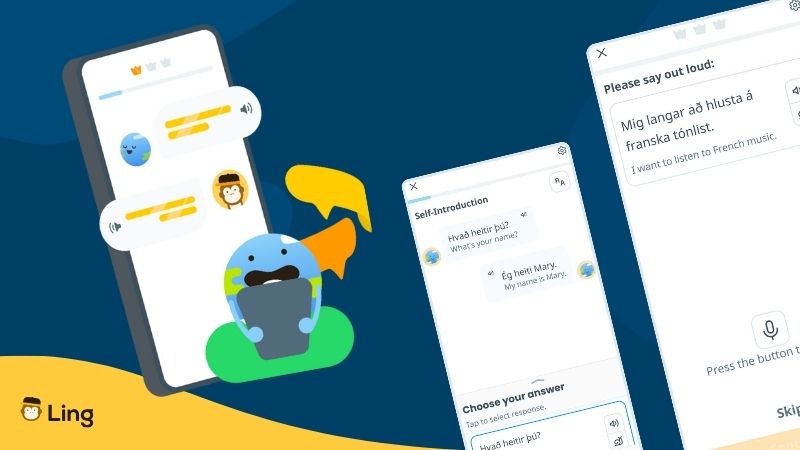
This is an app that I love writing about. And what really excites me about it is its gamified learning approach and a dialog feature. The game-like practice exercises make the lessons interactive, allowing you to learn while playing. And, the dialog feature offers you a private communication space where you hear audio recorded by native speakers and practice speaking Icelandic with them, simulating real-life situations.
Ling is a great choice for anyone passionate about learning languages, offering lessons in around 70 languages, including some of the least spoken ones. You can easily switch from learning Icelandic one day to Thai the next with just a few clicks. Whether you’re a beginner or more advanced, you can select your preferred level and progress at your own pace. The app’s interface is designed with users in mind, making it intuitive to navigate and enjoyable to use.
Pros
Covers all language skills; stimulates real conversations; short and interactive lessons with quizzes, native speaker audio, cultural notes, and several other practice exercises; spaced-repetition learning technology for enhanced retention.
Cons
Requires subscription after a 7-day free trial; some languages don’t have writing exercises and cultural notes.
2. Drops – Best For Visual Learning
Drops uses a visual approach to language learning, which sets it apart from other apps. Each word is paired with a related image, for example, a bucket of blue paint for the word blue (bláur/blár). The app offers a broad range of vocabulary, organized by topic to make navigation straightforward. You can select a unit and start learning new words immediately.
Its colorful interface and game-like exercises make the experience engaging and interactive. It also includes a multiplayer mode, allowing you to invite friends and practice vocabulary together. However, Drops focuses solely on vocabulary and does not provide lessons on grammar or other aspects of language. Still, according to user reviews, it is a solid choice for learning new words with visual support.
Pros
Ad-free, offers offline learning, has reasonable pricing, provides immediate feedback, and is the best app for beginners or for those who prefer learning during short coffee breaks.
Cons
The free version offers a limited time frame. It only focuses on vocabulary building and visuals, making it an unsuitable option for a long-term learning plan.
3. Memrise – Best For Mastering Native Accents
If you are building your Icelandic vocabulary and want to hear how locals pronounce those words, Memrise is a good choice. It offers videos recorded by native speakers saying different words and phrases to allow learners to hear how they’re actually pronounced. This feature of Memrise actually intrigued me the most.
It also helps you test your listening skills as you revise what you’ve learned, by using the same videos and asking you to identify what you hear. Think of it as learning Icelandic with a native friend online.
Pros
Real-Native speaker audio, fun flashcard games for revision, and spaced-repetition technique for long-term retention.
Cons
Little to no explanations on grammar topics. Doesn’t include other aspects of the language, such as writing. Sometimes lessons and exercises feel repetitive.
However, if you want a more detailed comparison of Memrise with other apps like Drops, you can skim through our detailed Memrise Vs Drops app review!
4. Mango Languages: Learning – Best For Mastering Real-Life Conversational Skills
Mango languages help you start speaking the language instantly by offering lessons based on real-life conversations, and users enjoy using Mango specifically for this reason. This app allows learners to listen to new words as many times as they want, record their voice saying the same word, and compare it with the native speaker’s audio.
In this way, you instantly can master the pronunciation of certain Icelandic words and become ready to use them in right away. Once you learn the word and its pronunciation, you also get a grammar note on it, and at last, revise it one last time before moving to another word. We can say that Mango languages: learning app offers learning in four steps: listen to the word, practice its pronunciation, get grammar insights on that word, and revise.
Additionally, you can save yourself from reading with its hands-free learning mode, which reads the text aloud for you. So, this app is a stable choice for learners who want to understand the context behind a word while learning its pronunciation.
Pros
Cultural notes, proper grammar explanations, practice quizzes, hands-free learning option, and record your voice feature
Cons
The free version is limited, comparatively short Icelandic language course.
5. BlueBird: Learn Icelandic – Best For Hands-Free Learning
Imagine learning Icelandic while doing house chores, traveling, having a cup of coffee, or simply resting. Bluebird makes this possible by offering a hands-free learning feature. With Bluebird, you can simply plug in your headphones, hear how the words are pronounced, and practice pronouncing them the same way. It also has a pronunciation analysis and voice comparison feature that ensures you speak the language accurately and confidently.
As Bluebird is totally hands-free, users who are multitaskers or busy prefer this app for learning languages. Moreover, the Bluebird: learn Icelandic app offers a one-time rapid evaluation that allows you to test your skills through a 45-minute adaptive test. This test evaluates all the learning skills and provides an official PDF certificate with your CEFR level. Thus, the test certificates and leaderboards keep the learners motivated.
Pros
Available in offline mode, completely hands-free, native speaker audio, and covers a vast range of topics.
Cons
The free version is very limited, the app isn’t very user-friendly, it takes more time to load, and has very little text.
6. OkyDoky: Language Courses – Best For People Who Prefer Visual And Auditory Learning
This language app combines auditory and visual learning methods to make lessons more engaging. After Ling, the app I liked most is OkyDoky, mainly because it offers structured vocabulary alongside colorful illustrations, native-speaker audio, grammar explanations, word-by-word translations, and example sentences.
One advantage is that you can adjust the audio speed, and it provides both male and female voices. If you want a quiet way to practice speaking, you can activate live chat mode, say anything you like, and receive instant feedback. For learners who prefer an immersive approach, OkyDoky is a solid option. You can also read our detailed Oky Doky review in our blog section.
Pros
User-friendly, attractive interface, suitable for all age groups, offers chat courses, progress tracker, and AI-powered live study option.
Cons
Not a perfect fit for serious learners; you need to look at the screen constantly, so it’s also not suitable for on-the-go learning; constant ‘buy premium’ pop-up might get frustrating.
A Quick Price Comparison Of The Best Apps To Learn Icelandic
Now, let’s answer the most asked question: how much do these apps cost? Here’s a quick price comparison of the best apps to learn Icelandic to help you find the one that fits you budget.
| Apps | Price |
|---|---|
| Ling | 7-day free trial 14.99$/ month 29.99$/ quarter (3 months) 79.99$/ year |
| Memrise | 11.11$/ month 47.36$/ year 151.62$/ lifetime |
| Drops | 12.99$/ month 69.99$/ year 159.99$/ lifetime |
| Mango Languages: Learning | Single language – 11.99$/month and 119$/year All languages – 19.99$/month and 200$/year |
| Bluebird: Learn Icelandic | All languages – 10.40$/ month, 104.23$/ year, and 26.92$/ lifetime One-Time Rapid Test Purchase – 23.67$ One language – 118.45$/ lifetime |
| OkyDoky: Learn Icelandic | 7-day free trial 4.72$/ month 28.41$/ year 47.36$/ lifetime |
Before you decide, keep in mind that it’s not just about the price; it’s about the value you get from what you pay. So, choose wisely!

Why Should I Learn Icelandic?
Still unsure about learning Icelandic? You don’t need to be. This language can open many opportunities and deepen your passion for mastering new languages. Here’s how:
1. Cultural Heritage
Iceland has a rich cultural heritage that becomes more accessible through its language. Learning the local language always deepens the experience of exploring new cultures and traditions, and the same is true for Icelandic. Knowing Icelandic makes it easier to engage with the country’s literature and folklore, which are central to its heritage.
2. Linguistic Uniqueness
Unlike most modern languages, which have evolved over time, Icelandic remains in its purest form, and this exceptional continuity is what makes Icelandic a unique language. Although you may notice slight changes in pronunciation and vocabulary, the script, grammar, and several vocabulary words remain the same. It means that present-day Icelandic speakers can easily read and understand the old Icelandic text.
3. Travel And Connection
Learning Icelandic and then visiting Iceland feels like the perfect combination, as you can explore a foreign country while also communicating and connecting with people like a local. Even if you don’t plan to visit Iceland anytime soon, studying the language out of passion can still be rewarding. You never know when you might meet an Icelandic speaker in your own country, giving you the chance to showcase your bilingual skills.
4. Career Benefits
Besides all the above reasons, knowing Icelandic can open several career opportunities. Although it isn’t a global language like French, you still gain an upper hand in fields like translation, academia, research, and tourism.
Wrapping Up
Learning Icelandic takes time, but the right tools help you stay on track. Each app on this list focuses on a different skill, such as vocabulary, pronunciation, or grammar. Practicing a little every day leads to steady improvement. Choose the app that fits your style, stick with it, and you’ll see progress. Icelandic is complex, but with patience and regular practice, it’s achievable.
Ready To Bring Icelandic Into Your Life? Ling Is Your Ultimate Solution
Hey language learners! You see, each language app has its own strengths and weaknesses, but if you ask me, I will choose Ling a thousand times. And, the primary reason is that it works as a comprehensive solution to all your learning needs.
Unlike other apps that focus solely on native audio or beginner lessons, the Ling app provides structured lessons for all learning levels (from beginner to expert) and helps you master speaking, listening, and reading Icelandic all in one place! Moreover, by combining effective learning strategies like game-like exercises and spaced repetition, Ling ensures that you also remember what you learn, without getting bored. Don’t all these features make Ling a well-rounded language learning platform?
So, if you truly want to keep your passion for learning Icelandic or other new languages alive, it’s high time to download the Ling app on your devices. You’ll surely love it!