


If you’re planning to move to Bosnia and Herzegovina, you’ve probably read or heard two contradictory things: “Everyone in the cities speaks English,” and “You’ll never really integrate without Bosnian and you need to speak Bosnian to live in Bosnia.” Both are somewhat true, and understanding exactly where the line falls will determine how prepared you need to be before you arrive.
This guide gives you an honest map of what English covers in Bosnia, where it fails you, and why even basic Bosnian phrases change the experience of living there entirely. Whether you’re still deciding how seriously to take learning Bosnian or you’ve already committed and want to know where to start, you’re in the right place!
Who will find this most useful:
- Remote workers and digital nomads relocating to Sarajevo or Mostar for the low cost of living
- Expats moving to Bosnia for work, a relationship, or a slower pace of life
- Heritage learners reconnecting with their Bosnian family or roots
- Anyone preparing for long-term residency, beyond a 90-day tourist stay
Start practicing the survival phrases in this guide with Ling’s Bosnian language course. Lessons are built around real-life scenarios with native-speaker audio, so your pronunciation and phrases will be on point from day one, not just memorized!
What English Actually Gets You In Bosnia
In Bosnia, English can help quite a lot, in specific places, with specific people.
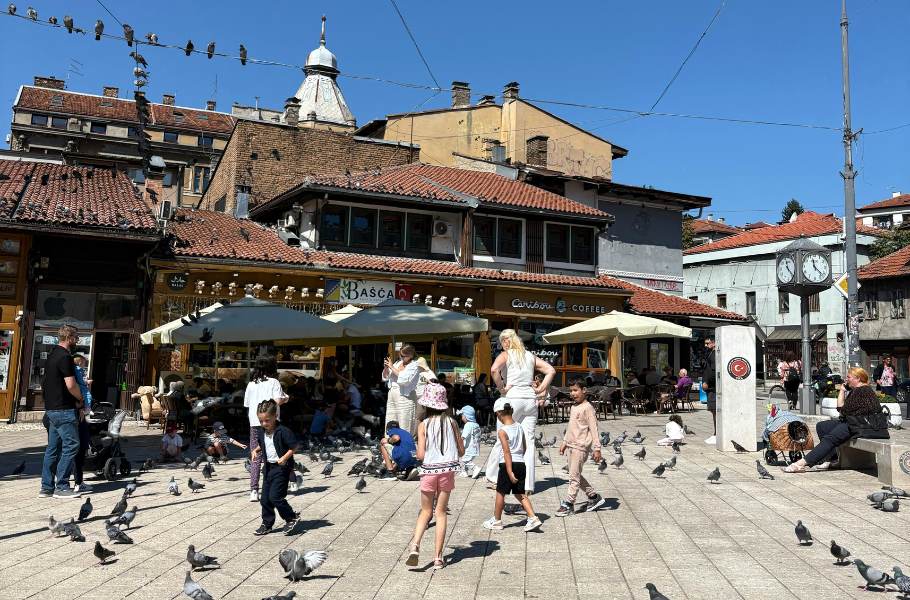
Sarajevo’s Baščaršija district, the capital’s expat and digital nomad cafés, most coworking spaces, and the majority of people under 35 in urban areas will communicate comfortably in English. That’s a fact.
The tourism infrastructure in Mostar, around the Old Bridge area, guesthouses, and tour operators, is heavily English-adapted. International organizations like the EU delegation, OSCE, and UN agencies are significant employers in Sarajevo and operate almost entirely in English. Like in most countries, there will always be a city or a district where English is widely spoken and where people feel comfy in a foreigner bubble.
Basically, if your life in Bosnia will be all about working remotely from a café, meeting other expats at events, and staying in short-term accommodations, then you can technically survive daily life without speaking Bosnian for months.
But that version of life in Bosnia will eventually be more expensive. As someone who has lived abroad in different countries at first without speaking the local language, I can assure you that only speaking English connects you to fewer people and keeps you permanently adjacent to the country, rather than inside it.
That is definitely not the path you want to take. It’s always best to be involved in the country fully, including understanding its culture and language.
Where English Runs Out If You Travel To Bosnia
This is the information section that most relocation guides would skip.
Most Government offices and bureaucratic establishments won’t speak English.
Similarly to what happens in other countries, every interaction with the state, from registering your address to apply for temporary residency to opening an account, paying utility services, or visiting the post office, will happen in Bosnian. The forms are usually in Bosnian, and you’ll have to speak with the staff in Bosnian.
Most of the time, what helps if you aren’t able to communicate fully yet is to have a local contact or translator for your first administrative appointments. But later, it’s recommended to learn the language so you can do it on your own.
Healthcare outside private clinics in Bosnia typically won’t have English-speaking staff.
Private clinics in Sarajevo increasingly have English-speaking staff, but many public health facilities, where you can end up if something urgent happens, operate entirely in Bosnian.
So explaining symptoms, understanding a prescription, and navigating a referral are all significantly harder without understanding the language. I know this frustration; if you don’t have a friend with you to translate, you’ll end up quite lost about your own health. It’s best to prepare yourself and start learning the language.
Many local Banks operate in Bosnian only.
Opening a local bank account requires documentation and in-person interaction, and often this must be done in Bosnian. It is true that for banking, those who don’t speak Bosnian are a bit in luck, since nowadays more staff use English in urban areas. The staff at international banks like Raiffeisen and UniCredit in the capital, for example, often know some English.
But anything involving forms, contracts, or disputes will still be in the Bosnian language.
Landlords and housing contracts.
Rental agreements in Bosnia are also in the Bosnian language. Landlords, particularly outside the capital’s expat-facing market, may speak no English at all, so you’ll need an intermediary.
If you don’t have any locals to help you, there’s bound to be a lot of misunderstandings about utilities, deposits, and lease terms, because communication usually happens through a translation app like Google Translate.
Neighbors, markets, and daily texture.
The pijaca (market), the local pekara (bakery), the butcher, and the building superintendent will most likely speak only Bosnian. And these interactions define what living somewhere actually feels like; they literally happen every day and are quite unavoidable.
What You’re Actually Learning: About The Bosnian Language
Before you start learning Bosnian, it really helps to understand a bit more about what kind of language you are dealing with.
Bosnian is a South Slavic language, closely related to Croatian and Serbian. The three are mutually intelligible, meaning speakers of one can generally understand the others due to their shared linguistic roots. This is often described with the acronym BCS (Bosnian-Croatian-Serbian).
If you have studied Serbian or Croatian before, you have an incredible head start that must be made the most of. Bosnian shares the same grammatical structure as both, and much of the vocabulary is identical, so learning it won’t be a huge challenge.
One thing that sets Bosnian apart, though, is that it incorporates more loanwords from Turkish, Persian, and Arabic compared to Serbian and Croatian. That’s a legacy of centuries under Ottoman rule. You will notice this especially in words related to food, architecture, and daily life in older Bosnian cities. And this is what gives the language a distinctive taste and makes Bosnia feel culturally different from its neighbors, even when the linguistics overlap.
Just like in Serbia, the Latin and Cyrillic scripts are officially recognized in Bosnia, but Latin is more commonly used in everyday life. Street signs, menus, and informal written communication are almost entirely in Latin script. You do not need to master Cyrillic to function in Bosnia, don’t sweat it! Though recognizing it is useful for some official contexts, and I’d definitely suggest you learn it eventually.
Bosnian vowels are pronounced clearly and distinctly, and unlike English, you should not reduce unstressed vowels. Words are spelled exactly as they sound. Once you learn how each letter is pronounced, you can read anything out loud correctly. Great, isn’t it? This is the little detail that makes spoken Bosnian much more approachable than what you might have thought when you saw it on paper.
Learning Bosnian can be considered moderately challenging for English speakers, mainly because of the grammatical complexity, seven-case system, and verb aspects. But as we said, what makes it more manageable than it looks is that Bosnian is completely phonetic, so its pronunciation is much easier to master than in many other languages. You read exactly what you see, every time.
To start learning effectively, focus first on the Bosnian Latin alphabet and the most common basic Bosnian words, things like da (“yes”), ne (“no”), voda (“water”), hrana (“food”), and ljubav (“love”). These foundational elements make everything else click faster.
Once you have those down, tools like Ling’s flashcards can help lock in vocabulary long-term, and language-exchange platforms let you start practicing real simple conversations with native speakers right away, even before you land.
For everyday expat survival communication, you can go far with a working vocabulary of 500 to 1,000 of the most common and basic Bosnian words, which cover roughly 70% of daily conversation, and the willingness to attempt rather than retreat.
Speak Bosnian To Live In Bosnia: Essential Bosnian Phrases
These essential phrases aren’t touristy words. They are for expats, for people who stay longer. These will carry you through your first month of actual life in Bosnia: dealing with admin, landlords, shopping, and neighbors.
| English Meaning | Bosnian | Pronunciation |
|---|---|---|
| Good day, formal greeting for offices, landlords, shops | Dobar dan | DOH-bar dan |
| Hello, informal, use with peers and people your age | Zdravo | ZDRA-voh |
| Thank you very much, use constantly | Hvala lijepo | HVAH-lah LYEH-poh |
| Please / you’re welcome, the most versatile phrase in Bosnian | Molim vas | MOH-leem vas |
| Where is…? Pair with any destination | Gdje je…? | GDYEH yeh |
| How much does it cost? | Koliko košta? | KOH-lee-koh KOSH-tah |
| How are you? Formal, use with landlords and officials | Kako ste? | KAH-koh steh |
| You’re welcome, the natural response to hvala | Nema na čemu | NEH-mah nah CHEH-moo |
| I don’t understand, I’m learning Bosnian | Ne razumijem, učim bosanski | Neh rah-ZOO-mee-yem, OO-cheem boh-SAHN-skee |
| The bill, please | Račun, molim | RAH-choon, MOH-leem |
| Can I get…? Essential for ordering anything | Mogu li dobiti…? | MOH-goo lee DOH-bee-tee |
| Have a nice day, use when leaving any interaction | Lijep dan! | LYEP dan |
Grab even more phrases with Ling’s Bosnian course before you arrive. The number one tip before traveling is to always try to learn Bosnian online, at least the basics! And Ling’s speaking exercises let you record your pronunciation and compare it against native-speaker audio, so you are not guessing whether you are getting it right.
Other languages might help you along the way, but soon enough, you’ll realize how important it is to be able to speak Bosnian.
How Much Bosnian You Actually Need To Live In Bosnia, By Situation
- Short-term stay (1 to 3 months) in Sarajevo, remote work:
- Language requirement: low.
- Phrases for greetings, ordering, and basic errands will cover most of your day. English carries the rest.
- Longer-term residency application:
- Language requirement: moderate.
- You do not need conversational fluency, but you need enough Bosnian to navigate forms, understand officials, and communicate with your landlord without a translator on call.
- Integrating socially, building real friendships, neighborhood life:
- Language requirement: meaningful.
- The expat bubble in Sarajevo is real and comfortable. Breaking out of it requires you to learn Bosnian. You don’t need to be fluent, but have enough skill to have a little basic conversation with your neighbor, enough to follow what is being said at a dinner table, or to make someone feel you are trying.
- Even broken Bosnian is useful here, because that consistent practice and effort is what will propel you into fluency. After all, integration is one of the best language learning methods.
- Working locally or running a business in Bosnia:
- Language requirement: high.
- Any professional context outside an international organization will definitely require functional Bosnian, both written and spoken.
3-Day Bosnian Survival Study Plan For Expats
Use this in the two to three weeks before you move. 15-20 minutes per day, focused and consistent, is enough to make a real impression on arrival.
Day 1: Greetings, Politeness, And Introductions (15 Minutes)
Focus on the core of every interaction. Start with how to say hello in Bosnian:
- Zdravo means “hello” and is informal: Use it with peers and people your age.
- Dobar dan means “good day” and is formal: Use it in shops, offices, and with your landlord.
- Kako ste? means “How are you?” formal)
- Dobro, hvala means “Fine, thank you”
- Ja sam… means “I am…”
- Do viđenja means “Goodbye” (formal)
Practice the difference between formal and informal registers. Bosnians notice it, and getting it right shows that you’re putting in genuine effort.
Real-world test: Greet the staff at your accommodation in Bosnian right on arrival. Even stumbling through it earns a different kind of welcome. You’ll see how the interaction switches to them being proud of you for trying.
You can practice with YouTube videos and use Ling’s bite-sized lessons for more in-depth learning.
Day 2: Numbers, Money, And Market Phrases (20 Minutes)
Bosnia uses the Konvertibilna marka (KM/BAM) as official currency, pegged to the euro at approximately 1.96 KM to EUR 1.
Learn numbers 1 to 100, “koliko košta?” (How much?), and “da li primate kartice?” (Do you accept cards?).
When you start knowing how to handle a price exchange in Bosnian, you’ll notice it makes every market and café interaction feel manageable and much easier, instead of awkward.
Real-world test: Buy something at a pijaca (market) or pekara (bakery) using only Bosnian.
Day 3: Directions, Transport, And Neighborhood Vocabulary (20 Minutes)
Learn: pijaca (market), apoteka (pharmacy), pekara (bakery), bolnica (hospital), policija (police), pošta (post office).
Practice saying: “gdje je…?” (Where is…?) and “kako doći do…?” (How do I get to…?).
Add “lijevo” (left), “desno” (right), and “ravno” (straight ahead). These three words unlock almost any navigation conversation.
Real-world test: Ask a local for directions in Bosnian. Even if they switch to English, the attempt changes the interaction.
I suggest you practice all three days in sequence with Ling’s structured Bosnian lesson path. The beginner modules follow this exact progression from survival phrases through practical daily vocabulary, so you are building on a real foundation rather than collecting random words you might not use.
4 Things Expats Learn Too Late About Language In Bosnia
#1: The International Bubble Has A Shelf Life
Many expats in Sarajevo spend their first six months in a comfortable English-speaking orbit: international organizations, digital nomad cafés that are increasingly popular, and expat community groups.
And yes, it works. Until it doesn’t. That’s because friendships start to stay shallow, bureaucratic moments become crises, and the whole experience of living in Bosnia starts to feel like watching the country through glass rather than being part of it.
Solution: Treat learning Bosnian as a necessity instead of a hobby, and start doing so before you arrive. At least 10 or 15 minutes a day with Ling for six to eight weeks before your departure date gives you enough to handle basic conversations, plus enough confidence to attempt rather than retreat!
#2: Grammar Is Complex, But You Will Be Understood Anyway
Bosnian has seven grammatical cases (nominative, genitive, dative, accusative, vocative, instrumental, and locative), two verb aspects (perfective and imperfective), and gendered nouns. All of these might become challenging for first-time learners.
Native speakers don’t really expect grammatical perfection from foreigners. They expect effort. Bosnian learners are often understood even with case mistakes if verbs are used correctly. Broken Bosnian with warmth beats grammatically perfect silence.
Solution: Simply focus on vocabulary and functional phrases first, and let grammar come later. Grammar will deepen over months of actual use.
#3: Sarajevo Is Not All Of Bosnia
Mostar, Banja Luka, Tuzla, Zenica: cities beyond the capital have smaller English-speaking populations and more immediate language requirements. If you are relocating somewhere other than Sarajevo, your Bosnian baseline needs to be higher before you arrive, not built from scratch after landing.
#4: The Language Connects You To Something That Matters
Bosnia’s recent history is present in daily life in ways that most visitors never reach. The conversations about the 1990s, about family, about what the country is building now, do not happen in tourist English. They happen in Bosnian, between people who have decided you are worth having the conversation with. That decision usually comes down to whether you have made any effort with the language at all.
Quick Reference: Bosnian Vocabulary For Admin And Daily Life
These words will show up in every practical interaction during your first weeks in Bosnia.
| Category | Meaning | Bosnian | Pronunciation |
|---|---|---|---|
| Housing | Rent, in every housing conversation | Stanarina | stah-NAH-ree-nah |
| Housing | Contract, rental agreements | Ugovor | OO-goh-vor |
| Banking | Account or bill | Račun | RAH-choon |
| Banking | Registration or application | Prijava | pree-YAH-vah |
| Health | Hospital | Bolnica | BOL-nee-tsah |
| Health | Doctor | Ljekar | LYEK-ar |
| Admin | Passport | Pasoš | PAH-sosh |
| Admin | Residence permit | Boravišna dozvola | boh-RAH-veesh-nah DOZ-voh-lah |
| Transport | Bus | Autobus | ow-TOH-boos |
| Transport | Station or stop | Stanica | STAH-nee-tsah |
| Food | Food, useful in restaurants and markets | Hrana | HRAH-nah |
| Daily | Water | Voda | VOH-dah |
Pro tip: Use the Ling app to practice these useful phrases in a dialog format, to polish your Bosnian speaking skills.
FAQ: Speaking The Bosnian Language As An Expat
Do I Need To Learn Bosnian To Live In Bosnia?
Basic survival in Sarajevo is possible in English, especially in the first few months. But long-term life in Bosnia, handling bureaucracy, building real friendships, and communicating with landlords and neighbors requires at least functional Bosnian. The more of the language you have, the more of the country opens up to you.
Is Bosnian The Same As Serbian And Croatian?
Bosnian, Serbian, and Croatian are mutually intelligible and share the same grammatical structure. Differences are primarily in vocabulary and some pronunciation patterns. One distinctive feature of Bosnian is that it incorporates more loanwords from Turkish, Persian, and Arabic compared to the other two languages, reflecting Bosnia’s Ottoman history.
If you learn Bosnian, you will largely understand Serbian and Croatian speakers and be understood by them. For expats living in Bosnia specifically, Bosnian is the appropriate choice. It is what you will hear in Sarajevo markets, on local TV, and in your landlord’s messages.
Do I Need To Learn The Cyrillic Script To Live In Bosnia?
No. Both the Latin and Cyrillic scripts are officially recognized in Bosnia, but Latin is more commonly used in everyday life. Street signs, menus, and informal written communication are almost exclusively in Latin script. Cyrillic appears in some religious and formal contexts, but is not a daily functional requirement for expats the way it is in Serbia. Focus your energy on vocabulary and speaking first.
How Long Does It Take To Learn Enough Bosnian For Daily Life?
According to the U.S. Foreign Service Institute, Bosnian requires approximately 1,100 class hours to reach professional working proficiency for English speakers. For practical expat life, enough to handle daily errands, basic admin, and friendly conversation, most dedicated learners report a workable baseline within 3 to 6 months of structured daily practice.
The most effective approach combines vocabulary building (start with the 500 to 1,000 most common Bosnian words), native-speaker audio for pronunciation, and scenario-based conversation rehearsal. Ling’s Bosnian course is built around exactly this structure.
Can I Get By In Bosnia With Just A Translation App?
For isolated moments, yes. For anything requiring sustained interaction, a landlord negotiation, a government appointment, or a real conversation with a neighbor, no. Translation apps break conversational flow, signal disengagement, and fail in noisy environments or with fast speakers. They are a backup tool, not a strategy for integration.
What Is The Single Most Useful Bosnian Phrase For A New Expat?
Ne razumijem, učim bosanski: “I don’t understand, I’m learning Bosnian.” This phrase does more social work than any other in your first weeks. It signals effort, invites patience, and earns goodwill that carries into every subsequent interaction with that person.
How Can I Make Learning Bosnian Stick Faster?
Start with the Latin alphabet and the most common Bosnian words. The first 500 to 1,000 cover roughly 70% of daily conversation. From there, spaced-repetition tools help lock vocabulary into long-term memory, and language exchange platforms get you speaking with native speakers immediately.
Passive exposure works too: Bosnian music, radio, or podcasts in the background help your brain absorb the rhythm of the language without extra effort. Apps like Ling that use gamified learning and short visual lessons tend to make practice stick better than traditional study because they don’t feel like work.
Your First Bosnian Conversation Starts Before You Land
Everything comes down to asking yourself this: do you want to live in Bosnia being fully present and as part of the society by involving yourself and communicating in the local language? Or do you only want to live there without putting much effort into learning Bosnian?
As always, English will keep you comfortable… But once you learn Bosnian, that’s what will truly make you part of Bosnia. A neighbor, a friend, a partner who can understand even Bosnian jokes that can’t be translated.
And this is what matters the most about learning a local language. You integrate into the society and understand it at a much deeper level than anyone living in the country with only English in their daily life.
The moments when you’ll need Bosnian will come: the landlord call, the form at the police station, the pharmacy visit, and more. When they do, even basic preparation will make the difference between feeling at home and feeling stranded.
Start learning with Ling’s Bosnian course before your departure date. You will build pronunciation with real native-speaker audio, practice situations you will actually face in week one, and arrive in Bosnia ready to attempt rather than retreat. That attempt is what changes how the country receives you.


