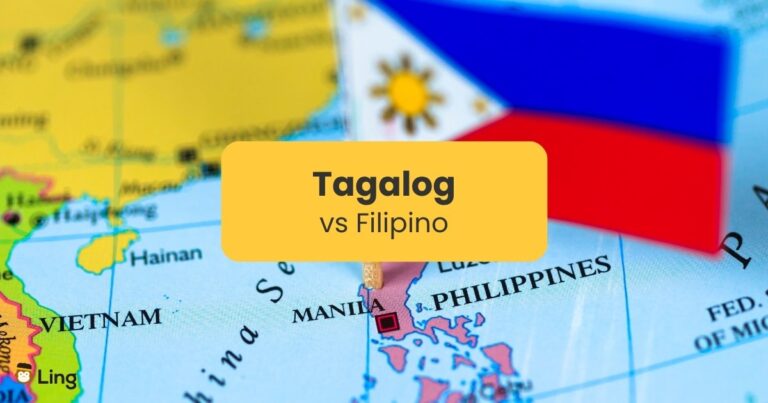
There’s more to discover about the Philippines than just its outstanding scenery! The modern Tagalog alphabet, officially the Filipino alphabet, has 28 letters: the same 26 as English, plus ñ and ng. It replaced the older 20-letter Abakada alphabet in 1976 to align with international standards.
For a serious language learner, getting to know the Tagalog alphabet helps you recognize words instantly, pronounce them like a local, and pick up cultural tidbits along the way. Best of all, it’s straightforward to learn since the writing system closely mirrors English.
Learning Tagalog is more than memorizing words
Explore more →
What Are The 3 Filipino Writing Systems?
There are three Filipino writing systems and alphabets in the country: the Baybayin, the Abakada, and the Modern Filipino Alphabet.
The first one is the Baybayin or Alibata, a pre-colonial script that’s the earliest form of writing in the country, used during the 16th and 17th centuries.
The second one is the Abakada or the Pilipinong Alpabeto, used from the 1930s until 1976, when the country introduced and adopted the Latin alphabet. This writing system was influenced by the English alphabet used by former American colonists and has 20 letters, including ng, and the letters c, f, j, ñ, q, v, x, and z are excluded.
The last one is the Modern Filipino Alphabet, which is the same as Abakada, but with the addition of letters c, f, j, ñ, q, v, x, and z. In Tagalog, it’s called Modernong Alpabeto sa Filipino.

1. What Is The Baybayin Script?
Baybayin is an ancient, precolonial Brahmic writing system that was used in the Philippines until the 17th century, when the Latin script was introduced.
Unlike the Latin-based alphabet used today, Baybayin is a syllabic script, meaning each character represents a whole syllable rather than a single letter. For example, the word ᜊᜌ᜔ᜊᜌᜒᜈ᜔ (baybayin) is written with syllable blocks.
You can still spot the script today on Philippine banknotes and in modern Filipino tattoo art.
2. What Is The Abakada Alphabet?
The Abakada alphabet is a version of the Latin alphabet adapted to represent the sounds in the Tagalog language.
It has 20 letters and was developed by the writer and senator of the Philippines, Lope Santos y Canseco, in 1939. It was eventually replaced with the modern Filipino alphabet.
| Abakada Letter | Pronunciation | Example Word | Sound |
|---|---|---|---|
| A | Ah | Aso (Dog) | |
| B | Ba | Baboy (Pig) | |
| K | Ka | Kahon (Box) | |
| D | Da | Damo (Grass) | |
| E | Eh | Elepante (Elephant) | |
| G | Ga | Galaw (Movement) | |
| H | Ha | Halaman (Plant) | |
| I | Ee | Itlog (Egg) | |
| L | La | Laso (Ribbon) | |
| M | Ma | Mata (Eye) | |
| N | Na | Nais (Want) | |
| NG | Nga | Ngipin (Tooth) | |
| O | Oh | Oras (Time) | |
| P | Pa | Patay (Dead) | |
| R | Ra | Rampa (Ramp) | |
| S | Sa | Saging (Banana) | |
| T | Ta | Tao (Human) | |
| U | Uh | Ubas (Grapes) | |
| W | Wa | Walo (Eight) | |
| Y | Ya | Yaman (Wealth) |
3. What Is The Modern Tagalog Alphabet?
The Modern Filipino Alphabet or Tagalog Alphabet (Makabagong Alpabetong Pilipino) is the official alphabet used today.
It was adopted in 1976 to align with international standards and takes the 20 letters from Abakada and adds eight new consonants (c, f, j, ñ, q, v, x, and z).
| Letter | Pronunciation | IPA | Example Word | Sound |
|---|---|---|---|---|
| A a | ey | /a/ | araw (sun) | |
| B b | bi | /b/ | bahay (house) | |
| C c | si | /k/, /s/ | kotse (car) | |
| D d | di | /d/ | daan (road) | |
| E e | ih | /e/, /i/ | eroplano (airplane) | |
| F f | ef | /f/, /p/ | Pebrero (February) | |
| G g | dyi | /g/, /dʒ/, /h/ | gamot (medicine) | |
| H h | eyts | /h/ | hangin (wind) | |
| I i | ay | /i/, /e/ | isda (fish) | |
| J j | dyey | /dʒ/, /h/ | jeep (jeepney) | |
| K k | key | /k/ | kamay (hand) | |
| L l | el | /l/ | lupa (earth) | |
| M m | em | /m/ | mata (eye) | |
| N n | en | /n/ | niyog (coconut) | |
| Ñ ñ | enye | /ɲ/ | Niño (child, as in Santo Niño) | |
| Ng ng | endyi | /ŋ/ | ngipin (tooth) | |
| O o | ow | /o/, /u/ | araw → oras (time) | |
| P p | pi | /p/ | puso (heart) | |
| Q q | kyu | /k/ | Quezon (Quezon, a place/name) | |
| R r | ar | /ɾ/ | relo (watch) | |
| S s | es | /s/ | saging (banana) | |
| T t | ti | /t/ | tubig (water) | |
| U u | yu | /u/, /o/ | ulan (rain) | |
| V v | vi | /v/, /b/ | Valentino (a name) | |
| W w | dobolyu | /w/ | wika (language) | |
| X x | eks | /ks/ | x-ray (x-ray) | |
| Y y | way | /j/ | yelo (ice) | |
| Z z | zi | /z/, /s/ | zipper (zipper) |
How Many Tagalog Vowels Are There?
There are five vowels, or patinig, in the Tagalog alphabet, the same as in the English alphabet:
- A a: ah (as in “father”)
- E e: eh (as in “bet”)
- I i: ee (as in “see”)
- O o: oh (as in “go”)
- U u: oo (as in “food”)
How Many Tagalog Consonants Are There?
There are 23 consonants, or katinig, in the Tagalog alphabet:
- B b: buh (as in “boy”)
- C c: kuh/suh (as in “cat”/”city”)
- D d: duh (as in “dog”)
- F f: fuh (as in “fan”)
- G g: guh (as in “go”)
- H h: huh (as in “hat”)
- J j: juh (as in “jam”)
- K k: kuh (as in “key”)
- L l: luh (as in “love”)
- M m: muh (as in “man”)
- N n: nuh (as in “net”)
- Ñ ñ: nyuh (as in “canyon”)
- Ng ng: nguh (as in “sing”)
- P p: puh (as in “pan”)
- Q q: kuh (as in “queen”)
- R r: ruh (rolled/tapped, as in Spanish “pero”)
- S s: suh (as in “sun”)
- T t: tuh (as in “top”)
- V v: vuh (as in “van”)
- W w: wuh (as in “water”)
- X x: ksuh (as in “box”)
- Y y: yuh (as in “yes”)
- Z z: zuh (as in “zoo”)

How Do You Say ‘Alphabet’ In Tagalog?
The Tagalog word for alphabet is alpabeto.
Vocabulary To Practice The Tagalog Alphabet
Now that you know all the letters in the Tagalog alphabet, it’s time to practice with some useful Tagalog vocabulary:
| English | Tagalog | Sound |
|---|---|---|
| Airport | Paliparan | |
| Bathroom | Banyo | |
| Beach | Dalampasigan | |
| Bill/Check | Kuwenta | |
| Bus | Bus | |
| Cheap | Mura | |
| Closed | Sarado | |
| Coffee | Kape | |
| Doctor | Doktor | |
| Eat | Kain | |
| Expensive | Mahal | |
| Friend | Kaibigan | |
| Help | Tulong | |
| Hospital | Ospital | |
| Hotel | Otel | |
| How much? | Magkano? | |
| Left | Kaliwa | |
| Market | Palengke | |
| Money | Pera | |
| Open | Bukas | |
| Right | Kanan | |
| Today | Ngayon | |
| Tomorrow | Bukas | |
| Water | Tubig | |
| Where? | Saan? |
Tips To Memorize The Tagalog Alphabet
Mastering the Tagalog alphabet is fairly straightforward, especially because it’s a Latin-based script, just like English. Still, here are some tips that can make it easier:
- It’s not really required to learn the alphabet first. Try listening to audio lessons and watching Tagalog movies, dramas, or songs. Then, you will become familiar with Tagalog pronunciation, which will help you recognize the letters.
- As we mentioned, the Tagalog alphabet is written in Latin/Romanized script. It doesn’t contain extra vowels other than the same ‘a e i o u’ English has, but some of them may be longer-sounding vowels.
- Although Tagalog is considered a hard language to learn for English speakers, the alphabet itself is one of the easier parts to pick up since it’s written in the familiar Latin script.
- Much like you probably learned your native alphabet, it’s best to start writing them in a notebook.
- If you want to learn the Tagalog alphabet on the go, use the Ling app. It has speaking practice, Tagalog grammar and culture notes, exams to review all the lessons, and more.
Frequently Asked Questions About The Tagalog Alphabet
How Many Letters Are In The Tagalog Alphabet?
The modern Tagalog (Filipino) alphabet has 28 letters. The older Abakada alphabet had 20 letters, but it was officially replaced in 1976.
How Many Letters Are In The Filipino Alphabet?
There are 28 letters in the Filipino alphabet, which is now the official alphabet of the Philippines. It’s the same as the modern Tagalog alphabet and replaced the older 20-letter Abakada system.
Is The Tagalog Alphabet The Same As The Filipino Alphabet?
Yes, the modern Tagalog alphabet and the Filipino alphabet are the same 28-letter system. “Filipino” is the official name of the national language, which is based largely on Tagalog, so the terms are often used interchangeably when talking about the alphabet.
What Is Baybayin?
Baybayin is the pre-colonial writing system of the Philippines, used long before the Latin alphabet arrived. Unlike today’s alphabet, it’s a syllabic script, where each character stands for a whole syllable.
Which Letters Were Added To The Modern Tagalog Alphabet?
Eight letters were added to the old 20-letter Abakada to form the modern 28-letter alphabet: c, f, j, ñ, q, v, x, and z. These are mostly used for foreign words and names, such as coffee, jeepney, or zebra.
How Do I Learn The Tagalog Alphabet?
We recommend using the Ling app to learn the Tagalog alphabet. It has short lessons for vocabulary, speaking, listening, and reading. You can also use the Ling app to read culture notes and grammar notes about Tagalog.
What Is The Tagalog Alphabet?
The Tagalog alphabet, officially called the modern Filipino alphabet, is the 28-letter writing system used in the Philippines today. It includes the same 26 letters as the English alphabet plus ‘ñ’ and ‘ng’, and it’s written in the Latin script. Adopted in 1976, it replaced the older 20-letter Abakada alphabet, which itself followed the pre-colonial Baybayin script.
Quick Recap: The Tagalog Alphabet
In this post, we went over how the Tagalog alphabet, or modern Filipino alphabet, was established in 1976 and had two predecessors: the precolonial Baybayin script and the 20-letter Abakada alphabet.
Moreover, we learned the Tagalog alphabet’s 28 letters (5 vowels and 23 consonants) and reviewed some practical vocabulary and tips to help you master them.
What’s next for you? Are you going to deep dive into idioms, transition phrases, proverbs, or Tagalog slang?
Learn Tagalog With Ling!
Do you want to discover more about the Tagalog alphabet and learn Tagalog? Then try the best language-learning app to help you out: the Ling app.
In the Ling app, you’ll find native-speaker audio, interactive exercises, pronunciation feedback, and even Tagalog grammar and culture notes to learn the language in more depth. You’ll also get to review everything you’ve learned with flashcards, a personal vocabulary bank, and short exams.
So what are you waiting for? Download the Ling app and start your Tagalog language journey today!