Linguists often describe Baltic languages as being the most archaic of the living Indo-European languages. Indeed, Lithuanian and its closest relative, Latvian, keep old features that most Indo-European languages lost long ago.
But there is a question that often comes up, especially among language learners: what are the real differences between these two languages, and which one to learn?
If you’re also asking yourself the same questions, this Lithuanian vs Latvian guide is right for you! So keep on reading!
I want to learn even more languages with Ling!
Download now!
Lithuanian Vs Latvian: What Are The Main Differences?
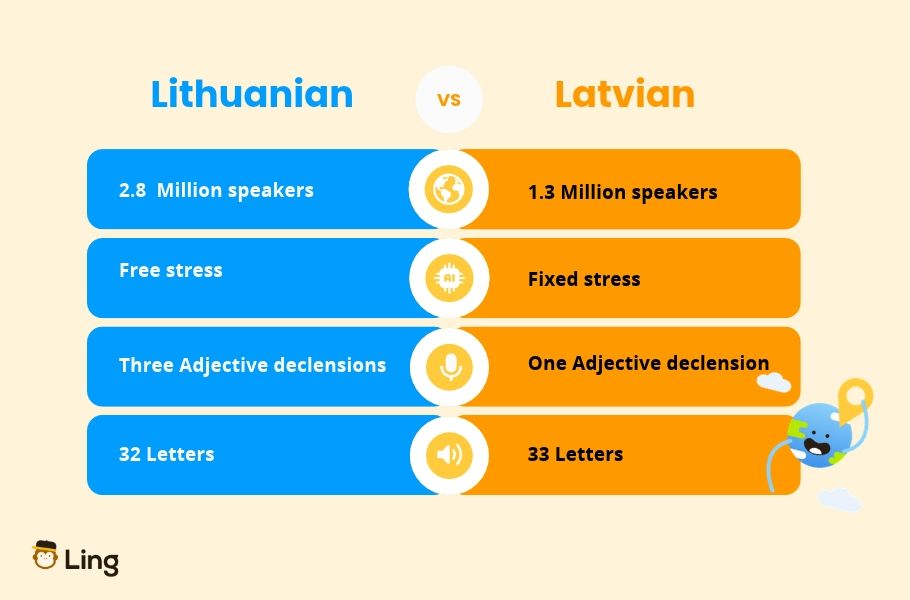
The main differences lie in their grammar, phonology, and stress patterns. Lithuanian has preserved more features of older forms of the language and uses free stress, meaning the stressed syllable can vary. Latvian has lost some of these older grammatical features and always places stress on the first syllable.
From a linguistic perspective, Lithuanian and Latvian are languages that present enough similarities to be called close. However, this same linguistic point of view also categorizes them as separate languages that people cannot understand without studying them.
Here is a quick Lithuanian vs Latvian comparison table:
| Feature | Lithuanian | Latvian |
|---|---|---|
| Number of speakers | ~ 2.8 million | ~ 1.3 million |
| Stress | Free (on any syllable) | Fixed (on the first syllable) |
| Noun declensions | Five (12 types) | Six (8 types) |
| Adjective declensions | Three | One |
| Special verb form | Frequentative past | Debitive |
| Alphabet | 32 letters | 33 letters |
As you can see, even though Latvian and Lithuanian share some similarities, they still differ enough to be distinct languages.
What Is The Lithuanian Language?
Lithuanian is an East Baltic language, and its dialects are quite archaic in form compared to other Indo-European languages.
This makes it an absolute favorite among historical linguists, as it helps them understand how older European languages worked and how to map their evolution.
In fact, 19th-century French linguist Antoine Meillet once suggested that anyone who wanted to hear something resembling Proto-Indo-European should visit the Lithuanian countryside and listen to local farmers speaking their dialects (The Lithuanian Language: Traditions and Trends by Giedrius Subačius).
What Is The Latvian Language?
Latvian is the only other East Baltic language still spoken today, along with Lithuanian.
While it is also considered an older Indo-European language, like Lithuanian, it absorbed more outside influences than its neighbor.
For example, many German loanwords found their way into Lithuanian, and Finno-Ugric languages such as Finnish, Estonian, and Hungarian also influenced it.
Latvian also has a close cousin, the Latgalian language, which is treated as a historical variant of Latvian rather than a separate language. According to UNESCO’s language atlas, this variety is still spoken by around 150,000 in eastern parts of Latvia.
Are Latvian and Lithuanian Mutually Intelligible?
Not really. Lithuanians and Latvians share many roots, both geographically and genetically, and their respective languages also share many similarities.
However, differences in phonetics, stress patterns, grammar, and vocabulary make the two languages mutually unintelligible.
For example, words like penki (five in Lithuanian) and pieci (five in Latvian) look closely related in their written form, but in speech, the different stress and pitch will make them sound much less alike.
As such, close roots can sometimes be difficult to recognize because of the endings of the final words, the stress pattern, or even the pronunciation itself.
Here are some similar words in Lithuanian and Latvian that may still sound very different to the native speakers of both languages:
| English | Lithuanian | Latvian |
|---|---|---|
| One | vienas | viens |
| Five | penki | pieci |
| Six | šeši | seši |
| Hundred | šimtas | simts |
How Different Is The Grammar In Lithuanian Vs Latvian?
At first glance, Latvian and Lithuanian grammar looks almost identical. Both have:
- Seven grammatical cases (nominative, genitive, dative, accusative, instrumental, locative and vocative)
- Three persons
- Three tenses
- Three verb conjugation groups
Both languages also form compound tenses by combining the verb “to be” with a participle.
In other words, if you are a learner of Lithuanian or Latvian, the grammar logic you learn in one language can easily carry over to the other.
- The main differences between Lithuanian and Latvian grammar lie primarily in adjectives and a couple of verb forms.
- Lithuanian adjectives follow three declensions (three ending types), whereas Latvian adjectives have only one.
- Each language has also developed a verb form that the other lacks.
For instance, Lithuanian has a frequentative past for habits. Latvian has a debitive verb form for obligation, formed with the prefix jā.
To sum up, because Lithuanian has kept more of the old system of endings, it is possible to say that it is grammatically conservative compared to Latvian and that it can also be a bit more difficult to learn.
Are Lithuanian And Latvian Slavic Languages?
Lithuanian and Latvian are not Slavic languages. They are the only two Baltic languages still spoken today.
However, it is possible to say that they sit fairly close to Slavic languages on the Indo-European family tree. This explains why some Slavic words can look quite familiar to Baltic language learners.
Some of these similarities stem from borrowing, as both languages took words from their Slavic neighbors.
For example, kurtas in Lithuanian and kurts in Latvian both mean “hunting dog.” The same word has cognates in other Slavic languages, such as Russian khort (хорт) and Polish chart.
The fact that these words share the same Slavic roots is quite visible. However, this does not categorize Latvian or Lithuanian as Slavic languages from a linguistic perspective.
Which Language Is Easier To Learn: Lithuanian Or Latvian?
It is generally said that Latvian is an easier language to learn.
In fact, its stress patterns are predictable, since it always falls on the first syllable, and its adjectives only have one ending type.
On the other hand, Lithuanian requires some brain work to memorize where the stress falls in each word and to master three sets of adjective endings.
As such, Lithuanian is said to be more difficult to learn than Latvian. Moreover, the gap between the two languages tends to widen at the intermediate level, especially as Lithuanian grammar becomes more complex.
Should You Learn Lithuanian Or Latvian First?
When you choose to learn a language, it is important to know your goal first.
So, whether you choose to learn Latvian or Lithuanian will ultimately depend on the reasons why you want to learn them.
Here is what you should keep in mind:
- Lithuanian is useful to learn if you are tracing your ancestry or planning to travel in Lithuania, since you will use it in real situations from the first week.
- Lithuanian can be good for you to learn if you want to discover a language with archaic features and if you want to learn more about the origins and expansion of the Indo-European language family.
- Pick Lithuanian if you want more learning material, since it has roughly twice as many speakers as Latvian.
- Learning Latvian can be very useful if you plan to live or work in Latvia, as everyday life there will require you to use the local language instead of relying on English.
- If you’re looking for an easy language with Baltic origins, Latvian might be the right choice because its stress always falls on the first syllable and its adjectives follow only one declension.
To sum up, a combination of factors is what will determine your language choice. So before picking a language, take time to understand your goals and needs first.
Tips To Learn Lithuanian Or Latvian Easily
Compared to English (or your native language), both Latvian and Lithuanian can seem a bit difficult to learn for beginners.
Here is how you can start to learn them easily:
- Master greetings, numbers, and short phrases first, because they help you build a vocabulary foundation
- Repeat every new word or sentence you learn aloud, and mark the stressed syllable of each new Lithuanian word, since Lithuanian stress can fall anywhere. In Latvian, remind yourself that stress is always on the first syllable
- Study nouns with their case endings, because both languages have seven cases and the endings carry the meaning
- Write short sentences with the special verb forms to understand their inner workings more deeply
- Listen to native speaker audio every day, since the stress patterns are hard to pick up from text alone
- Review a little every day to build good learning habits, progress fast, and avoid hitting the plateau
FAQs – Lithuanian Vs Latvian?
Can Lithuanian Speakers Understand Latvian?
Lithuanian speakers generally cannot understand Latvian, even though they can recognize some words, sentences, or patterns. This is mainly because Latvian and Lithuanian are distinct languages, even though they are related.
Are Lithuanian And Latvian Related To Russian?
No. Baltic and Slavic belong to the same wider Indo-European family and share some features, but Baltic languages remain separate from Slavic languages.
Are the Latvian And Lithuanian Alphabets Similar?
Both the Latvian and the Lithuanian alphabets are similar, in the sense that they are based on Latin. However, they are not the same at all, since Lithuanian has 32 letters, while Latvian has 33.
Is Lithuanian Or Latvian Harder To Learn?
Lithuanian is generally considered harder than Latvian, as its grammar kept many older forms and its stress pattern is not fixed.
How Many Baltic Languages Are There?
As of today, Lithuanian and Latvian are the only two living Baltic languages. Some linguists also classify Latgalian (a dialect of Latvian) and Samogitian (a dialect of Lithuanian) as regional languages, but most consider them only dialects.
Other Baltic languages and varieties (all extinct today) include Old Prussian, Galindian, Sudovian (Yotvingian), Curonian, Semigallian, Selonian, Nadruvian, and Skalvian.
What Is The Main Difference Between Lithuanian And Latvian?
The main difference is that Lithuanian has preserved more archaic features of the Baltic languages, while Latvian has undergone more grammatical and phonological changes. For example, Lithuanian has free word stress, whereas Latvian consistently stresses the first syllable. Although both languages share seven grammatical cases, verb conjugations, and many word roots, they are not mutually intelligible.
Ready To Learn The Baltic Language Of Your Choice?
Here you go! You have all the information you need about Lithuanian and Latvian. As you now understand, both languages share many roots and similarities, but their stress patterns, grammar, and vocabulary make them distinct enough to be categorized as separate languages.
So if you were to learn one of them, your best choice is actually to choose the one that matches your goals, and once you have started, you will enjoy spotting the links to the other one!
Start Learning Lithuanian Or Latvian With Ling (7-Day Trial)
Made your choice? You can start right away with Ling, the app that offers comprehensive courses in 70+ languages, especially for smaller languages like Latvian and Lithuanian!
With over 10M+ downloads and a 4.7/5 rating across platforms, it’s a great place to start building your language skills.
So, don’t wait any longer! Choose your language, join us, and start learning Lithuanian or Latvian right away!