Did you grow up hearing Arabic at family dinners and want to finally answer back in it? The answer to how to learn Arabic starts with one choice: pick the kind of Arabic that fits your goal, then learn the alphabet and speak from your first week.
This guide covers how hard Arabic really is, how long it takes, an eight step roadmap and a weekly plan. The Ling app fits right into that plan, with short daily Arabic lessons created by native speakers.
How To Learn Arabic: What’s The Short Answer?
Choose Modern Standard Arabic or one spoken dialect, learn the 28 letters, then build about 300 high frequency words and use them in short spoken sentences every day. Grammar fits in around that core, not before it.
I want to learn even more languages with Ling!
Download now!
| Question | Answer |
|---|---|
| Is Arabic hard to learn? | Hard for English speakers. The alphabet is quick to learn, but new sounds, gender and the gap between written and spoken Arabic take time. |
| Writing system | The Arabic alphabet: 28 letters, written right to left, with most short vowels left out |
| Study time for short conversations | About 150 to 250 hours |
| Best learning method | A daily app habit plus regular conversations with family, friends or a tutor |
| Daily study recommendation | 30 minutes a day |
| Realistic first goal | CEFR A2: introductions, everyday questions, simple plans |
In one line: choose your Arabic, learn the letters, then speak a little every day, and Arabic becomes a long project you can actually finish.
Why Should You Learn Arabic?
Arabic is one of the most widely spoken languages on Earth and an official language across North Africa and the Middle East. UNESCO’s World Arabic Language Day page says it is used daily by more than 400 million people, and the United Nations adopted it as its sixth official language in 1973.
Its status is written into national law too. Article 2 of Egypt’s constitution on the Constitute Project names Arabic as the country’s official language. Here is why learners take it on:
- Heritage: understand the stories, jokes and prayers you grew up around, and reply to relatives in their own language.
- Relationships: talk with a partner’s parents in the language they relax in, not the careful English they switch to for you.
- Travel: Cairo, Amman, Marrakesh and Dubai feel very different once you can greet people, read a sign and ask a price.
- Work: diplomacy, journalism, aid work and business across the region all reward even basic Arabic.
Is Arabic Hard To Learn?
Arabic is hard for English speakers, but the difficulty is spread out rather than all at once. The alphabet takes a few weeks, while the sounds, the grammar and the gap between written and spoken Arabic take longer.
Arabic is a Semitic language, a relative of Hebrew and Amharic. Most words grow from a root of three consonants, so once you spot the root, whole families of words start to look familiar.
| Skill | Difficulty | Why |
|---|---|---|
| Alphabet | Moderate | 28 new letters, written right to left, and most letters change shape depending on where they sit in a word |
| Pronunciation | Hard | Several sounds made deep in the throat, plus heavy consonants that have no English match |
| Vocabulary | Moderate | Few shared words with English, but the root system makes new words easier to guess |
| Grammar | Hard | Masculine and feminine verbs, a separate form for two of something and plural patterns to memorize |
| Written vs spoken | Hard | Modern Standard Arabic is used for writing and news, while everyday speech changes from country to country |
The takeaway: the alphabet falls quickly, and the real work is the sounds and the two faces of the language, so plan for both from the start.
For a longer look at why some learners find the language tough and whether it is worth the effort, read whether Arabic is hard to learn.
How Long Does It Take To Learn Arabic?
At 30 minutes a day, expect about 150 to 250 hours of study before you can hold a short everyday conversation in Arabic.
The US Foreign Service Institute places Arabic in Category IV, its “super-hard” group, at about 88 weeks or 2,200 class hours of full time training for professional use. The estimates below scale that benchmark down to everyday goals.
| Goal | Estimated Hours | Estimated Timeline |
|---|---|---|
| Read the Arabic alphabet and use greetings and polite phrases | About 40 to 60 hours | About 12 to 17 weeks |
| Short everyday conversations, CEFR A1 to A2 | About 150 to 250 hours | About 10 to 16 months |
| Comfortable family conversation, CEFR B1 | About 450 to 600 hours | About 30 to 40 months |
All three rows assume 30 minutes a day with no long breaks. These factors move the numbers the most:
- Hearing Arabic at home: much faster, because the sounds and many everyday words already feel familiar.
- Sticking to one variety: faster, because switching between Modern Standard Arabic and a dialect too early splits your practice.
- Staying in romanized Arabic: slower overall, because spellings vary and real signs, menus and messages use the Arabic alphabet.
To see how Arabic compares with Spanish, Korean and the rest, this FSI language difficulty ranking explains every category.
Should You Learn Modern Standard Arabic Or A Dialect?
Start with the variety your goal needs. Modern Standard Arabic is the shared written language of news, books and signs across the Arab world, while dialects such as Egyptian, Levantine, Gulf and Moroccan Arabic are what people speak at home.
Neither choice is wasted. The alphabet, the root system and much of the core vocabulary carry over, so the second variety comes faster than the first.
| Your Goal | Start With | Why |
|---|---|---|
| Reading, news or formal study | Modern Standard Arabic | It is the written standard everywhere Arabic is official |
| Talking with family | Your family’s dialect, plus the alphabet | Relatives speak their dialect at home, and the script lets you read their messages |
| Living in one country | That country’s dialect | It is what you hear at the market, at work and from neighbors |
| Travel across the region | Modern Standard Arabic basics | Signs, menus and announcements use it, and educated speakers understand it |
The takeaway: pick one variety for your first few months, learn the alphabet either way and add the other variety by ear once the basics feel steady.
What Is The Best Order To Learn Arabic In? Your 8 Step Roadmap
Work through these eight steps in order. Each one takes a few weeks of steady practice and builds on the step before it.
Step 1: Learn The Arabic Alphabet
Give the alphabet your first three or four weeks. Arabic is written right to left, most letters join to the next one, and each letter can take up to four shapes depending on whether it starts, sits inside or ends a word.
Learn a few letters a day, write them by hand and read them back aloud. Writing lessons in the Ling app let you trace each Arabic letter with handwriting recognition, and this guide to the Arabic alphabet covers the vowels, letter spacing and a full letter chart.
Step 2: Build A Core Of 300 Arabic Words
About 300 well chosen words carry most of an ordinary day. Start with greetings, family, food, numbers and the verbs you use all the time: go, come, eat, want, know.
| English | Arabic | Transliteration |
|---|---|---|
| Hello! | مرحباً! | marhaban! |
| Good afternoon! | مساء الخير! | masaa’u al-khayr! |
| How are you? | كيف حالك؟ | kayfa haaluk? |
| I’m fine. | أنا بخير. | ana bikhayr. |
| Thank you very much! | شكراً جزيلاً! | shokran jaziilan! |
| Yes | نعم | na’am |
| No | لا | laa |
| Excuse me! | عفواً! | afwan! |
| I don’t know. | لا أعرف. | laa a’rif. |
| No problem. | لا توجد مشكلة. | laa toujadu moshkila. |
| Goodbye! | وداعاً! | wadaa’an! |
Notice that the Arabic reads from the right, and that the question mark in kayfa haaluk? faces the other way. For more ways to open a conversation, see these common greetings in Arabic.
Step 3: Learn The Phrases For Meeting People
First conversations follow a pattern: a greeting, names, where you are from and a polite goodbye. Arabic changes the word for “you” with the person you are talking to, so learn both forms from day one.
- To a man: anta (أنتَ), as in kayfa haaluk? (كيف حالكَ؟), “How are you?”
- To a woman: anti (أنتِ), as in kayfa haaluki? (كيف حالكِ؟), “How are you?”
- Asking a woman where she is from: min ayyi baladin anti? (من أي بلد أنتِ؟)
For a longer self introduction, see how to introduce yourself in Arabic in eight lines.
Step 4: Learn How Arabic Sentences Work
Arabic has no word for “is” in the present tense. “She is from Germany” comes out as “she from Germany”: hiya min almaaniya. (هي من ألمانيا.)
Verbs carry a lot of information in a short prefix. The same verb changes its first letter to show who is doing the action:
- He speaks Chinese: huwa yatahaddathu as-siniyya. (هو يتحدث الصينية.)
- She speaks Japanese: hiya tatahaddathu al-yaabaaniyya. (هي تتحدث اليابانية.)
The ya- at the start of yatahaddathu points to “he,” and the ta- in tatahaddathu points to “she.” Roots work the same way across nouns: kitaab (كتاب) is a book, kaatib (كاتب) is a writer and maktaba (مكتبة) is a library, all built on k-t-b.
Pronouns are the next building block, and this easy guide to Arabic pronouns shows how they shift across dialects.
Step 5: Train Your Ear Every Day
Listening lags behind every other skill, so give it a daily slot of its own. News clips, songs, podcasts and family phone calls all count, even when you only catch one word in five.
Here is a short exchange from the Basic Sentences unit of the Arabic course in the Ling app, recorded with native speaker audio. One person says what they are studying, then two quick questions get two quick answers.
The rest of the conversation, and the rest of the unit, are in the lessons. Listen for the ta- and ya- prefixes from Step 4 in taf’alu and yaf’alu.
Step 6: Say Something Out Loud Daily
Understanding a language and speaking it are separate skills, and heritage learners often have the first without the second. Say your new words aloud each day, then build one short sentence with each.
Record yourself saying marhaban and masaa’u al-khayr, then compare it with a native speaker.
Step 7: Read Short Real Text
Once the letters feel automatic, read something written for Arabic speakers rather than for learners. Shop signs, menus, product labels and short social media posts are all short enough to finish.
Numbers are an easy early win, since many signs and prices use Eastern Arabic numerals. This guide to Eastern vs Western Arabic numerals shows both sets side by side.
Step 8: Build An Arabic Habit You Can Keep
Thirty minutes every day beats three hours every other Sunday. Tie the session to something you already do, such as the commute or your morning coffee.
What Is The Best Way To Learn Arabic?
For most beginners, the best way is one structured daily method plus one way to speak with real people. Here is how the main options compare.
| Method | Best For | Pros | Limitations |
|---|---|---|---|
| Language apps | Daily structure and vocabulary | Short sessions, native audio, visible progress | Need real conversations alongside them |
| Private tutors | Pronunciation and correction | Instant feedback, lessons built around you | The most expensive option per hour |
| Music, films and podcasts | Listening and culture | Enjoyable and full of natural speech | Usually in a dialect and too fast for a true beginner |
| Family practice | Heritage learners and couples | Real context and instant correction | Relatives often switch back to English to help you |
| A stay in an Arabic speaking country | Rapid progress | Constant exposure and strong motivation | Many people reply in English, so it needs a base first |
Pick one method for daily structure and one for speaking, and leave the rest until those two are habits.
What Are The Best Apps To Learn Arabic?
Arabic has more app options than most languages Ling teaches, so the real question is what each one is for. These are the options worth knowing.
| App | Platforms | Best For |
|---|---|---|
| Ling | iOS and Android | A full Arabic course with native speaker audio, script tracing, games and conversation practice |
| Duolingo | iOS and Android, web | Short daily drills in its Arabic course for English speakers |
| italki | iOS and Android | Booking one to one video lessons with an Arabic tutor |
The first two are self study apps and the third adds a human tutor. For a longer comparison, see these Arabic learning apps compared side by side.
Inside the Ling app, Dialog lets you watch a conversation first and then fill in the blanks yourself, which is good rehearsal before you try it with family.
How Does The Ling App Teach Arabic?
Ling teaches Modern Standard Arabic through short daily lessons built around real conversations, with alphabet practice from the start. Its courses span 70+ languages, with a focus on Asian and Eastern European languages, all created by native speakers.
The Arabic course covers everyday vocabulary and conversation, with flashcards, mini-games and a romanization toggle you can switch off as the letters get easier. One learner put it simply:
- “THANK YOUUU SO MUCHH I UNDERSTAND ARABIC NOW!!” An Arabic learner on Google Play, 5 stars.
If you have already tried another app and want more speaking practice, these Duolingo alternatives that help you speak compare the options.
What Does A Weekly Arabic Study Plan Look Like?
Here is what 30 minutes a day looks like across a week.
| Day | Focus | What You Do |
|---|---|---|
| Monday | New letters | Three or four new letters in all their shapes, written by hand and read aloud |
| Tuesday | New words | Ten new words with their gender, then one spoken sentence with each |
| Wednesday | Listening | One short news clip or song twice, the second time without subtitles |
| Thursday | Speaking | A five minute conversation with a relative, a friend or a tutor |
| Friday | Review | Everything from the week, with extra passes on the words you got wrong |
| Saturday | Reading | One short real text: a sign, a menu, a family message |
| Sunday | Light and fun | An Arabic song or a film you already love, no notebook needed |
Friday is the day most people skip, and it is the one doing the most work.
What Mistakes Do Arabic Beginners Make?
Most beginner problems come from mixing varieties too early, or from leaning on romanization for too long.
| Mistake | Better Approach |
|---|---|
| Mixing Modern Standard Arabic and a dialect from day one | Pick one variety for your first few months and add the other later |
| Staying in romanized Arabic forever | Switch the romanization off once you can sound out the letters |
| Skipping the throat sounds | Practice them aloud daily, since they change the meaning of a word |
| Using the same “you” for everyone | Learn anta for a man and anti for a woman together |
| Learning words without their root | Note the three root letters of every new word to see its word family |
| Only listening, never speaking | Speak badly in week one. Family is far more forgiving than you expect |
If you fix only one, fix the mixing: one variety at a time keeps your progress steady. The romanization toggle in the Ling app helps with the second row, since you can turn it off lesson by lesson as the letters stick.
How Can You Learn Arabic Faster?
Faster progress comes from better practice, not longer sessions. These five habits do most of the work.
- Use active recall: cover the Arabic column, say the word, then check it.
- Shadow native audio: play a sentence and repeat it straight away at the same speed and melody.
- Review at the end of every session: run through today’s words once more before you stop.
- Work your weak spots. The Ling app keeps track of the words you miss so you can practice them again.
- Hunt for roots: each week, pick one root such as k-t-b and collect every word you meet that grows from it.
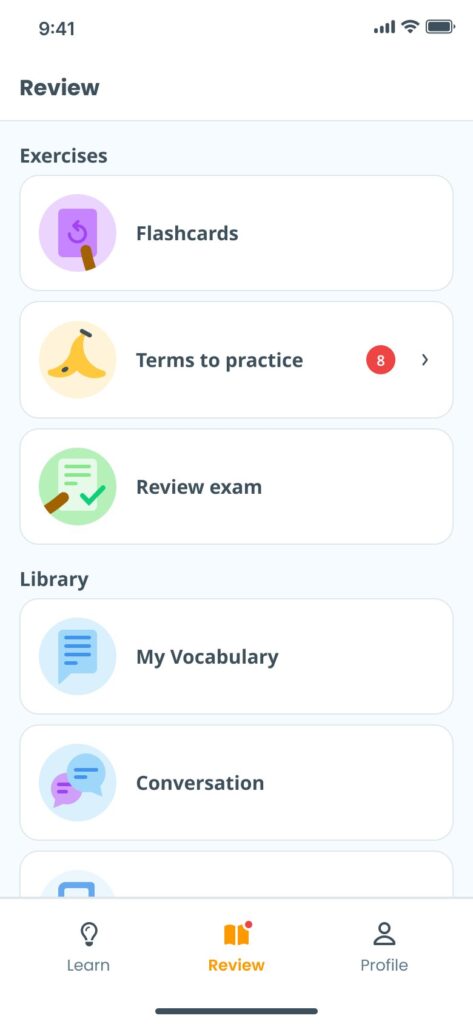
Short, frequent review beats one long cram session, especially for letter shapes and the two forms of “you.”
Which Arabic Learning Path Is Right For You?
Your reason for learning should decide what you study first. Find your row and start there.
| Your Goal | Recommended Approach |
|---|---|
| Reconnect with your roots | Your family’s dialect first, built on the listening you already have, then the alphabet so you can read messages from relatives |
| Talk with a partner and their family | Greetings, family words and food vocabulary first, with your partner as a daily practice buddy |
| Travel in the Arab world | Survival phrases, numbers and directions, plus enough script to read signs and prices |
| Work or study in the region | Modern Standard Arabic for reading, plus the local dialect for daily conversation |
| Enjoy the language for its own sake | The alphabet and roots from the start, then calligraphy, songs and poetry |
Whichever row fits, the daily half hour stays the same. Only the word lists change.
Frequently Asked Questions About How To Learn Arabic
Can I Learn Arabic On Duolingo?
Yes. Duolingo’s public course list includes an Arabic course for English speakers, so it can be one part of your daily practice. Whichever app you use, add the pieces a beginner needs most: alphabet practice, native speaker audio and real conversations with people who speak Arabic. Those three are what turn app streaks into actual speaking.
Is Arabic Hard To Learn For English Speakers?
Yes, it is one of the harder languages for English speakers, but it is very learnable. The alphabet takes only a few weeks. The harder parts are the throat sounds, masculine and feminine verb forms, and the gap between Modern Standard Arabic and the spoken dialects. Steady daily practice makes each of these manageable.
How Long Does It Take To Learn Arabic?
At 30 minutes a day, the alphabet, greetings and polite phrases take about 12 to 17 weeks, and short everyday conversations take about 10 to 16 months. Comfortable family conversation is closer to 30 to 40 months. Learners who grew up hearing Arabic at home usually move much faster.
Should I Learn Modern Standard Arabic Or A Dialect First?
Choose by goal. Modern Standard Arabic suits reading, news, formal study and travel across the region. A dialect such as Egyptian or Levantine suits talking with family or living in one country. Either way, learn the alphabet, and stick with one variety for your first few months before adding the other.
Can I Learn Arabic By Myself?
Yes. Many people reach conversational Arabic without a classroom, using an app for daily structure and a relative, friend or tutor for speaking. What self study cannot give you is correction, so build in one regular conversation with an Arabic speaker who will tell you when a sound or an ending comes out wrong.
Can An App Make Me Fluent In Arabic?
No app makes anyone fluent on its own. A good app handles the daily work of the beginner and intermediate stages: the alphabet, vocabulary, listening and conversation patterns. Fluency needs real conversations on top of that, which is why any plan for how to learn Arabic should include a speaking partner.
What Should You Remember About Learning Arabic?
Start by choosing your Arabic, then learn the alphabet, because it gives way faster than it looks.
After that, it is steady work: a core of everyday words, the throat sounds, the right “you” for the right person and one variety at a time. Consistency will do more for you than talent.
- Pick Modern Standard Arabic or one dialect for your first few months.
- Aim for 300 high frequency words, each noted with its root.
- Keep the daily half hour and speak out loud in every session.
Start Speaking Arabic With Your Family
You have the roadmap, so the only step left is the first one, and it can be a small one today. Picture the moment you answer your grandmother in Arabic instead of English, and work back from there.
With Writing lessons for the Arabic alphabet, native speaker audio you can slow down, Dialog for conversation practice and a romanization toggle for the early weeks, Ling keeps learning simple and fun. Open the app, pick your half hour and start learning Arabic today!