


What does a typical family in Cantonese culture look like? Hong Kongers are family-oriented. Most of the families in this country live in nuclear families because of the high cost of living spaces in Hong Kong. But, what’s fantastic about them is they still maintain traditional Chinese concepts like family solidarity and family glory even though there are many influences from Western culture.
Hong Kongers’ family culture is guided by filial piety, which is common in most Southeast Asian countries. In this culture, hierarchal seniority is determined by age, which means, all the family members are expected to show respect to their elders. In fact, they pay respect to their ancestors at least twice a year. There are different ways to pay respect to elders, and one of them is through language. So, let us learn this Cantonese vocabulary for family (家庭 gaa1 ting4 ).
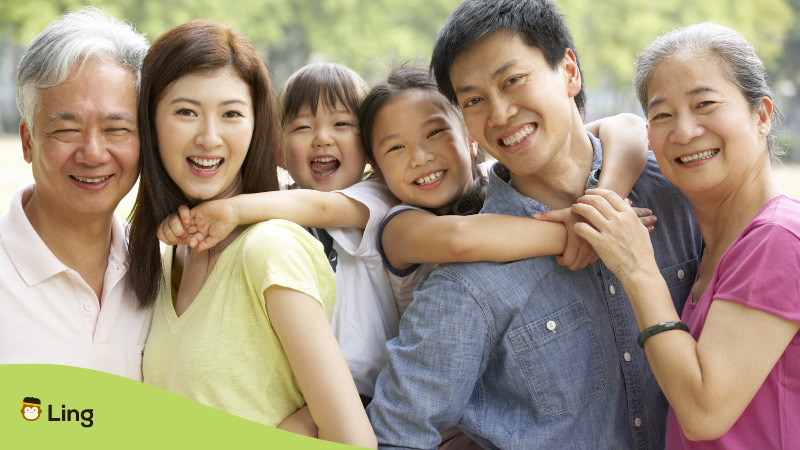
How Do You Say Family Members In Cantonese?
Just like in other cultures, each family members in the Cantonese culture have their own responsibilities. But, the Cantonese family tree is more complicated than that of other cultures. It may be very daunting to learn at first, but once you’ve got to practice it yourself, you’ll understand it better. What can be confusing at first is that Cantonese terms differ from the maternal or paternal side. But, you don’t have to worry because the terms you’ll learn below have English translations that will help you get through.
I want to learn even more languages with Ling!
Download now!
You also don’t have to memorize every Cantonese vocabulary for a family written in this post if you are not marrying a local or have a close friend who practices this culture. Instead, you may start learning about the nuclear family and consider other relatives as a bonus.
Cantonese Vocabulary For Family: Cantonese Family Tree
1. 父母 (Fu6 Mou5) – Parents
Parents are the heart of every family. Traditionally, the father is the main provider and the head of the family, while the mother takes care of the house chores in Hong Kong. But, in these modern times, women have proven their place in society, so many families in Hong Kong hire a maid to do the house chores while both parents are working.
So, if you want to learn the Cantonese vocabulary for family related to parents, please refer to the words below:
Father In Cantonese
| English Translation | Cantonese | Pinyin | Sound |
|---|---|---|---|
| Father (formal- written) | 父親 | fu6 can1 | |
| Father (less formal – both written and spoken) | 爸爸 | baa4 baa1 |
Mother In Cantonese
| English Translation | Cantonese | Pinyin | Sound |
|---|---|---|---|
| Mother (formal written) | 母親 | mou5 can1 | |
| Mother (less formal both written and spoken) | 媽媽 | maa4 maa1 |
2. 孩子 (Haai4 Zi2) (Formal Written) – Children
Children are expected to be respectful and obedient to their parents. Because parents want their children to succeed in life, they provide their children with a quality education. So, if you want to learn Cantonese vocabulary for families related to children, create a room in your mind for these words:
| English Translation | Cantonese | Pinyin | Sound |
|---|---|---|---|
| Children (less formal both written and spoken) | 小朋友 | siu2 pang4 jau5 | |
| Children less formal both written and spoken) | 仔女 | zai2 neoi2 | |
| Siblings | 兄弟姊妹 | hing1 dai6 zi2 mui6 |
Son, Younger Brother, Elder Brother, Grandson In Cantonese
| English Translation | Cantonese | Pinyin | Sound |
|---|---|---|---|
| Son | 仔 | zai2 | |
| Elder brother | 哥哥 | go4 go1 | |
| Younger brother | 弟弟 | dai4 dai2 | |
| Grandson (son’s son) | 孫仔 | syun1 zai2 | |
| Grandson (daughter’s son) | 外孫 | ngoi6 syun1 |
Daughter, Younger Sister, Elder Sister, Granddaughter In Cantonese
| English Translation | Cantonese | Pinyin | Sound |
|---|---|---|---|
| Daughter | 女 | neoi2 | |
| Elder sister | 姐姐 | ze4 ze1 | |
| Younger sister | 妹妹 | mui4 mui2 | |
| Granddaughter (son’s daughter) | 孫女 | syun1 neoi2 | |
| Granddaughter (daughter’s daughter) | 外孫女 | ngoi6 syun1 neoi2 |
3. Grandparents
Just like what is written above, Cantonese culture is rooted in the Confucian belief – filial piety. Other Cantonese family members respect elders. This is also why sending grandparents to the home for the aged is not a practice in Cantonese culture. Elders are expected to be treated with respect, love, and kindness by the family for a lifetime. So, here are the polite Cantonese words and phrases for family related to grandparents that you need to know.
Grandfather In Cantonese
| English Translation | Cantonese | Pinyin | Sound |
|---|---|---|---|
| Grandfather (father’s father) | 爺爺 | je4 je2 | |
| Grandfather (mother’s father) | 公公 | gung4 gung1 | |
| Grandfather (mother’s father) | 外公 | ngoi6 gung1 |
Grandmother In Cantonese
| English Translation | Cantonese | Pinyin | Sound |
|---|---|---|---|
| Grandmother (father’s mother) | 嫲嫲 | maa4 maa4 | |
| Grandmother (mother’s mother) | 婆婆 | po4 po2 | |
| Grandmother (mother’s mother) | 外婆 | ngoi6 po4 |
4. Relatives (親戚 chānchìk)
Relatives are also valued in the family. Although most Hong Kongers usually live with the nuclear family, the extended family is still important for them as they believe in the concept of family glory. So you’ll bring your family’s reputation to everything you do. This is the part mentioned above where terms depend on the maternal or paternal side.
Brace yourself with more Cantonese vocabulary for family. Of course, this would not be that useful when you’re just traveling, but it would still be great if you had an idea about this.
| English Translation | Cantonese | Pinyin | Sound |
|---|---|---|---|
| Aunt (general) | 姨姨 | ji1 ji1 | |
| Aunt (mother’s elder sister) | 姨媽 | ji4 maa1 | |
| Aunt (mother’s younger sister) | 阿姨 | aa3 ji1 | |
| Aunt (mother’s brother’s wife) | 舅母 | kau5 mou5 | |
| Aunt (father’s elder sister) | 姑媽 | gu1 maa1 | |
| Aunt (father’s younger sister) | 姑姐 | gu1 ze1 | |
| Aunt (father’s elder brother’s wife) | 伯娘 | baak3 noeng4 | |
| Aunt (father’s younger brother’s wife) | 阿嬸 | aa3 sam2 | |
| Uncle (general) | 叔叔 | suk1 suk1 | |
| Uncle (mother’s brother) | 舅父 | kau5 fu2 | |
| Uncle (mother’s sister’s husband) | 姨丈 | ji4 zoeng2 | |
| Uncle (father’s elder brother) | 伯父 | baak3 fu6 | |
| (father’s younger brother) | 叔父 | suk1 fu6 Uncle | |
| Uncle (father’s sister’s husband) | 姑丈 | gu1 zoeng2 | |
| Nephew (brother’s son) | 侄 | zat6 | |
| Nephew (sister’s son) | 外甥 | ngoi6 saang1 | |
| Niece (brother’s daughter) | 侄女 | zat6 neoi2 | |
| Niece (sister’s daughter) | 外甥女 | ngoi6 saang1 neoi2 | |
| Elder male cousin (father’s side) | 堂阿哥 | tong4 aa3 go1 | |
| Elder male cousin (mother’s side) | 表哥 | biu2 go1 | |
| Younger male cousin (father’s side) | 堂細佬 | tong4 sai3 lou2 | |
| Younger male cousin (mother’s side) | 表弟 | biu2 dai2 | |
| Elder female cousin (father’s side) | 堂家姐 | tong4 gaa1 ze1 | |
| Elder female cousin (mother’s side) | 表姐 | biu2 ze2 | |
| Younger female cousin (father’s side) | 堂細妹 | tong4 sai3 mui2 | |
| Younger female cousin (mother’s side) | 表妹 | biu2 mui2 |
5. Terms For Married Couple (夫婦 fu1 fu5)
Last but not least are the terms for married people. Marriage is important in Cantonese culture. Their beliefs and traditions are rooted in the traditional Chinese culture, wherein they believe that family is the most important thing in life. So if you marry someone, you will not only marry that person but their whole family. You have to respect them the way you respect yours. So if you are planning to marry a local, it is essential to learn Cantonese vocabulary for families related to married people.
| English Translation | Cantonese | Pinyin | Sound |
|---|---|---|---|
| Spouse | 配偶 | pui3 ngau5 | |
| Husband | 先生 | sin1 saang1 | |
| Husband | 丈夫 | zoeng6 fu1 | |
| Wife | 太太 | taai3 taai2 | |
| Wife | 妻子 | cai1 zi2 | |
| Mother-in-law (husband’s mother) | 奶奶 | naai4 naai2 | |
| Mother-in-law (wife’s mother) | 外母 | ngoi6 mou2 | |
| Father-in-law (husband’s father) | 老爺 | lou5 je4 | |
| Father-in-law (wife’s father) | 外父 | ngoi6 fu2 | |
| Son-in-law | 女婿 | neoi5 sai3 | |
| Daughter-in-law | 新抱 | san1 pou5 | |
| Sister-in-law (elder brother’s wife) | 阿嫂 | aa3 sou2 | |
| Sister-in-law (younger brother’s wife) | 弟婦 | dai6 fu5 | |
| Sister-in-law (husband’s elder sister) | 姑奶 | gu1 naai1 | |
| Sister-in-law (husband’s younger sister) | 姑仔 | gu1 zai2 | |
| Sister-in-law (wife’s elder sister) | 大姨 | daai6 ji1 | |
| Sister-in-law (wife’s younger sister) | 姨仔 | ji1 zai2 | |
| Brother-in-law (elder sister’s husband) | 姐夫 | ze2 fu1 | |
| Brother-in-law (younger sister’s husband) | 妹夫 | mui6 fu1 | |
| Brother-in-law (husband’s elder brother) | 大舅 | daai6 kau5 | |
| Brother-in-law (husband’s younger brother) | 舅仔 | kau5 zai2 | |
| Brother-in-law (wife’s elder brother) | 大伯 | daai6 baak3 | |
| Brother-in-law (wife’s younger brother) | 叔仔 | suk1 zai2 |
Cantonese Words And Phrases Related To Family
Now that you have learned the Cantonese vocabulary for family, you are now ready to use those in sentences for better pronunciation. Here are some sentences you can use to practice your spoken language about Cantonese vocabulary for family.
| English Translation | Cantonese | Pinyin | Sound |
|---|---|---|---|
| We are a family of four. | 我 哋 一 家 四 口。 | ngo5 dei6 yat1 ga1 sei3 hau2。 | |
| This is my father. | 呢 位 係 我 爸 爸。 | ne1 wai2 hai6 ngo5 ba4 ba1。 | |
| This is my mother. | 呢 位 係 我 媽 媽。 | ne1 wai2 hai6 ngo5 ma4 ma1 | |
| That is your son. | 呢 個 係 你 個 仔。 | ne1 go3 hai6 nei5 go3 jai2。 | |
| That is your daughter. | 呢 個 係 你 個 女。 | ne1 go3 hai6 nei5 go3 neui5。 | |
| He is my elder brother. | 佢係我大佬 | keoi5 hai6 ngo5 daai6 lou2 | |
| My younger sister went to England to study abroad. | 我妹妹去咗英國留學。 | ngo5 mui6 mui2 heoi3 zo2 jing1 gwok3 lau4 hok6. | |
| We are husband and wife. | 我哋係老公老婆 | ngo5 dei2 hai6 lou5 gung1 lou5 po4 |
Going On A Trip To Hong Kong? Learn Cantonese Now!
Hong Kong is a place where you can bring your whole family, from youngest to oldest, to enjoy. So if you are planning a trip to this country, make sure to back yourself up with sime Cantonese phrases.
Not only will it make your travel smoother, but you’ll also have the opportunity to connect with the locals and understand their culture better. But, how will you do that? It’s easy, learn Cantonese with the Ling app.
The Ling app is a language learning app developed to help language learners learn languages conveniently and with more fun. If you often bring a dictionary with you, with the Ling app, you don’t have to because everything can be learned as long as you have a phone/computer and internet connection. Vocabulary words are arranged like flashcards with audio recordings from native speakers.