

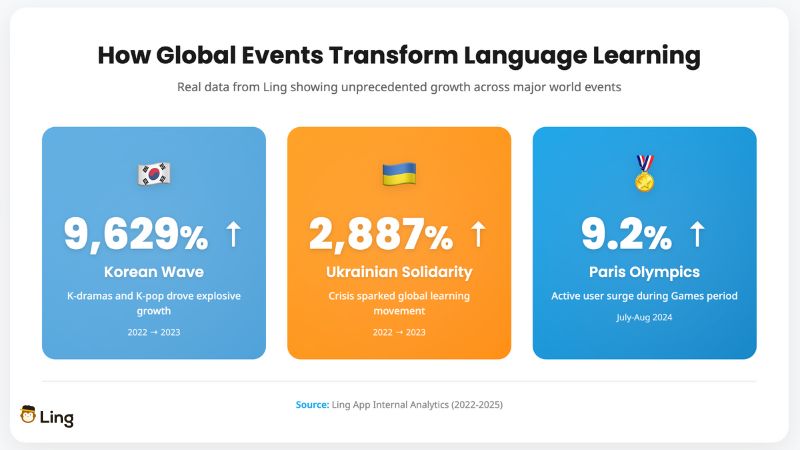
Korean language learning exploded by 9,629% on Ling between 2022 and 2023, from 833 users to over 81,000, driven by the Korean Wave’s cultural dominance. And that’s nothing compared to what happened after Russia invaded Ukraine. Ling’s Ukrainian course saw a 2,887% surge, while globally over 1.3 million people started learning Ukrainian, with Ireland seeing a 2,229% increase.
These aren’t random spikes. They’re part of a pattern where major world events transform “I should learn a language someday” into “I’m downloading an app right now.”
The Olympics, geopolitical crises, viral shows, and cultural moments create perfect storms of motivation. They give you specific, emotional reasons to finally start learning that language you’ve been thinking about.
I want to learn even more languages with Ling!
Download now!
Let’s break down why this happens and how you can use these patterns to fuel your own foreign language learning journey.
Key Findings From Ling’s Data:
Korean Language Growth (2022-2023) – Ling’s Korean active users: 833 → 81,067 (+9,629%) – Sustained at 73,871 users in 2025 – Driven by K-drama, K-pop, and Korean cinema
Ukrainian Language Growth (2022-2023) – Ling’s Ukrainian active users: 141 → 4,214 (+2,887%) – Russia is #1 country learning Ukrainian (4,000 users) – Sustained at 6,842 users in 2025
Paris 2024 Olympics Impact – Daily installs increased 10.7% during Games – Active users increased 9.2% during Games – Pre-Olympics: 11,150 daily active users – During Olympics: 12,181 daily active users
Why Do Global Events Trigger Language Learning Spikes?
Think about the last time you watched something incredible from another culture and the subtitles completely failed you. Maybe a joke landed flat. Maybe an emotional moment felt off. Maybe you caught yourself wondering what was lost between their words and your screen.
That frustration isn’t just annoying—it’s what researchers call “integrative motivation.” You don’t just want to learn vocabulary. You want to be part of something. This feels personal, urgent, almost emotional.
When Squid Game went viral, bilingual viewers flooded social media with explanations of what the subtitles missed. According to Netflix records, the show hit 100 million viewers in its first weeks. Suddenly, those viewers realized they were getting a filtered version of the story. The class dynamics embedded in Korean speech levels? Completely lost in translation. The specific character archetypes that Korean audiences recognize instantly? Explained away in subtitles.
No wonder 17% of new Korean learners said they were studying specifically for “culture.” They wanted to experience the media authentically, without that translation filter.
Crisis-driven spikes work differently. They’re powered by solidarity and empathy. When you see people fleeing war or disaster, learning their language becomes one tangible way to help, show respect, or simply say, “I see you.” It’s not about career goals or travel plans—it’s about human connection.
And sports? The Olympics create this unique blend of both. A 2016 Duolingo and YouGov survey found that 54% of Indian respondents wanted to learn languages specifically to understand athlete interviews during the Olympics.
While this represents one market’s perspective, broader research supports the pattern: a Language Connections study documented over 1 million Brazilian volunteer candidates training in foreign languages specifically for Rio 2016, with 80% of surveyed participants citing Olympic participation as their primary motivation for language learning.
How The Korean Wave Changed Foreign Language Learning Forever
Let’s talk about one of the most dramatic language learning shifts of the 21st century—and no, it didn’t start with one Netflix show.
The Korean Wave Has Been Building For Decades
The “Korean Wave” (Hallyu) has been building since the early 2000s, with a major peak between 2008 and 2014. K-pop groups like BTS and BLACKPINK, K-dramas like Crash Landing on You and Itaewon Class, Korean cinema, beauty trends—all of it created this growing global fascination with Korean culture.
And people weren’t just passively watching. According to Modern Language Association data, between 2013 and 2016, while overall US university language enrollments fell by 9.2%, Korean and Japanese were the only languages in the top fifteen showing gains. Students were literally choosing Korean over traditionally popular languages like French and German.
Many of these learners didn’t stop at apps. They applied for programs like the KGSP (Korean Government Scholarship Program) to actually move to Korea and study the language there. Thousands of international students annually got so into Korean culture through entertainment that they restructured their entire lives around it.
Ling’s data tells the story of this sustained growth. In 2022, our Korean language course had 833 active users for the entire year. By 2023? Korean exploded to 81,067 active users—a staggering 9,629% increase year-over-year. Korean jumped from a mid-tier language to Ling’s top list of most popular languages.
And this momentum hasn’t stopped. In 2025, Korean remained at the top with 73,871 users. This isn’t a temporary trend. It’s a fundamental reordering of which languages people want to learn, driven by decades of Korean cultural exports.
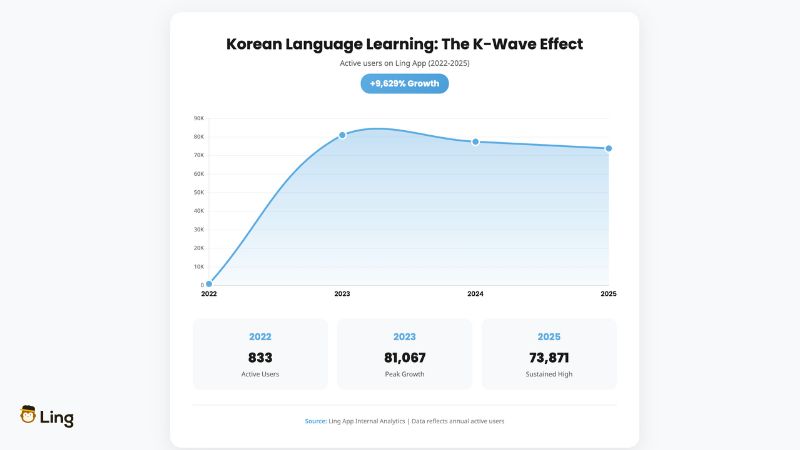
Key Stat: Ling’s Korean active users exploded from 833 in 2022 to 81,067 in 2023—a 9,629% increase driven by sustained K-drama and K-pop cultural momentum.
Ling App Internal Analytics
Squid Game: One Viral Moment In A Larger Movement
When Squid Game premiered in September 2021, it became the most visible example of how Korean entertainment drives foreign language learning.
Within ten days of the show’s release, Duolingo reported a 40% spike in new Korean learners in the US, while the UK saw an even more dramatic 76% increase according to reports from The Guardian and Reuters. But Squid Game didn’t create this interest—it amplified what was already happening.
The trigger? Social media exploded with bilingual viewers explaining what the subtitles missed. Discussions centered on how English translations failed to capture essential cultural nuances, like the “smart but underprivileged” character trope that Korean audiences recognized instantly but was invisible in English subtitles.
Suddenly, millions of viewers realized they were experiencing a filtered version of the story. And the only solution? Learn Korean themselves.
By 2023, Korean became the 6th most popular language globally to study, overtaking Italian, according to Duolingo’s Language Report. Gen Z drives 86% of this interest, and they’re not stopping. Every new K-drama release, every BTS comeback, every Korean film at international festivals brings a fresh wave of learners.
Why This Is Important For Language Learners
For Ling, which specializes in Asian languages that traditional platforms ignore, this entertainment-driven boom transformed the entire platform. When you actually want to understand K-dramas without subtitles, you need an app designed for Asian languages with native speaker audio and cultural context—not an app that treats Korean like an afterthought.
Ling’s nearly 10,000% growth in Korean learners proves that people choose platforms that take Asian languages seriously. The Korean Wave isn’t just changing what languages people learn. It’s changing how they expect to learn them, demanding cultural authenticity and native speaker content rather than generic, Western-focused apps.
How Do The Olympics Inspire Language Learners?
Unlike unpredictable viral shows, the Olympics take place like clockwork every two years. This predictability makes them fascinating case studies for foreign language learning spikes.
Everyone Prepares Months In Advance
Foreign language learning doesn’t wait for opening ceremonies. It starts the moment a city wins the hosting bid.
For Rio 2016, over 1 million Brazilian volunteer candidates got trained in English, French, or Spanish. The organizing committee provided 10,000 free online English courses just for taxi drivers. When 300,000 people apply for 70,000 volunteer spots, many of them are learning languages specifically for that Olympic moment.
But it’s not just host countries. Fans worldwide start studying too.
Tokyo Showed Us The Long Game
The Tokyo Olympics (eventually held in 2021) demonstrated how powerful anticipation can be. Duolingo data showed Japanese had a 41% increase in UK learners during 2020, explicitly linked to Olympic excitement and the 2019 Rugby World Cup.
Even when the pandemic postponed everything, learners kept going. In 2021, Japanese overtook Italian globally to become the 5th most popular language to study. It stayed the fastest-growing language in the UK that year.
The postponement actually helped some learners. They had extra time to reach real proficiency before the Games finally started.
Youth engagement was off the charts—over 18% of new Japanese learners cited “culture” as their primary driver, blending Olympic interest with anime, manga, and Japanese entertainment more broadly.
Ling’s Olympics Data: Real Numbers From Paris 2024
Want proof that the Olympics actually move the needle on foreign language learning? Ling’s internal analytics from the Paris 2024 Summer Olympics tell a clear story.
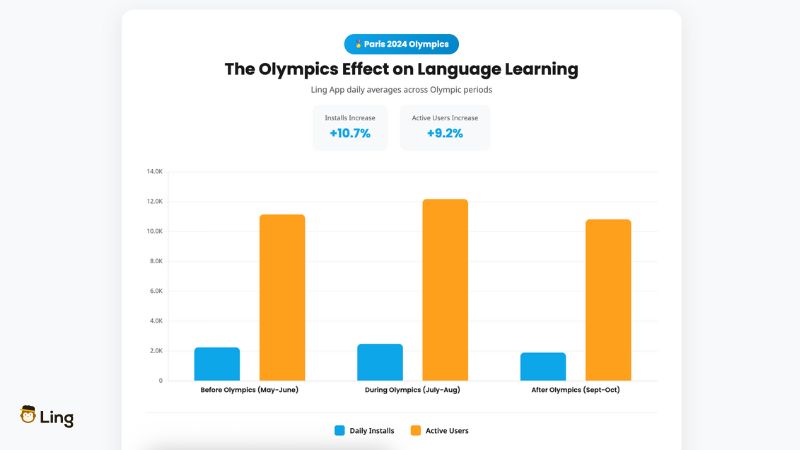
During the Games (July-August 2024), Ling tracked daily averages across three key metrics—and the results validate everything researchers have been saying about Olympic-driven language spikes.
The Olympics drove measurable spikes across all metrics. Daily installs jumped 10.7%, adding roughly 240 new downloads per day. More importantly, active users—the people actually completing lessons—surged 9.2%, growing from 11,150 to over 12,000 daily users.
The engagement matters more than the downloads. Anyone can install an app. Actually opening it, completing lessons, and building a learning habit? That’s the hard part. The near-identical growth rates for installs and active users prove people were genuinely motivated by Olympic coverage, not just casually downloading and abandoning the app.
But here’s the more important number: active users surged 9.2% during the Games. Pre-Olympics (May-June), Ling averaged 11,150 active users daily. During the Olympics, that jumped to 12,181. That’s over 1,000 additional people actively using the app every day—not just downloading it and abandoning it.
The engagement matters more than the downloads. Anyone can install an app. Actually opening it, completing lessons, and building a learning habit? That’s the hard part. The fact that active users increased nearly as much as installs shows people were genuinely motivated by Olympic coverage to start learning.
Post-Olympics, both metrics settled slightly below their pre-Games baseline—the event-driven urgency had passed. But many Olympic-inspired learners stuck around, incorporated into the regular user base.
This data explains why Ling focuses so heavily on underserved Asian and Eastern European languages. When the Olympics spotlight countries like Japan, Korea, China, or various Eastern European nations, Ling is uniquely positioned to serve that sudden demand. Traditional platforms scramble to add these languages as afterthoughts. Ling built its entire foundation on them.
Why Olympic Language Learning Actually Sticks
Unlike crisis spikes that fade once headlines disappear, Olympic-inspired foreign language learning often creates lasting habits.
The event provides your initial spark, but many learners discover deeper motivations along the way. Travel plans emerge. Career opportunities in international business pop up. You realize you genuinely enjoy the language itself, separate from the sports.
For Ling, Olympic periods are perfect for highlighting languages from host countries and major competing nations. The combination of cultural visibility, media coverage, and emotional engagement creates ideal conditions for converting curious people into committed learners.
And with the Winter Olympics coming to Milan-Cortina in 2026, followed by Los Angeles 2028, Brisbane 2032, and beyond—these language learning opportunities aren’t going away. They’re becoming more frequent, more global, and more accessible through mobile apps that make learning possible anywhere.
What Happened To Ukrainian Learning After 2022?
February 2022 changed everything. When Russia invaded Ukraine, foreign language learning became an act of resistance.
Within weeks, over 1.3 million people worldwide started learning Ukrainian on language apps. But these weren’t people checking off a travel bucket list. These were teachers trying to welcome Ukrainian kids into their classrooms. Neighbors wanting to help refugee families feel less alone. Activists looking for any tangible way to show solidarity when everything felt helpless.
The Geography Of Solidarity
The spike mapped directly onto refugee displacement. Countries welcoming the most Ukrainian refugees saw the most dramatic increases.
Refugee-hosting nations saw explosive growth—Ireland leading at 2,229%, with Germany and Poland each seeing increases above 1,600%. The spike mapped directly to where refugees resettled.
According to Duolingo’s 2022 Language Report, in the UK, Ukrainian jumped from 37th to 17th most-studied language. In the US, it went from 36th to 22nd. These weren’t casual learners scrolling through app stores. These were people with Ukrainian families in their homes, Ukrainian children in their schools, and Ukrainian colleagues in their workplaces.
Ling’s Response: Making Ukrainian Free
When the crisis hit, Ling immediately made the app free for Ukrainians and opened the Ukrainian course to everyone at no cost. The campaign ran throughout 2022 and into 2023, ensuring anyone who wanted to learn Ukrainian—whether to help refugees or show solidarity—could do so without barriers.
The impact wasn’t immediate, but it was massive.
In 2022, before and during the early campaign, Ling had just 141 active users learning Ukrainian. By 2023, as the campaign continued and word spread, that number exploded to 4,214 active users—a staggering 2,887% increase. But here’s what really matters: this wasn’t a temporary spike that disappeared when the headlines faded.
2024 saw Ukrainian learners grow even more, reaching 6,412 active users. In 2025, Ukrainian remained strong at 6,842 active users. And in 2026? We’re only in January, but already over 1,000 people are actively learning Ukrainian on Ling. This isn’t a trend that died out—it’s a sustained commitment.
Who’s Learning Ukrainian? The Surprising Geography
Here’s where it gets really interesting. Ling’s data from 2023-2025 reveals where Ukrainian learners are actually located, and the results might surprise you.
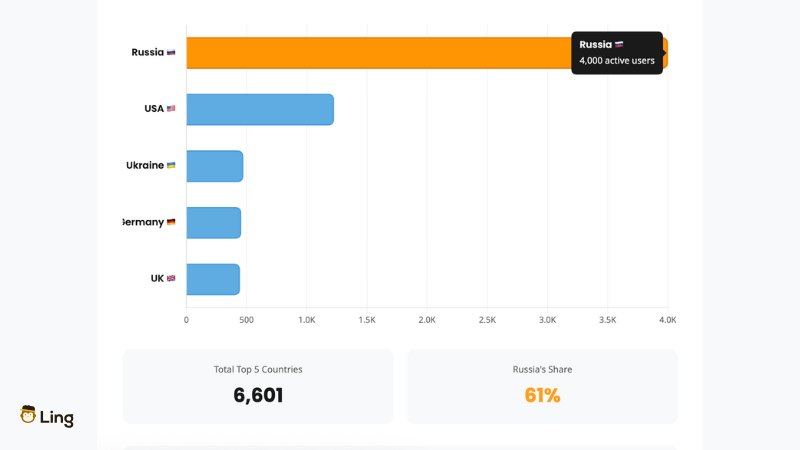
Russia leads Ling’s Ukrainian learners with 4,000 active users—likely anti-war Russians showing solidarity through language learning.
Ling App Data (2023-2025)
Despite—or perhaps because of—the war, thousands of Russians are learning Ukrainian. These are likely anti-war Russians showing solidarity, people with Ukrainian family ties they’re trying to maintain, or individuals wanting to understand the culture and people their government is attacking. This represents a quiet but powerful form of resistance.
The rest of the top countries:
- United States: 1,227 users (solidarity and Ukrainian diaspora)
- Ukraine: 473 users (heritage learners and language maintenance)
- Germany: 456 users (major refugee host)
- United Kingdom: 445 users (solidarity and refugees)
- Canada, Poland, France, and Singapore round out the list with smaller but significant numbers
This geographic spread tells a deeper story. It’s not just countries hosting refugees—it’s a truly global solidarity movement, including learners in the aggressor nation itself.
Why People Kept Learning After Headlines Faded
Here’s what surprised researchers: Ukrainian learners cited “showing solidarity” as their primary motivation at more than double the rate of traditional languages like English or French. This wasn’t about career advancement, it was about human connection.
These learners weren’t chasing career advancement. They were:
- Helping refugee families feel welcomed in new countries
- Communicating with displaced kids at school
- Supporting humanitarian organizations more effectively
- Showing respect for Ukrainian culture under attack
Ling’s sustained numbers prove the commitment runs deep. Many who started learning during the crisis formed real friendships with Ukrainian speakers. Others discovered they genuinely liked the language. Some continued purely out of commitment to the people they’d wanted to support.
Crisis-driven learning transforms language from a skill into a statement. And those statements, turns out, can last.
Which Trending Languages To Watch For Upcoming Global Events?
Want to get ahead of the next foreign language learning wave? Here’s what’s coming up—and which languages are about to surge.
2026 Winter Olympics (Milan-Cortina, Italy)
Italian will obviously spike, but Italy already has a massive learning infrastructure. The real opportunities? Languages from countries that dominate winter sports.
Watch these languages:
Korean – South Korea doesn’t just compete in short track speed skating; they dominate it. And with K-dramas already creating millions of learners, Olympic coverage will be gasoline on an existing fire.
Japanese – Figure skating and ski jumping keep Japan in the spotlight every Winter Olympics, and anime fans are already primed to learn.
Mandarin – China’s winter sports investment after Beijing 2022 is massive. Watch for this.
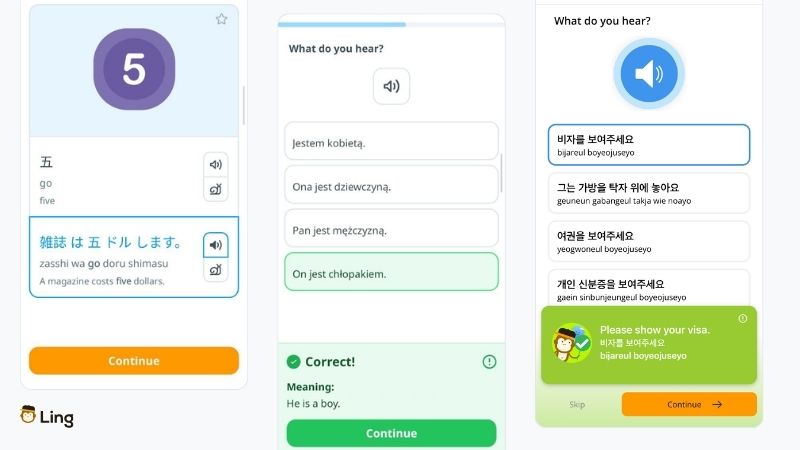
Polish – Poland’s winter sports presence is growing, Eurovision keeps Polish visible, and almost nobody’s learning it yet. Low competition, high potential.
Eastern European languages offer the best ROI—less competition, growing demand, and limited quality resources. Ling is one of the few platforms with comprehensive courses in these underserved languages.
2028 Summer Olympics (Los Angeles, USA)
When the Olympics come to the US, expect reverse spikes—global learners wanting to engage with American culture and commentary.
Watch these languages:
- English (obviously, but specifically American English resources)
- Spanish – LA’s massive Latino population will drive bilingual content
- Thai – Thai-American community + Thailand’s Olympic presence
- Tagalog – The Filipino-American community is huge in California
Entertainment-Driven Trends To Watch
Korean content isn’t slowing down. With Korean maintaining 73,871 active users on Ling in 2025, every new K-drama release brings fresh learners. The same pattern is emerging for:
- Japanese – Anime continues global dominance, plus Japan’s tourism boom
- Turkish – Turkish dramas are gaining Netflix prominence
- Hindi – Bollywood’s global expansion is accelerating
Geopolitical Wildcards
We can’t predict crises, but certain languages sit at geopolitical flashpoints:
- Arabic – Ongoing Middle East developments
- Urdu/Hindi – South Asian diaspora growing globally
- Mandarin – US-China relations drive business interest
The Smart Strategy: Choose Languages With Multiple Triggers
The most sustainable choice? Languages that combine multiple motivators:
- Korean = Entertainment + Business + Olympic presence
- Japanese = Entertainment + Tourism + Business + Olympics
- Mandarin = Business + Olympics + Geopolitical importance
When a language has multiple drivers, one event can reignite interest even after another fades. This creates sustained learning momentum instead of brief spikes.
Frequently Asked Questions
Why Did Ukrainian Language Learning Spike After The 2022 Invasion?
According to Ling app data, Russia’s 2022 invasion triggered massive solidarity-driven learning. Ling’s Ukrainian active users increased 2,887% (from 141 to 4,214) between 2022 and 2023. Approximately 37% cited “showing solidarity” as their primary motivation—more than double the rate for traditional languages like English or French.
What Causes Korean To Remain One Of The Fastest-Growing Languages?
The Korean Wave (Hallyu) drives sustained growth beyond viral moments. Ling’s Korean users exploded from 833 (2022) to 81,067 (2023)—a 9,629% increase. This reflects decades of K-pop, K-dramas, and Korean cinema creating cultural momentum. Unlike temporary spikes, Korean maintains 73,871 active Ling users in 2025 because new content is constantly released, creating continuous motivation.
What Languages Should I Learn For The 2026 Winter Olympics?
There are strategic opportunities in Eastern European (Polish, Serbian, Croatian) and Asian (Korean, Japanese, Mandarin) languages from countries excelling in winter sports. While Italian will surge due to Milan-Cortina hosting, these underserved languages offer less competition and growing demand.
How Do Global Events Create Lasting Language Learning Habits?
Global events provide time-specific emotional motivation that transforms “someday” intentions into immediate action. The Paris 2024 Olympics increased Ling’s daily active users by 9.2% (11,150 to 12,181), with many continuing afterward. External motivators help establish daily 15-minute habits that become intrinsic as learners discover cultural connections beyond the initial event.
Do The Olympics Actually Increase Language Learning, Or Is It Just Hype?
Real data confirms Olympic spikes. During Paris 2024, Ling saw 10.7% more daily installs and 9.2% more active users. Japanese increased 41% in the UK before Tokyo 2021. India reported 54% of Olympic fans learning languages to understand athlete interviews. These aren’t casual downloads—engagement metrics prove people build actual learning habits during Olympic periods.
The Future Of Event-Driven Foreign Language Learning
The 2026 Winter Olympics are around the corner, followed by LA 2028 and Brisbane 2032. More events. More cultural moments. More sparks of “I want to learn that language.”
We built Ling for the languages that get left behind—70+ Asian and Eastern European languages with native-speaker audio, cultural authenticity, and bite-sized lessons that actually fit into real life. Because when that Olympic moment or K-drama obsession or humanitarian crisis makes you want to learn, you shouldn’t have to settle for “sorry, we don’t really do that language well.” Try Ling.
The language you’re excited about? We probably built a real course for it.