


“Good Morning” is one of the basic greetings that you need to learn if you’re in a foreign country like Hong Kong. Starting the day with a warm and lively greeting like “Good Morning” 早晨(Zou2 San4)can make anyone’s day brighter. It is also an act of courtesy and a good conversation starter.
In this blog, we will learn how to say “Good morning” in Cantonese as well as its Cantonese pronunciation.
Table of Contents
How To Say Good Morning In Cantonese?
Cantonese is the Chinese language spoken in Hong Kong, Macau, and Guangdong Province in Mainland China. You might be confused with another Chinese language that you’ll often hear, which is Mandarin. It is spoken in Mainland China and Taiwan. So, when you hear the greeting “早上好 (Zǎoshang hǎo), it’s “Good morning” in Mandarin.
I want to learn even more languages with Ling!
Download now!
When you’re in a foreign land like Hong Kong, you need to show respect and courtesy to the native people. Here is how to say “Good Morning” in Cantonese that you can use in greeting Hong Kongers.
| English | Cantonese | Pronunciation |
| Good Morning | 早晨! | Zou2 San4 |
| Good Morning, Sunshine | 早晨,陽光明媚 | Zou2 San4, Joeng4 Gwong1 Ming4 Mei6 |
| Rise And Shine | 該起床了! | Goi1 Hei2 Cong4 Liu5 |
| Good Morning, Sleepy Head | 早晨,慾睡嘅頭 | Zou2 San4, Juk6 Seoi6 Ge3 Tau4 |
| Wakey, Wakey! | 喚醒,喚醒 | Wun6 Sing2, Wun6 Sing2 |
| Have A Good Day | 一切順利 | Jat1 Cai3 Seon6 Lei6 |
| Nice Day Outside, Isn’t It? | 出面好好天喎,係咪? | Ceot1 Min6 Hou2 Hou2 Tin1 Wo3, Hai6 Mai6? |
| You Look Great Today | 你今日好精神 | Nei5 Gam1 Jat6 Hou2 Zing1 San4 |
| Do You Want Some Breakfast? | 你想食啲早餐咩? | Nei5 Soeng2 Sik6 Di1 Zou2 Caan1 Me1 |
| I Dreamt Of You Last Night | 我昨晚夢見你 | Ngo5 Zok6 Maan5 Mung6 Gin3 Nei5 |
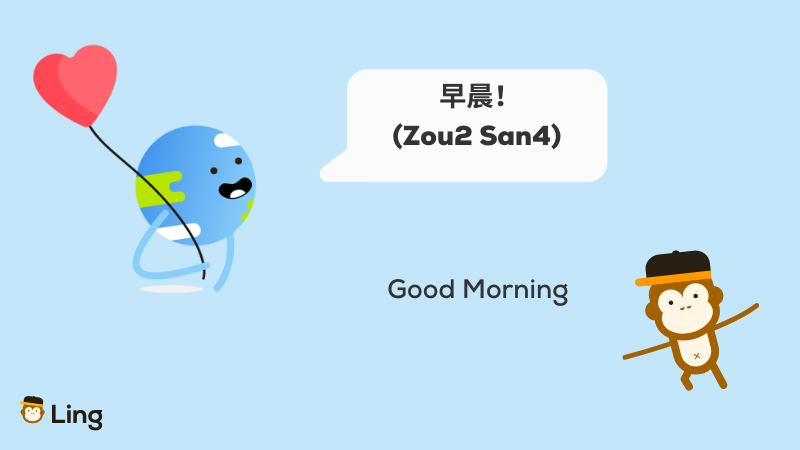
早晨!(Zou2 San4)
The most common way of saying Good Morning in Cantonese is “早晨! (zou2 san4)”.
You can use it in almost every situation, like in the workplace, on phone calls, or just in daily conversations with your friends.
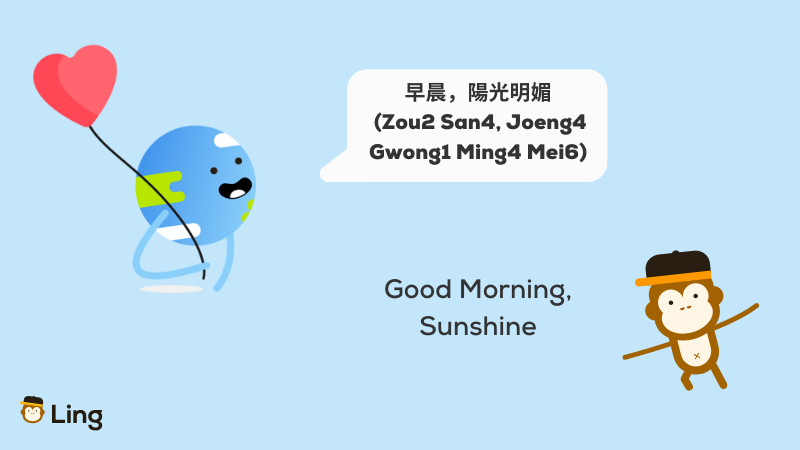
早晨,陽光明媚 (Zou2 San4, Joeng4 Gwong1 Ming4 Mei6)
Another way of saying “Good morning” in Cantonese is “早晨,陽光明媚 (zou2 san4, joeng4 gwong1 ming4 mei6). This phrase literally translates to “Good morning, it’s sunny!” This is a sweeter kind of greeting.
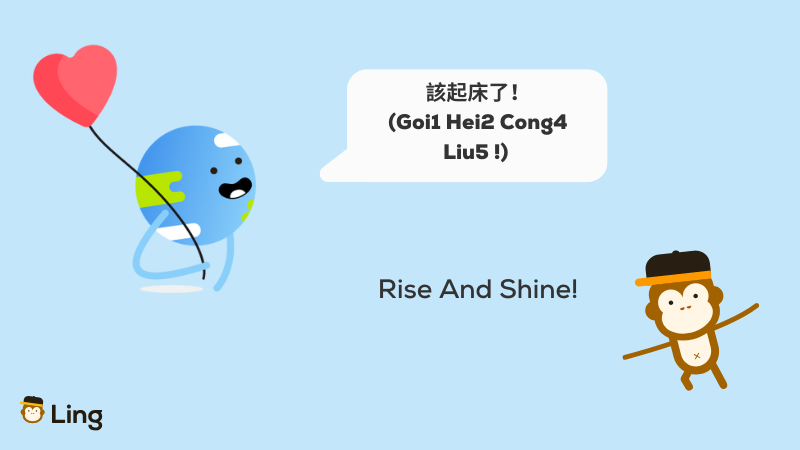
該起床了!(Goi1 Hei2 Cong4 Liu5 !)
This phrase literally means “It’s time to get up!” but we often use the expression “Rise and shine.”
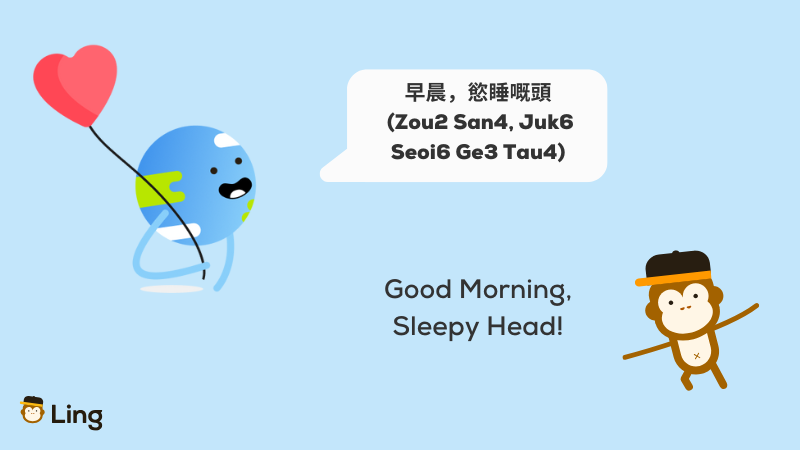
早晨,慾睡嘅頭 (Zou2 San4, Juk6 Seoi6 Ge3 Tau4)
This means “wake up ,sleepy head” It is also a cute way of saying “Good morning” to someone really close to you.
When someone seems so sleepy, and they haven’t gotten out of bed, you can use “早晨,慾睡嘅頭” zou2 san4, juk6 seoi6 ge3 tau4).
喚醒,喚醒 (Wun6 Sing2, Wun6 Sing2)
This phrase literally means “Wake up,” but, to make it cuter, it became “wakey.”
You’ll mostly see this in chats or text messages. You can also hear this expression used to talk to little children as we want to wake them up very gently.

一切順利 (Jat1 Cai3 Seon6 Lei6)
This means “Have a good day”.
It lightens the mood, and it can also make someone’s day brighter. Wishing someone to have a good day is also an act of courtesy and also shows sincerity towards the person.
出面好好天喎,係咪?(Ceot1 Min6 Hou2 Hou2 Tin1 Wo3, Hai6 Mai6?)
The phrase is not only to say “Good morning.” It’s also an expression that you can use to check on someone’s feelings for that day. They may respond “No” if they are not having a great day.
This phrase can also be used to invite someone out, maybe for a drink or a meal. It simply implies that the day is very nice, which is perfect for doing something fun outside.
你今日好精神。(Nei5 Gam1 Jat6 Hou2 Zing1 San4.)
This means” you look great today” Compliments can indeed brighten someone’s day. Isn’t it?
If somebody says this to you, simply respond with “Thank you (唔該. m4 goi1.)” to express gratitude.
你想食啲早餐咩?(Nei5 Soeng2 Sik6 Di1 Zou2 Caan1 Me1)
This means” Do you want some breakfast?”
Hong Kong used to be a British colony, its breakfast food is different from that of Cantonese. Its East-Meets-West culture has led to a cuisine that is unique to Hong Kong. It is a mix of Cantonese and English flavors. Even though Hong Kong-style restaurants serve the typical Cantonese you tiao crullers and congee, it’s the things that are only found in Hong Kong that stand out.
我昨晚夢見你 (Ngo5 Zok6 Maan5 Mung6 Gin3 Nei5)
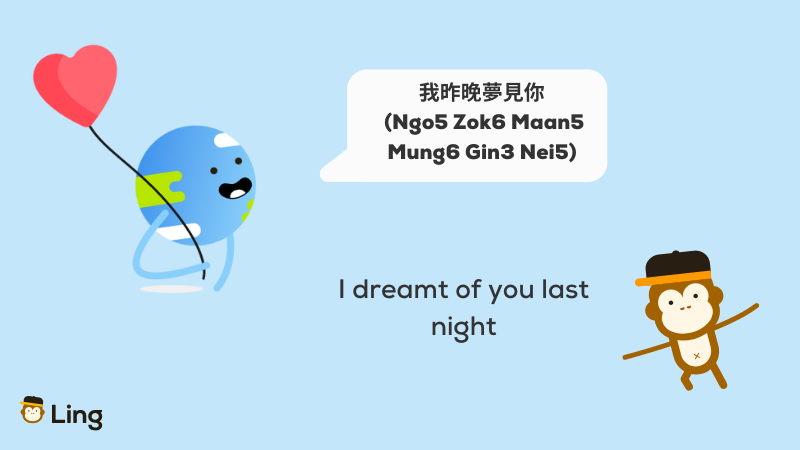
It means ” I Dreamt Of You Last Night. ”
It is such a sweet way to check on someone close to you. You’re actually letting the other person feel that you think of them first thing in the morning.
Good Morning In Cantonese Related Phrases
The phrases introduced above are the different ways to say Good morning in Cantonese. In this part, you will learn some Cantonese phrases related to morning.
| English | Cantonese | Pronunciation |
| breakfast | 早餐 | zou2 caan1 |
| breakfast in bed | 喺床上食早餐 | hai2 cong4 soeng6 sik6 zou2 caan1 |
| bed and breakfast | 民宿 | man4 suk1 |
| early in the morning | 一早 | jat1 zou2 |
| morning workout | 早晨鍛煉 | zou2 san4 dyun3 lin6 |
| sunshine | 陽光 | joeng4 gwong1 |
| this morning | 今朝 | gam1 ziu1 |
| I love the smell of coffee in the morning. | 我鍾意朝早聞到咖啡香。 | ngo5 zung1 ji3 ziu1 zou2 man4 dou2 gaa3 fe1 hoeng1 |
Frequently Asked Questions About Good Morning In Cantonese
How Do You Say Good Morning In Hong Kong?
In Hong Kong, people will say ” 早晨!(Zou2 San4) ” as Good morning.
How Do You Say Morning In Cantonese?
In Cantonese, morning is “早“(Zou2).
What Are Typical Cantonese Greetings?
Some typical cantonese greetings are:
- 早晨(zou2 san4), means “Good morning”
- 晚安(maan5 on1),means “Good night”
- 食咗飯未?(sik6 zo2 faan6 mei6?),means “Did you eat?”
Learn Cantonese With Ling App Now!
Wanna make your mornings extra special? Spend a few minutes of your time answering bite-sized lessons in Ling App that will definitely improve your language skills. Learning Cantonese may sound hard, but the Ling app will make it much easier for you.
Learning a new language and ready to start your day? Download Ling App now!